
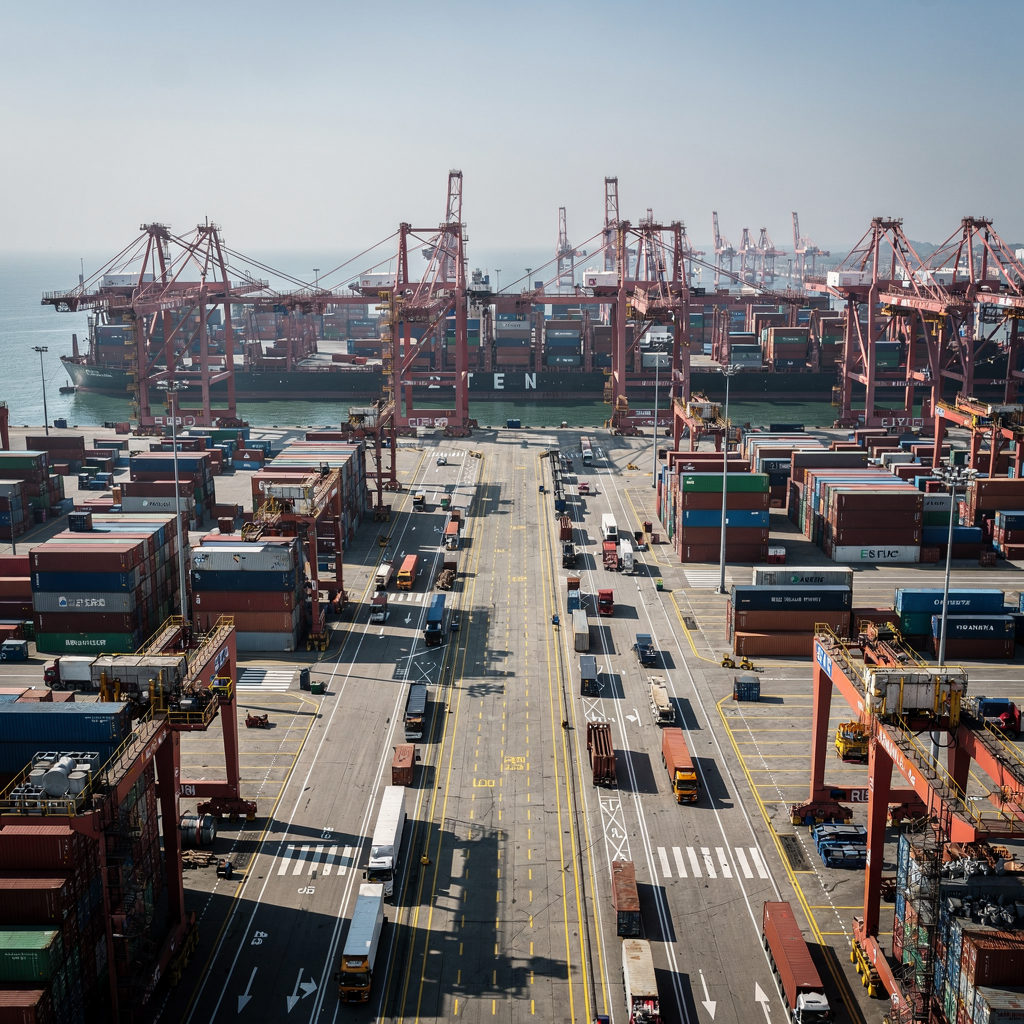
The Scheduling Problem in Container Terminal Operation
The scheduling problem in a container terminal operation defines which moves happen, when they happen, and which resources perform them. First, tasks include quay crane work, yard crane handling, gate processing, and container truck pickups. Second, constraints cover equipment availability, safety separations, stacking limits, and truck appointment windows. Third, objectives typically seek to minimize crane idle time, reduce rehandles, and minimize travel distance. Also, planners treat this as a scheduling optimization problem that balances throughput and cost. Next, a clear formulation helps translate yard priorities into dispatch rules and an optimization model for automation.
The problem shapes yard truck queues and storage yard usage. If quay crane sequences are not synchronized with the yard, containers pile up. Consequently, waiting grows at the gate and trucks queue outside the port. One study found that long waits directly reduce throughput and increase truck congestion [waiting time statistic]. Therefore, scheduling quality matters. It affects the number of container moves per hour and the workload balance for RTGs or straddles. Also, the scheduling problem links to container stacking rules. Poor allocation increases rehandles and extends average dwell.
Scheduling also drives the relationship between quay crane and yard. Good schedules synchronize quay crane lifts with yard crane placements and truck routing. This reduces idle time across equipment. Furthermore, integrated scheduling optimization avoids firefighting on peak days. For example, Loadmaster.ai uses a digital twin to train RL agents so planners can move from reactive tactics to policy-driven control. The approach generates millions of scenarios. Then, the RL agents propose robust plans that respect constraints and the terminal’s KPIs. Finally, the result is more consistent performance across shifts and fewer unpredictable outcomes caused by human-only rule engines.
For readers who want deeper detail on how execution-level scheduling interfaces with dispatch, explore our material on terminal transport job scheduling terminal job scheduling. Also, the scheduling problem must account for a variable number of container vessels and the number of container trucks on site. In practice, one combined schedule reduces rehandles and helps minimize carbon emission. Also, it reduces the cost of moves while protecting quay productivity and yard flow.
Routing Challenges and Yard Truck Route Optimization
Routing in a container terminal presents many practical challenges. First, distance matters. Shorter truck routes reduce fuel and time. Second, congestion creates delays at choke points. Third, dynamic traffic flows inside the yard change minute to minute when cranes finish lifts or when sudden vessel delays occur. Therefore, a good route optimization model must adapt to those dynamics and produce executable truck routes. Also, planners must consider safety clearances and one-way lanes that constrain feasible paths. In some terminals, the number of container trucks shifts rapidly during gate peaks. Thus, routing should adjust without large computational delays.
Exact methods such as integer programming provide provable optimality. However, they can be too slow for live dispatch. Heuristics and metaheuristics deliver near-optimal plans fast. For example, genetic algorithm variants and particle swarm optimization are common. Researchers recommend choosing an approach based on problem size and required reaction time. As the literature states, “the role of the decision-maker is to adopt the optimization method that best fits the operational context, balancing cost and service quality” [decision-maker quote]. Next, hybrid methods combine heuristics with exact solvers. Such hybrids keep compute low while improving plan quality. Also, simulation-based optimization helps validate solutions before live rollout.
Real-time updates rely on GPS and IoT telemetry. Modern yards feed vehicle positions, gate counts, and crane status into centralized systems. Then, the route optimization model recalculates truck routes and priorities. This reduces queuing at the gate and limits idle truck time. One ITS study highlighted that ITS-based routing reduced truck congestion near terminals by about 25% [ITS congestion stat]. Therefore, route updates must flow to drivers quickly. Loadmaster.ai integrates low-latency data feeds to update dispatch decisions and reduce firefighting. For methodologies on integrating AI with live telemetry, see our guidance on low-latency data processing low-latency data processing.
Drowning in a full terminal with replans, exceptions and last-minute changes?
Discover what AI-driven planning can do for your terminal
Optimization for Yard: Multi-Objective Approaches
Optimizing yard operations requires balancing multiple, often conflicting goals. First, terminals want to minimize travel time and fuel. Second, they want to reduce rehandles and maximize space utilization. Third, they want to limit emissions while preserving quay throughput. Multi-objective optimization frameworks let operators weight these goals. For example, an optimization algorithm can trade slightly longer truck routes to avoid a costly rehandle. Also, a planner might accept a small increase in crane idle time to dramatically reduce carbon emission and truck miles. This flexibility supports tailored KPI trade-offs across terminal operations.
Data Envelopment Analysis (DEA) has been used to benchmark yard performance and spur improvements. In one study DEA identified underperforming routes and suggested changes that improved capacity utilization by 10–20% [DEA study]. Also, multi-stop shipment logic can cut travel distance and time. For example, the Conopt Merge Algorithm demonstrated reductions in travel distance up to 25% in specific routing instances [Conopt multi-stop example]. Therefore, using the right mix of DEA benchmarking and multi-objective heuristics produces measurable gains.
Quantitative metrics matter. Waiting-time reduction of up to 30% has been reported after introducing ITS strategies and route optimization [waiting time stat]. Additionally, distance savings between 15–25% were observed under consolidated multi-stop routing schemes [distance savings]. Also, DEA-backed measures improved yard capacity. Thus, the evidence supports deploying multi-objective optimization models in active yards. Loadmaster.ai applies integrated scheduling optimization with RL agents to find balanced, robust policies that act like a controller for cranes, trucks, and stacks. This method avoids the need for long historical training sets and improves resilience to changing vessel mixes and gate surges.
Allocation and Container Stacking Strategies
Allocation and container stacking choices shape throughput and cost. Allocation methods decide which container truck takes which job. Next, stacking strategies determine where each container sits. Both affect the frequency of rehandles. Simple rules such as grouping by export container area or by destination reduce reshuffles. Also, blocking by container type, weight, or dwell time limits unnecessary moves. In many terminals, planners apply bay planning and grouping heuristics to limit rehandles during peak vessel windows. Thus, container placement becomes a pivot for overall efficiency.
Truck-to-task allocation impacts throughput directly. For example, ensuring that container trucks will go to nearby stacks reduces travel time and frees quay crane capacity. An allocation policy that ignores yard balance can produce uneven workload across yard crane bays. Therefore, scheduling optimization that includes allocation produces smoother operations. Loadmaster.ai’s StackAI and JobAI concepts illustrate how automated strategies can coordinate placement with execution to minimize rehandles and protect future plans. Also, operators use a combination of heuristic algorithm and optimization model to decide which container goes where when space is scarce.
Container stacking also affects yard capacity utilisation and operational costs. Techniques like bay optimization and designated export container zones reduce the need for empty container repositioning. Furthermore, planning that anticipates container retrieval times reduces case-by-case reshuffles and improves crane productivity. A careful container stacking policy can reduce handling and lower carbon emission through less driving. For more on cost trade-offs in re-stow planning see our restow modeling work restow cost modeling. Finally, combining allocation with stacking in an integrated scheduling optimization framework increases the moves per hour and lowers per-move cost.
Drowning in a full terminal with replans, exceptions and last-minute changes?
Discover what AI-driven planning can do for your terminal
Yard Crane Integration and Maritime Container Handling
Yard crane integration is essential to synchronize landside and waterside flows. Yard cranes must receive tasks that align with quay crane discharge patterns. If yard scheduling lags, quay crane and the yard can develop bottlenecks. Thus, coordinating sequences reduces dwell time for maritime container flows. Also, when quay crane and yard plans are linked, the system minimizes periods when trucks wait for a container that was not yet relocated. Good coordination improves overall cycle times for container vessels and on-dock storage.
Coordinating yard crane sequences with truck routing plans requires closed-loop feedback. For example, if a quay crane falls behind schedule, the yard must postpone or reroute trucks to prevent congestion. In practice, planners either set conservative buffers or use dynamic rescheduling. The latter works better if the optimization model reacts to live telemetry. An optimization algorithm that considers both quay and yard constraints reduces rehandles and keeps equipment busy. Also, simulation-based optimization validates the sequences before they are executed in the yard.
Managing maritime container flows also reduces dwell time at the terminal. Terminals that align vessel discharge, container stacking, and truck appointment systems see fewer peaks and troughs in activity. A DOT report noted that advanced optimization methods, including multi-objective and heuristic algorithms, are essential tools for terminals aiming to meet rising freight demand while controlling costs and environmental impact [DOT quote]. Therefore, integrating vessel planning with yard operations provides the best outcomes. For more on vessel planning and how it links to stowage and execution, see our piece on container terminal vessel planning vessel planning explained.
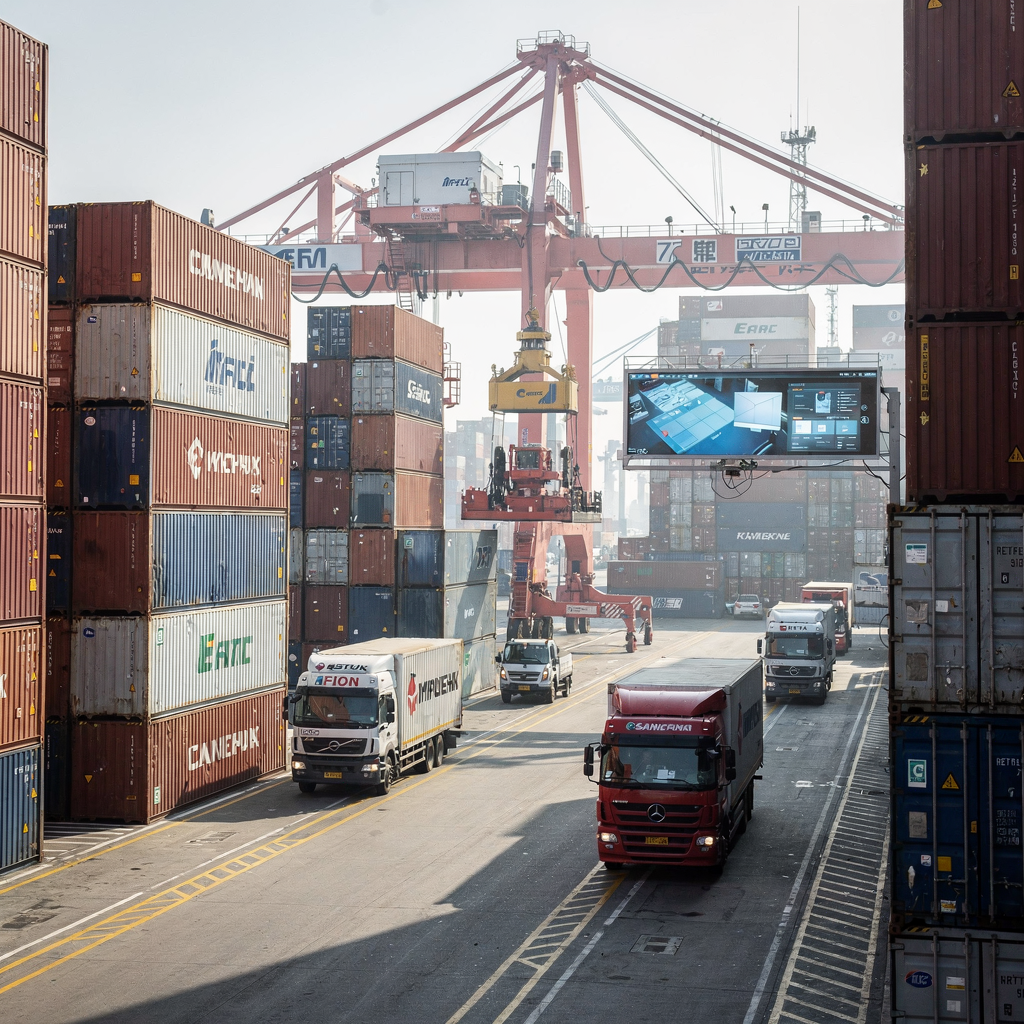
Maritime Perspectives on Container Terminal Optimization
From a maritime viewpoint, container terminals are nodes in a global network. Shipping schedules, feeder rotations, and hinterland links all influence on-dock priorities. First, port planners must coordinate import and export flows to free yard space. Second, intermodal connections affect how fast containers leave the terminal. Third, transshipment volumes change the number of container vessels that call and the mix of container types the yard must handle. Therefore, terminal operations must stay aligned with shipping lines and inland carriers.
Port network interactions matter. When a terminal receives an unexpected wave of feeders, the scheduling optimization must reweight objectives and reallocate resources. One case study shows how flexible rescheduling reduced dwell and improved handling rates. Also, the future of routing leans toward AI-driven agents and digital twins that test policy choices. For example, using simulation-first AI lets agents learn policies in a sandbox instead of needing massive historical data. This approach supports cold-start readiness and avoids teaching the system past mistakes. Loadmaster.ai’s simulation-first strategy trains policies against explainable KPIs, then deploys them with operational guardrails.
Future trends include AI-driven routing, digital twins, and near-real-time IoT. Such tools will enable the terminal to adapt to vessel delays quickly and to rebalance yard resources in minutes. Also, improved particle swarm optimization and genetic algorithm hybrids remain relevant for offline plan generation. Researchers continue exploring particle swarm optimization algorithm variants and improved particle swarm optimization methods for routing in container contexts. Finally, maritime container handling will benefit from integrated approaches that align cranes, trucks, and stacks, reduce carbon emission, and improve the efficiency of container transfers across the port network. For recent discussion on automation and trends see our automation trends overview trends in port automation.
FAQ
What is the core scheduling problem in a container terminal?
The scheduling problem assigns resources to moves under constraints such as equipment availability, safety, and stacking limits. It aims to minimize cranes’ idle time, reduce rehandles, and optimize throughput.
How does routing affect yard truck queues?
Routing influences where and when trucks travel inside the yard. Poor routes create choke points and long queues, while good routing minimizes travel distance and cut waiting times. Also, dynamic rerouting based on IoT telemetry reduces queuing.
Which algorithms are used for truck routing in container terminal settings?
Practitioners use exact methods, heuristics, genetic algorithm variants, and particle swarm optimization. Also, hybrid approaches and simulation-based optimization are common when balancing quality and speed.
Can optimization reduce emissions at terminals?
Yes. Route consolidation and reduced driving lower fuel use and carbon emission. For instance, multi-stop routing and ITS strategies showed measurable distance savings and reduced congestion in studies.
What role does DEA play in yard optimization?
DEA benchmarks yard operations and highlights underperforming routes or areas. Using DEA can lead to better allocation decisions and improved yard capacity utilisation, based on comparative efficiency scores.
How do stacking strategies impact cost?
Stacking decisions influence rehandles and the number of moves per container. Smart grouping and bay planning lower reshuffles, reduce handling costs, and improve equipment productivity.
What benefits do digital twins and RL agents provide?
Digital twins let teams test policies in a simulated environment and train RL agents without historical data. Then, agents can propose robust control policies that adapt to real-time disruptions and protect multiple KPIs.
How do quay crane operations tie into routing?
Quay crane sequences determine when containers become available for yard handling. Coordinating quay crane and the yard reduces truck idle time and prevents storage bottlenecks. Also, synchronized plans reduce unnecessary container moves.
Is live GPS tracking necessary for route optimization?
Live GPS and IoT feeds significantly improve responsiveness and reduce waiting time. They allow optimization models to update routes and allocations in near real time, which reduces congestion and improves service levels.
Where can I read more about implementing AI for terminal optimization?
For guidance on integrating AI and low-latency data, see our articles on low-latency data processing and simulation-first AI strategies. Also, our materials cover how to move from rule-based planning to AI optimization in port operations from rule-based planning to AI optimization.
our products
 stowAI
 stackAI
 jobAI
jobAI
Innovates vessel planning. Faster rotation time of ships, increased flexibility towards shipping lines and customers.
Build the stack in the most efficient way. Increase moves per hour by reducing shifters and increase crane efficiency.
Get the most out of your equipment. Increase moves per hour by minimising waste and delays.
stowAI
Innovates vessel planning. Faster rotation time of ships, increased flexibility towards shipping lines and customers.
stackAI
Build the stack in the most efficient way. Increase moves per hour by reducing shifters and increase crane efficiency.
jobAI
Get the most out of your equipment. Increase moves per hour by minimising waste and delays.