
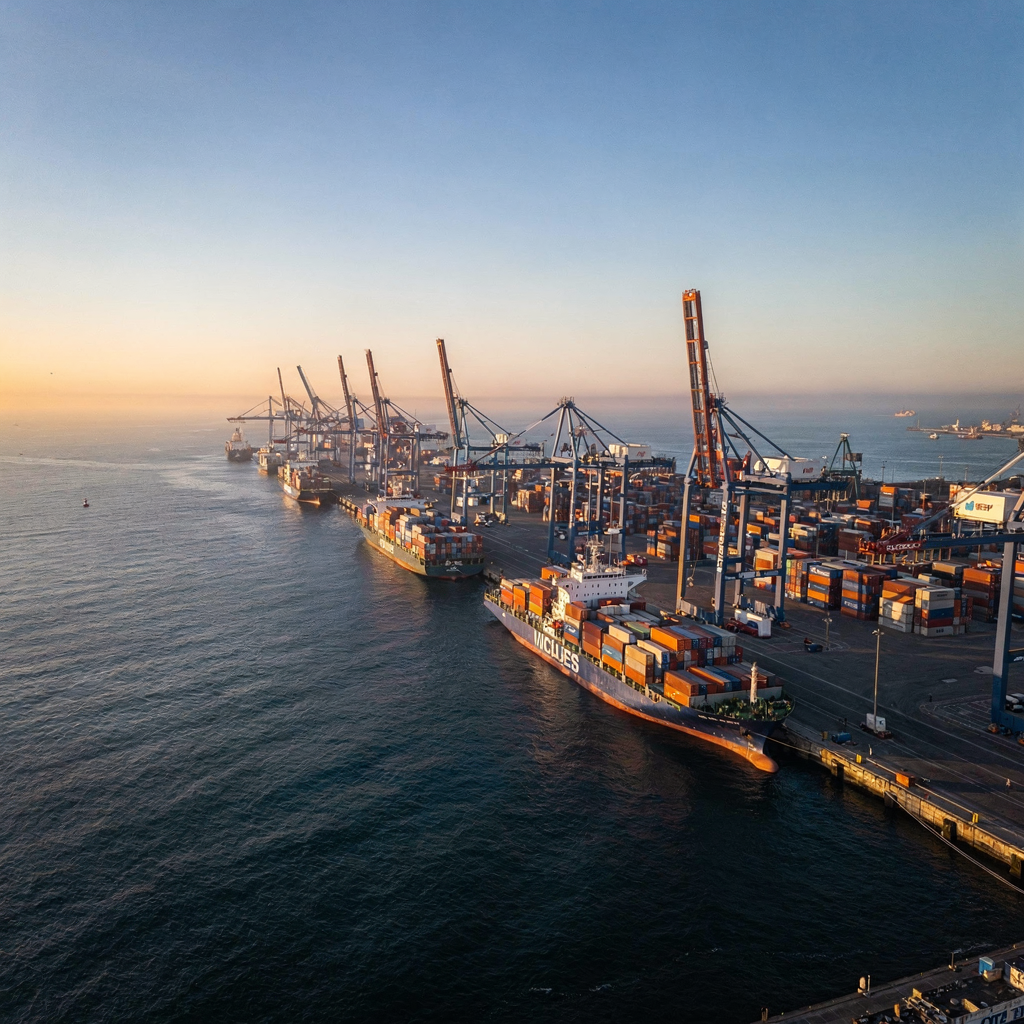
Port context: container terminals and berth allocation challenges
Container terminals sit at the heart of global trade and maritime logistics. They connect ocean carriers, supply chain partners, and hinterland transport. As vessel sizes have grown and call patterns have shifted, congestion at major container terminals has increased. This rise in scale and complexity strains traditional planning methods. As a result, planners face tougher constraints and more frequent disruptions. The berth allocation problem arises from these pressures. The berth allocation problem defines how to assign arriving ships to available quay space and time windows while respecting operational limits, service priorities, and equipment availability. Simple rules can work when traffic is light. Yet when occupancy exceeds 80% the margin for error vanishes. For example, an analysis of 20 major ports shows average berth occupancy rates often top 85%, which produces long queues and erratic performance (Berth time and statistics of 20 ports).
Congestion increases vessel waiting times and reduces throughput. It also raises CO2 emissions from ships idling outside the harbour. A study using AIS data on 10,000 voyages found that cutting berth waiting times by 10% can deliver meaningful CO2 savings (port queuing and CO2 emissions). Waiting boats also cascade delays into hinterland transport and disrupt schedules. Port authorities and terminal operators therefore need better ways to forecast berth availability and arrival times. Traditional heuristics and fixed schedules are too rigid. They do not adapt to evolving conditions, such as sudden berth assignments, yard congestion, or equipment breakdowns. Operators increasingly look for methods that can optimize berth allocations in near-real time and reduce costly rehandles and waiting.
At the same time, container terminals must balance multiple KPIs. Quay productivity, yard density, and driving distance trade off against each other. That complexity leads to firefighting rather than proactive planning. Loadmaster.ai builds reinforcement learning AI agents that address these trade-offs by simulating millions of decisions in a digital twin. Our approach aims to avoid the limits of historic-only models and to provide adaptable policy-based control that helps planners make robust berth allocation decisions. For readers seeking related methods for congestion and predictive KPIs, see our guide on solving terminal operations congestion with predictive analytics (predictive analytics for congestion).
Literature review: data-driven and machine learning approaches
The literature review shows a rapid shift from heuristics to data-driven techniques. Researchers extract features from AIS data, vessel characteristics, and port logs to train models that predict berth occupancy and estimated time of arrival. AIS feeds record position, speed, heading, and timestamps. Combining that telemetry with vessel type, cargo capacity, and past port call duration yields richer inputs for supervised and deep learning models. One peer-reviewed work highlights “data-driven optimization for the well-known berth allocation problem” and demonstrates improved scheduling robustness with machine learning (Robust berth scheduling using machine learning). That study used vessel classification features and operational records to raise accuracy and resilience.
Comparisons in the field contrast static scheduling with reinforcement learning and optimisation frameworks. Static schedules lock in assignments based on expected arrival times and service durations. They perform poorly when delays, weather, or hinterland bottlenecks occur. Optimization methods, including integer programming and metaheuristics, improve allocations but can be slow at scale. Reinforcement learning and policy search offer a different path. They explore policy spaces under simulated variability and adapt to multiple KPIs. For terminals exploring RL, our work on reinforcement learning for deepsea container port operations provides practical methods to train agents in a sandbox digital twin (RL for deepsea port ops). That approach avoids the need for perfect historical records and targets explainable KPI objectives.
Several studies report high prediction accuracy when models ingest multi-source datasets. For example, recent models that combine inbound/outbound manifests and AIS trajectories achieved over 90% prediction accuracy in berth availability forecasting (global ship cargo capacity and multi-source prediction). These models typically use supervised learning, sometimes enriched with deep learning models to capture non-linear interactions. The field also explores hybrid solutions that pair optimisation with forecasts to produce feasible berth allocations and crane schedules. A comprehensive analysis points to the growing role of AI in smart container ports and the need to integrate predictive models into daily operations (AI in smart container ports). Finally, research shows that improved forecasting of berth availability and arrival times shortens queues and adds resilience when disruptions strike.
Drowning in a full terminal with replans, exceptions and last-minute changes?
Discover what AI-driven planning can do for your terminal
Berth modelling techniques: from heuristics to AI-driven solutions
Berth modelling spans several techniques, and each has strengths. Discrete-event simulation and agent-based models capture system dynamics and interactions. They model vessels, tugs, berths, and quay cranes as agents that follow rules and trigger events. Such simulations can test policies under many scenarios. They help validate how changes to arrival sequences or quay crane allocations affect throughput. Researchers have used agent-based discrete-event models that combine AIS data with hydrodynamic and operational parameters to simulate berth occupancy under real conditions (port accessibility and cascading interactions).
Supervised learning methods forecast berth occupancy and arrival times. Models include gradient boosting, random forests, and neural networks. Deep learning models can learn complex temporal patterns from AIS tracks and port records. For ETA tasks, recurrent neural networks and transformers capture sequence dynamics. However, supervised methods need representative historical data. When history is sparse or biased by past inefficiencies, supervised models risk copying poor practices. That problem is one reason Loadmaster.ai focuses on reinforcement learning agents that simulate policies rather than mimic history. Still, supervised and deep learning approaches remain powerful when combined with simulation-based augmentation.
Integrating hydrodynamic, weather, and hinterland delay data improves realism. Wind, tide, and visibility can affect mooring times and crane performance. Hinterland delays at gates or rail terminals change berth occupancy windows. Therefore, robust models incorporate external feeds. Forecast modules handle temporal uncertainty. They output probabilistic berth availability windows and a range for estimated time of arrival. These outputs then feed optimisation layers that generate feasible berth assignments and crane plans. For related work on yard and stacking impacts, see our piece on identifying hidden capacity with AI in container terminals (hidden capacity identification).
Prediction of berth availability and arrival times
Accurate prediction of berth availability and arrival times boosts operational decision-making. Time-series forecasting methods, such as ARIMA variants and LSTM networks, support ETA and berth slot forecasts. Classification algorithms also predict whether a berth will be free within a given time window. These outputs enable dynamic reshuffling of quay crane schedules and yard assignments. Real-time adjustment is required. Streaming AIS feeds and terminals’ operational updates must update forecasts continuously. Many systems now support 24 h monitoring of vessel movements with automated reforecasting.
Live AIS streams improve short-term estimates. Using ais data and historical port call records, models can estimate remaining travel time and issue an updated vessel estimated time of arrival. Implementations that combine predictive analytics with optimisation can trim vessel waiting times. One field test reduced waiting time by around 10% and produced measurable emission savings. That outcome mirrors simulations that tie reduced queues to lower CO2 output. A robust pipeline typically includes data ingestion, feature engineering, model inference, and optimisation for berth assignments and quay crane sequencing. Operators must also account for vessel delay signals and report their estimated time when they change speed or route. The practice of ships reporting their ETA feeds the prediction process and refines arrival time forecasting over time.
Real-world deployments must bridge forecast outputs with execution. Predicted remaining travel time and predicted berth windows become inputs to allocation engines. Those engines solve scheduling problems in container terminals and output berth assignments and crane schedules. For terminals that want to reduce dwell and improve job-level timing, our insights on dwell time prediction in port operations are relevant (dwell time prediction). Finally, the combination of machine learning and deep learning with optimisation delivers practical gains when the pipeline is designed end-to-end.
Drowning in a full terminal with replans, exceptions and last-minute changes?
Discover what AI-driven planning can do for your terminal
Case study: applying predictive analytics in a deep-sea container port
We present a pragmatic case study of a deep-sea terminal that deployed predictive analytics and optimisation. The terminal collected historical voyages, cargo capacity reports, AIS traces, and congestion indices. These datasets supported training and validation. The workflow began with data cleaning and feature extraction. The team engineered features such as vessel type, past port dwell, speed profiles, and predicted remaining travel time. They also added external variables like tide and gate throughput. Importantly, the team combined supervised forecasts with a simulation-based policy search to avoid overfitting to past mistakes. This hybrid approach aligns with operations research best practices and mitigates the “average past” problem in pure supervised models.
Model training used a mix of methods. Time-series models provided baseline ETA forecasts. Gradient-boosted trees and deep learning models refined berth availability forecasts. The deployment also tested a reinforcement learning agent in a sandbox digital twin to produce robust berth allocation decisions under uncertainty. That agent optimized multiple KPIs: quay crane productivity, yard balance, and travel distance. Loadmaster.ai’s approach mirrors this method and aims to produce closed-loop optimization with separate agents for stow, stack, and job execution.
During live trials the terminal observed several measurable outcomes. Vessel waiting times fell by about 10%, matching academic findings on emission reductions when queues shorten (port queuing CO2 link). Throughput improved during peak windows, and crane idle time decreased. Emissions from idling vessels at anchor also came down. The project team noted that system interoperability was critical. They integrated model outputs into the terminal operating system so planners received updated berth assignments and crane sequences. For readers interested in practical integration, our article on decoupling fleet control logic from TOS covers similar integration patterns (TOS decoupling and integration).
Conclusion and future directions
Predictive berth availability and arrival times modelling improves efficiency, resilience, and environmental performance. When forecasts feed optimisation, terminals can reduce vessel waiting times and CO2 emissions, and better balance quay and yard KPIs. As one paper concludes, “Robust berth scheduling using machine learning can transform port operations, making them more reliable and sustainable” (Robust berth scheduling using machine learning). For terminals that lack long, clean histories, combining simulation and reinforcement learning is a practical path. That approach creates policies that do not simply repeat past mistakes and that can adapt to new vessel mixes and disruptions.
There are challenges ahead. Data quality and integration of heterogeneous sources remain major hurdles. Systems must fuse AIS, weather, tide, cargo manifests, and gate status. They also need to react in real time and maintain explainability for operators and regulators. Future research directions include improved hybrid models that blend physics-informed simulation with data-driven forecasts, enhanced multi-agent coordination for crane and truck flows, and wider adoption of standards for ETA reporting. For those building systems, consider a roadmap that includes a digital twin, sandbox training, and staged integration into the daily planning workflow. Loadmaster.ai focuses on this path by training RL agents in a replica terminal so that deployments start robust and cold-start ready.
To continue learning, practitioners should consult a comprehensive review of the literature on berth models and AI in terminals, attend forums like the IEEE international conference where operations research and machine learning intersect, and run controlled pilots that measure vessel waiting times and energy savings. With careful engineering and cross-team collaboration, predictive models and optimisation will keep deep-sea container terminals competitive and more sustainable.
FAQ
What is predictive berth availability modelling?
Predictive berth availability modelling uses data and algorithms to forecast when quay space will be free to service arriving ships. It combines telemetry, port records, and optimisation to inform berth allocation decisions and reduce waiting time.
How does AIS data improve arrival time forecasts?
AIS data provides continuous vessel movements, including speed and position, which help estimate remaining travel time and refine ETA. When models ingest AIS feeds they can update arrival times in near real time and thus support dynamic berth assignments.
What gains can terminals expect from these models?
Terminals that pair forecasts with optimisation typically see lower vessel waiting times and reduced emissions. Trials and studies have reported waiting time reductions on the order of 10% and improved throughput under peak conditions.
Can predictive analytics integrate with my TOS?
Yes. Most systems expose optimisation outputs via APIs or EDI so a TOS can receive updated berth assignments and crane sequences. Decoupling fleet control logic from the TOS helps simplify integration and supports safe rollouts.
Do supervised models need lots of historical data?
Supervised models perform best with representative history, but that history can embed past inefficiencies. Hybrid strategies that use simulation or RL agents can reduce reliance on historical quality and provide a cold-start option.
How do weather and tides factor into predictions?
Weather and hydrodynamics affect manoeuvring time, mooring windows, and crane productivity. Robust predictive systems include these variables to produce more accurate berth availability and arrival time estimates.
What role does reinforcement learning play?
Reinforcement learning finds policies by simulating millions of scenarios in a digital twin. That enables multi-objective optimisation across quay, yard, and gate, and it can outperform methods that only copy historical patterns.
Is there an environmental benefit to better forecasting?
Yes. Shorter queues and fewer idling hours reduce CO2 emissions. Studies linking port queuing to emissions show measurable savings when berth waiting times fall.
How should a terminal start a pilot project?
Begin with a scoped data ingest, a sandbox digital twin, and clear KPIs. Validate forecasts offline, then run a short live trial with manual oversight before full integration. Tracking measured outcomes is essential.
Where can I read more about implementing these systems?
See technical and practical resources on predictive KPIs and congestion reduction. For example, Loadmaster.ai offers articles on reinforcement learning for deep-sea operations and solving terminal operations congestion with predictive analytics to help guide implementations.
our products
 stowAI
 stackAI
 jobAI
jobAI
Innovates vessel planning. Faster rotation time of ships, increased flexibility towards shipping lines and customers.
Build the stack in the most efficient way. Increase moves per hour by reducing shifters and increase crane efficiency.
Get the most out of your equipment. Increase moves per hour by minimising waste and delays.
stowAI
Innovates vessel planning. Faster rotation time of ships, increased flexibility towards shipping lines and customers.
stackAI
Build the stack in the most efficient way. Increase moves per hour by reducing shifters and increase crane efficiency.
jobAI
Get the most out of your equipment. Increase moves per hour by minimising waste and delays.