
Introduction: Integrating Berth Call Optimisation with Quay Crane Planning
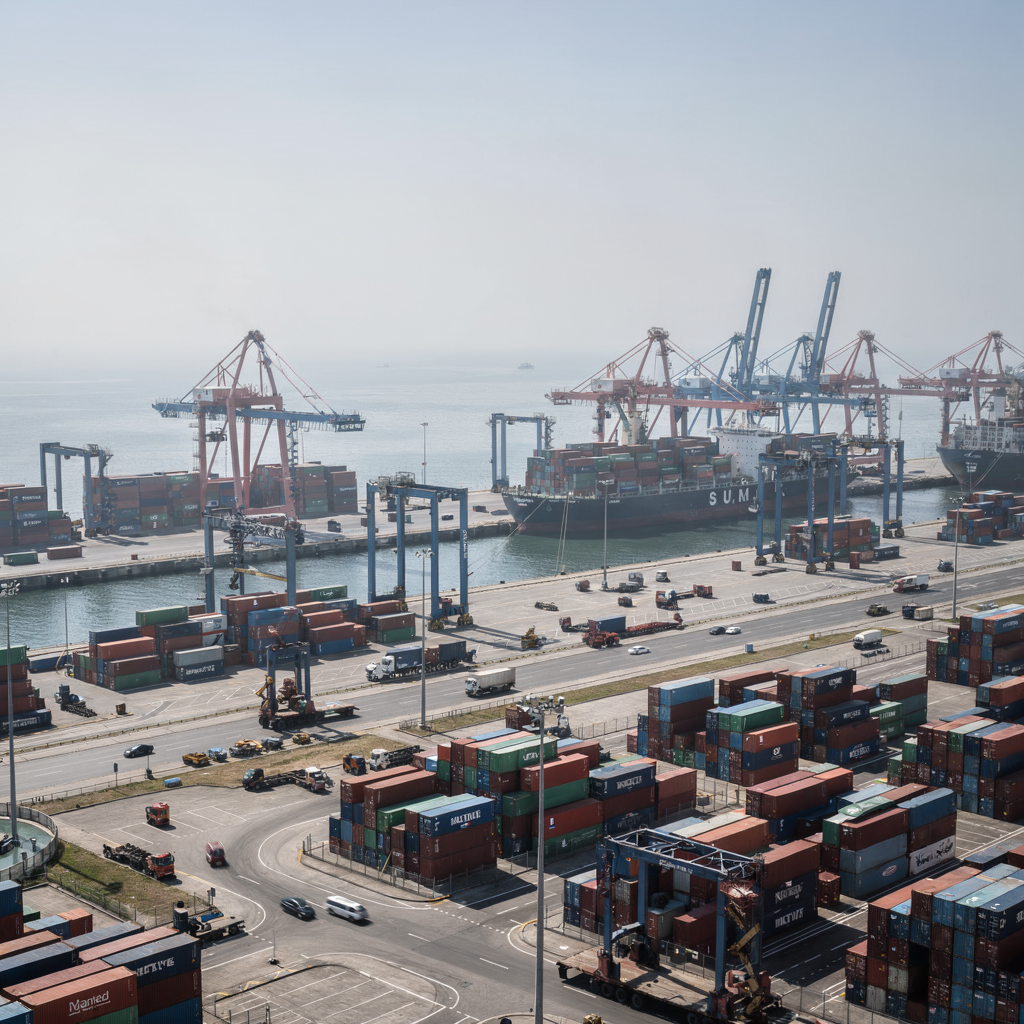
Berth allocation and QUAY CRANE scheduling represent two tightly linked puzzles at the heart of a container terminal. Berth allocation assigns incoming vessels to quay space, and quay cranes handle the container moves on and off those vessels. Both tasks face constraints: vessel arrival uncertainty, tide windows in some tidal port contexts, and the finite number of quay cranes available per berth. When planners treat these tasks separately, they can increase idle time, cause extra handling, and extend berth time for ships. When planners coordinate them, terminals can cut delays, improve resource use, and raise throughput.
Synchronising vessel arrivals with crane operations pays off in concrete metrics. Integrated approaches frequently report a 15–20% reduction in vessel turnaround time, which directly speeds cargo flow and can free berth capacity for extra sailings (the Role of Reliability in Container Shipping Networks). Integrated solutions also boost berth utilization by roughly 10–15% and lift crane productivity by 12–17% in moves per hour, helping terminals avoid costly expansions (a decision support system for maintaining a resilient port).
These numbers matter to operational goals. By coordinating berth and crane assignments, planners can minimize the total waiting time for ships, and they can reduce rehandles and truck queues. Integrated scheduling supports targets across yard crane balance, QC productivity, and gate throughput. For terminals exploring digital twin or AI pilots, coordinated schemes give measurable ROI and more resilient day-to-day plans. For readers who want to explore related simulation methods, see our material on simulation models for automated terminal operations, and for multi-agent techniques see our page on multi-agent AI in port operations.
literature review of berth allocation and quay crane scheduling
This literature review summarises seminal work on the berth allocation problem and on quay crane planning. Early studies treated the berth assignment and the quay crane assignment as separate optimisation problems. Researchers adopted programming model formulations, mixed-integer programming, and search heuristics to solve these discrete choices. Later work combined berth assignment with crane assignment and scheduling to capture interference, crane coverage constraints, and tidal port restrictions. The academic corpus shows clear benefits from integrated approaches: coordinated berth allocation and quay crane schedules often outperform decoupled plans.
Stand-alone research on berth scheduling laid the foundations for continuous and discrete models. The dynamic berth allocation problem and the continuous berth allocation problem model time-continuous arrivals and berth position choices. These models aimed to minimize the total delays and to solve the problem of arrival clustering. Separately, studies on the quay crane assignment problem and the quay crane scheduling problem addressed crane interference, crane coverage, and the number of quay cranes needed to meet service windows. Later integrative research created algorithms that jointly optimise berth and crane deployment, labelled by some as the integrated berth allocation and quay challenge.
Combined studies report up to an 18% efficiency improvement from integrated berth allocation and quay crane schemes (decision support system for resilient port operations). Cost reductions up to 10% were observed where AI or closed-loop optimisation reduced vessel waiting time and unnecessary crane idle time (impact of artificial intelligence on enhancing operational). The literature review finds recurring themes: the need for robust real-time adjustments, the value of heuristics that balance multiple KPIs, and the importance of modelling arrival uncertainty in scheduling problem formulations. For a technical deep dive on digital twin testing for yard and quay interactions, consult our digital twin container port yard strategy testing resource.
Drowning in a full terminal with replans, exceptions and last-minute changes?
Discover what AI-driven planning can do for your terminal
Insights from transportation research part e on integrated port planning
Transportation Research Part E publishes applied studies that move theoretical models into operational contexts. Case studies in that journal detail decision support systems and scenario-based analyses that plan for peak congestion and disruption. One influential study described a decision support system that integrated berth and quay crane planning and reported an 18% operational efficiency improvement in simulated stress tests (decision support system for maintaining a resilient port). That paper also included sensitivity tests that varied vessel arrival patterns, crane breakdowns, and yard congestion to measure resilience under stress.
Transportation Research Part E articles typically combine optimisation with descriptive scenario analyses. Authors simulate weekly berth and quay crane allocations, and they run what-if tests to evaluate contingency rules. These studies stress the role of qc assignment logic and of a proposed model that couples berth position choices with crane coverage limits. In peak congestion cases, integrated scheduling reduced vessel queues and diminished berth time variability. The journal showed that coupling berth and quay crane planning produces tangible benefits in both average performance and worst-case scenarios.
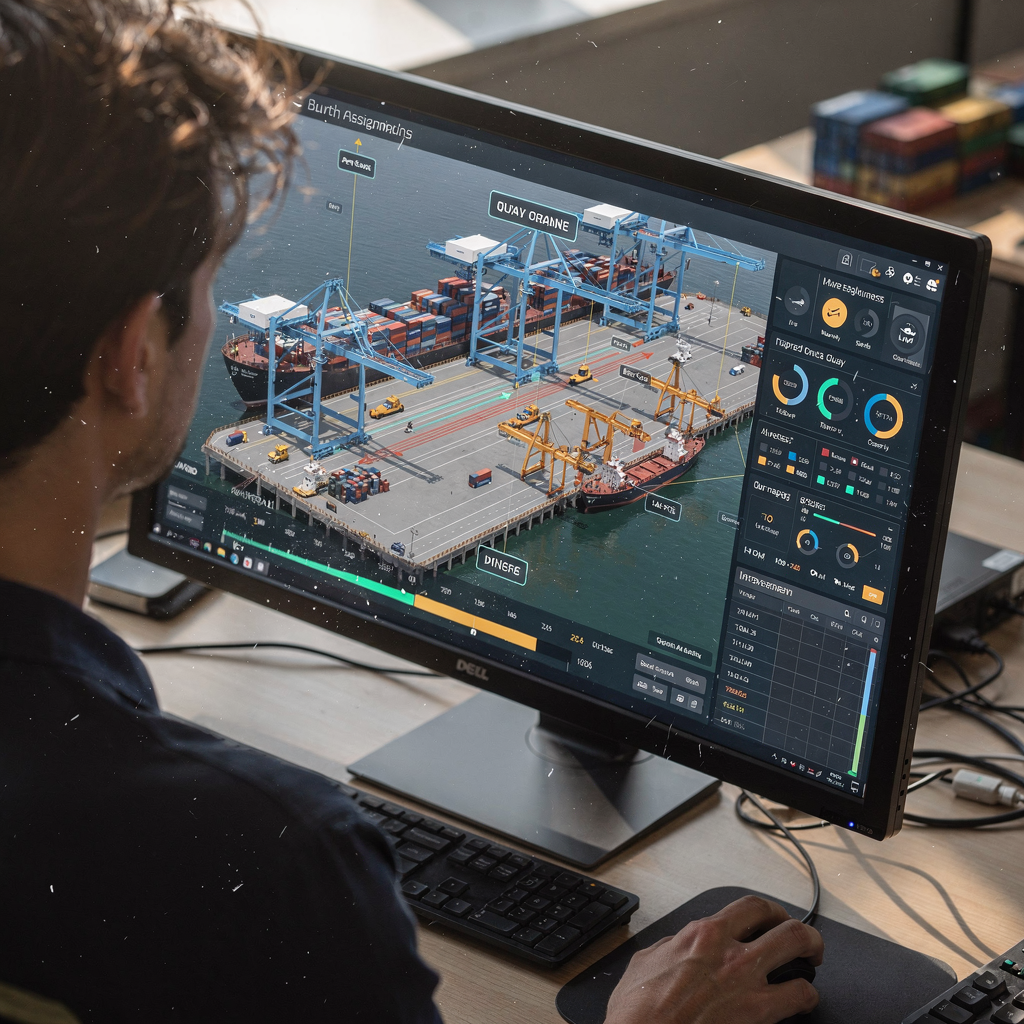
Decision support systems discussed in the literature include features that planners need: real-time reoptimisation, visualisation of berth positions and crane coverage, and the ability to test counterfactuals with a digital twin. Those features align with recent practical deployments that use simulation to test terminal changes before live rollout. For implementation guidance on governance and explainability when deploying AI for deepsea container ports, see our page about governance-ready AI for deepsea container ports. The transportation research also underlines that robust operations research models must support QC assignment, dynamic berth allocation problem variants, and the integration of yard crane and truck flows.
Role of logistics and transportation technologies in integration
AI-driven scheduling tools and real-time data feeds are transforming berth and quay crane coordination. Modern AI systems support online re-planning, and they react to gate surges, weather delays, and late arrivals. Digital twin applications let operators test integrated berth allocation and crane rules in a sandbox. Using a virtual replica, planners can trial different QC assignment rules and measure impacts on quay crane productivity and yard traffic. Digital twin studies also show energy benefits, as smoother plans typically cut fuel consumption by reducing idle equipment use (Digital Twin for resilience and sustainability assessment of port facility).
Automated control systems and IoT sensors feed the AI with live telemetry. That input enables closed-loop optimisation where agents adjust crane assignments and vessel berthing dynamically. Loadmaster.ai uses reinforcement learning agents that train in a digital twin and then execute policies to coordinate stowage, crane sequencing, and dispatcher tasks. Our closed-loop agents—StowAI, StackAI, JobAI—work together to reduce rehandles and balance workloads, and they do not rely on historical data alone. This approach addresses key user pain: planners firefighting instead of planning, variable performance between shifts, and loss of tribal knowledge.
Logistics and transportation research emphasises interoperability. To scale, integrated systems must connect to the TOS, to equipment telemetry, and to gate systems. They must also support explainable KPIs and guardrails for safe operation. Automated quay crane allocation and scheduling reduces human fatigue and shortens decision cycles. For terminals considering cloud versus edge configurations, review our analysis of cloud versus edge AI for container ports which discusses latency, resilience, and data flows. Overall, modern technologies make integrated optimisation feasible as operational practice, not just as an academic proposed model.
Drowning in a full terminal with replans, exceptions and last-minute changes?
Discover what AI-driven planning can do for your terminal
operations research methods for berth and crane optimisation
Operations research methods power the models that coordinate berth and quay crane activity. Practitioners use mixed-integer programming, constraint programming, and metaheuristics to tackle allocation and scheduling. A typical programming model will encode berth position limits, crane interference, crane coverage windows, and yard constraints. The goal can be multi-objective: minimize vessel turnaround, minimize handling costs, and balance crane workload. For many terminals, the objective includes an explicit clause to minimize the total waiting time for vessels and trucks.
Heuristic and hybrid approaches are common because exact solvers struggle with scale and uncertainty. Researchers propose a search heuristic for the integrated berth that combines local search with greedy crane assignment heuristics. Time-variant quay crane assignment methods and time-invariant quay crane assignment baselines are compared to test robustness. Multi-objective frameworks let planners weigh turnaround time against energy or yard travel. Some frameworks handle the crane assignment and scheduling problem concurrently with yard crane and truck flows to better reflect operations in container terminals.
Real-time adjustment techniques rely on predictive analytics and short-horizon reoptimisation. Reinforcement learning provides another avenue: agents learn policies across millions of simulated episodes in a digital twin and then adapt online. That approach can avoid cold-start data dependencies and can suggest adaptive machine learning policies that respond quickly to a crane breakdown or to a sudden gate peak. Algorithms for the integrated berth often incorporate robust approaches for the integrated environment; these include stochastic programming for scheduling problem considering uncertain arrivals, and rolling-horizon solvers for the scheduling problem under uncertain arrival patterns. For applied algorithmic examples and tests, see our write-up on reducing crane idle time with better planning.
Future Directions and Implementation Challenges
Adopting integrated berth allocation and quay crane systems faces technical, human, and organisational barriers. Data heterogeneity is a core issue: TOS logs, crane telemetry, and gate data often differ in format and timing. Standardisation helps, and APIs or EDI bridges can reduce friction. A second challenge is change management; operators must align planners, dispatchers, and engineers around new workflows. Human factors remain central: planner trust in automated qc assignment hints and in automated rescheduling matters for adoption.
Research direction points to adaptive machine learning models and improved sustainability metrics. Adaptive reinforcement learning agents can handle evolving vessel mixes and tidal port constraints, and they can optimise multiple KPIs simultaneously. Future work should study integrated continuous berth allocation, combined with crane assignment under uncertainty, and with yard crane coordination. A promising research track is the development of integrated optimisation that not only maximises moves per hour but also minimises emissions and energy use by reducing unnecessary equipment movement.
Implementation requires safe-by-design guardrails, and transparent operation plan outputs so that planners can accept automated suggestions. Practical pilots should use a digital twin for sandbox testing, and the rollout should include rollback paths and audit trails to meet governance and compliance needs. Loadmaster.ai’s approach—training agents in a tailored digital twin and deploying with operational guardrails—addresses these needs by allowing cold-start readiness and explainable KPIs. Finally, research should continue to bridge theory and practice by proposing models for berth and quay crane allocation that are computationally tractable and that help solve the problem in container terminals under real-world uncertainty.
FAQ
What is berth allocation and why does it matter?
Berth allocation assigns vessels to specific quay locations and times. It matters because efficient allocation reduces waiting time, improves berth utilization, and shortens berth time for ships.
How do quay cranes affect vessel turnaround?
Quay cranes perform the container moves that determine how fast a ship is processed. Better crane assignments and sequencing raise moves-per-hour and can cut vessel turnaround by up to 15–20% according to recent studies (research).
What benefits come from integrated berth allocation and quay crane planning?
Integration synchronises berth use and crane activity, reducing idle time and rehandles. It can boost berth utilisation by around 10–15% and improve crane productivity by 12–17% (case studies).
Which technologies support integrated scheduling?
Key technologies include AI-driven scheduling, digital twins, IoT sensors, and automated control systems. Digital twins enable virtual testing of scenarios and measure resilience and sustainability (digital twin study).
Are there practical decision support systems for these problems?
Yes. Transportation Research Part E and other outlets describe decision support systems that combine berth and crane planning and show measurable efficiency gains in stress tests (study).
What role does Loadmaster.ai play in integration?
Loadmaster.ai provides reinforcement learning agents trained in a digital twin to coordinate stowage, yard strategy, and dispatch. This closed-loop approach aims to deliver stable performance and reduce reliance on historical data.
How do terminals handle uncertainty like late arrivals?
Terminals use stochastic models, rolling-horizon optimisation, and adaptive learning agents to respond to late or early arrivals. These methods allow real-time reoptimisation and guardrails to keep plans executable.
Can integrated systems reduce environmental impact?
Yes. Smoother crane and berth plans cut idle equipment time and unnecessary movement, which lowers fuel use and emissions. Digital twin tests often quantify these sustainability gains.
What are common obstacles to adoption?
Obstacles include data heterogeneity, planner trust, integration with TOS, and organisational change management. Pilots in a sandbox digital twin can mitigate these risks before full deployment.
Where should terminals start when pursuing integrated optimisation?
Start with a scoped pilot that connects berth planning, crane telemetry, and yard monitoring in a digital twin. Evaluate outcomes on KPIs such as turnaround time, moves per hour, and rehandles, and iterate with stakeholder feedback.
our products
 stowAI
 stackAI
 jobAI
jobAI
Innovates vessel planning. Faster rotation time of ships, increased flexibility towards shipping lines and customers.
Build the stack in the most efficient way. Increase moves per hour by reducing shifters and increase crane efficiency.
Get the most out of your equipment. Increase moves per hour by minimising waste and delays.
stowAI
Innovates vessel planning. Faster rotation time of ships, increased flexibility towards shipping lines and customers.
stackAI
Build the stack in the most efficient way. Increase moves per hour by reducing shifters and increase crane efficiency.
jobAI
Get the most out of your equipment. Increase moves per hour by minimising waste and delays.