
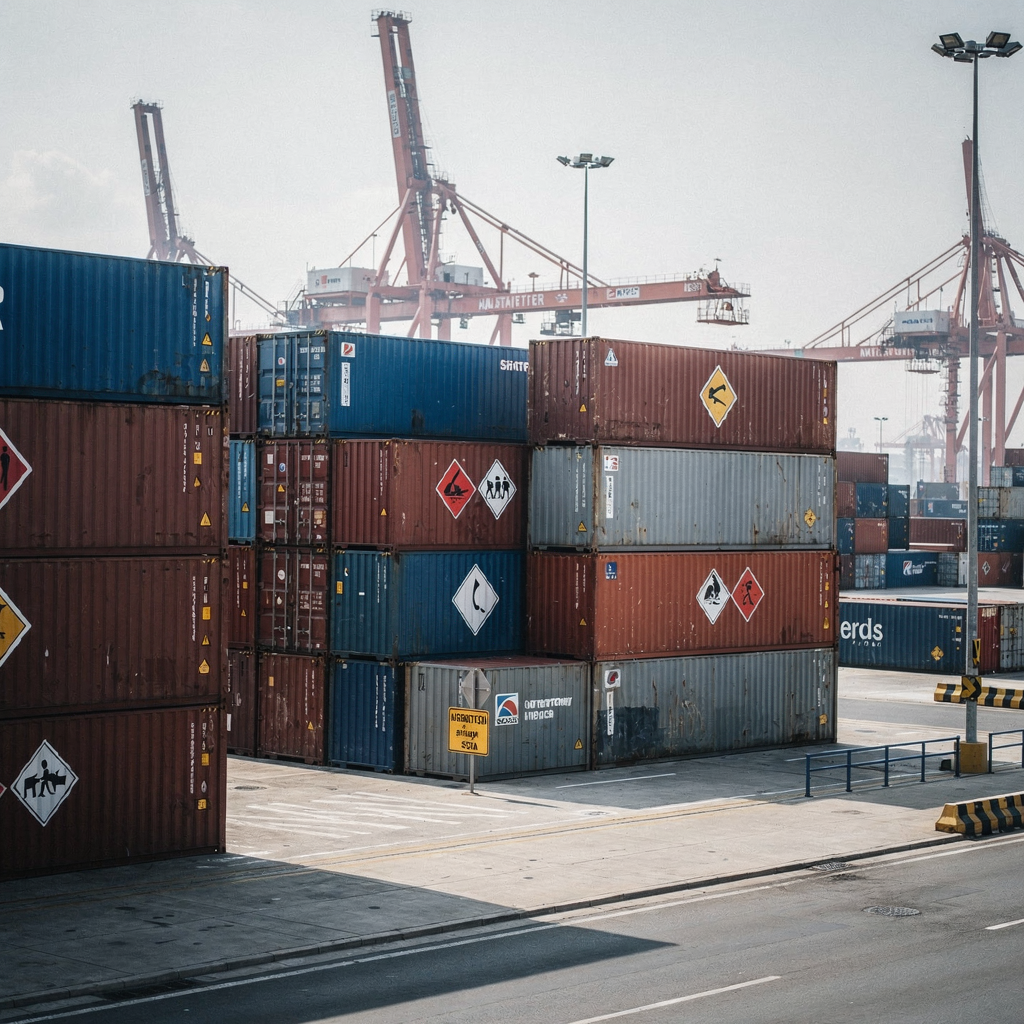
Hazardous Goods Stowage Principles
First, define hazardous goods. Hazardous goods include substances that are explosive, flammable, toxic, corrosive, oxidizing, or otherwise harmful to people, property, and the environment. Next, terminals apply the IMDG CODE and CTU Code to inland operations. For example, the CTU Code states “Proper packing and securing of cargo transport units is essential to prevent damage to the cargo and to ensure the safety of personnel handling the cargo.” CTU Code quote. Also, the international maritime dangerous goods framework informs segregation, labelling, and documentation for inland terminals. Therefore, operators must translate sea-focused rules into inland stowage practice.
First, segregation by UN hazard class prevents dangerous chemical reactions. Next, terminals separate oxidizers from flammable liquids, and acids from bases. Then, containers must be labeled and placed so incompatible cargo does not sit adjacent. Also, rules say packages of hazardous materials must be placed and restrained so they cannot shift. In addition, the shape of the package and the stuffing pattern matter to preclude shifting of the load. Terminals often require that hazardous materials must be braced to avoid being crushed by a superimposed load. Consequently, planning teams verify that freight containers or a vessel designed for and carrying hazardous loads meet structural requirements.
Furthermore, inland terminals face denser urban proximity and limited space. Thus, they must balance operational flow with strict stowage requirements. For example, terminals adopt transport units best practices to ensure hazardous cargo stays secure. Because the term TRANSPORT UNITS covers both containers and other CTUs, planners must include transport units in their checks. Similarly, Loadmaster.ai helps terminals simulate yard layouts and test stowage policies with a digital twin digital twin testing. Finally, careful attention to segregation tables, load restraint, and avoidance of a potentially dangerous situation reduces accidents and improves regulatory compliance.
Cargo Transport Regulations in Inland Terminals
First, review international frameworks that govern dangerous cargo in inland terminals. The IMDG Code sets sea-based standards that inland operators adapt for container yards. Also, the UNECE Recommendations provide harmonised rules for road and rail legs of container movement. See the UNECE recommendations for detailed guidance UNECE Recommendations. Next, the IMO/ILO/UNECE Code of Practice for Packing of Cargo Transport Units (CTU Code) offers packing and securing principles that terminals must apply to avoid incidents. The CTU Code remains a cornerstone resource and its text helps shape inland stowage requirements.
Then, national adaptations overlay these international regulations. For instance, the U.S. uses federal rules derived from the Hazardous Materials Regulations and citations like 49 cfr. Additionally, specific administrative notices such as 55 fr 52689 and 41 fr 16110 have amended U.S. rules over time. Also, parts of the Code of Federal Regulations reference sections like 176-30 and 176-1 when dealing with vessel carriage and barge handling. Terminals often implement permit systems for certain classes. For instance, class 9 and miscellaneous hazardous loads sometimes require special handling permits and route approvals.
Next, inland terminals must update terminal operating procedures so that containers must follow segregation tables and documentation flows. Also, regulators may require that freight containers or barges containing hazardous cargo carry fixed fire extinguishing and fire detection systems when certain thresholds apply. For context, OSHA and inland navigation safety guides provide operational details and the need for training OSHA Longshoring and Marine Terminals. Finally, operators should align with best practices for cargo transport across modes. For example, read how deep simulation improves yard strategy to balance safety and productivity capacity planning with digital twins.
Drowning in a full terminal with replans, exceptions and last-minute changes?
Discover what AI-driven planning can do for your terminal
Handling and Stowage Procedures for IMDG Compliance
First, packing and securing follow the CTU Code. Packages must be declared and packed to withstand handling stresses. Also, the package and the stuffing pattern must preclude shifting of the load. Next, terminals check that hazardous materials must be braced and dunnaged where required. Moreover is banned, so I will say additionally, dunnage must not pierce vulnerable packages or be crushed by a superimposed load. If the cargo is likely to be pierced by the dunnage, terminals change the dunnage material or the pattern.
Then, lifting and handling rules reduce the risk of accidental drops. For example, use certified spreader bars and inspect twistlocks before each lift. Also, forklifts handle palletised loads with rated attachments. Terminals ensure that hazardous materials must be secured in transport units to prevent movement during stacking. Packages of hazardous materials must be accompanied by correct labels. Additionally, paperwork must include Safety Data Sheets and transport emergency cards.
Next, personal protective equipment (PPE) and training remain mandatory. Terminal staff may wear chemical-resistant gloves, eye protection, and respirators as the SDS prescribes. Also, emergency response protocols must be practised on shift rotations. Terminals should stage spill kits and breathing apparatus where hazardous cargo is stored. Because a mistake can create a potentially dangerous situation, drills and clear procedures save lives and reduce property damage. In practice, Loadmaster.ai’s JobAI can help coordinate moves so that dangerous cargo moves avoid high-traffic lanes, cutting exposure and unnecessary rehandles multi-agent AI integration. Finally, terminals document every handling step and keep an auditable trail for compliance and continuous improvement.
Electronic Code of Federal Regulations in Hazardous Cargo Management
First, terminals consult the electronic code of federal regulations to translate national law into daily practice. For U.S. inland yards, references include 49 cfr and sections that govern vessel carriage, stowage, and handling. Also, regulations such as 176-1, 176-12, and 176-30 provide specific rules for packaged hazardous materials and for freight containers or barges containing hazardous loads. For example, 176-1a clarifies packing group requirements and shipping papers. See the U.S. Federal notices like 41 fr 40687 and 55 fr 52689 for historical amendments to these rules.
Next, terminals integrate e-CFR tracking into their TOS and safety workflows. Systems must record declarations, UN numbers, and emergency contact data for each shipment. Also, the requirement that containers must display placards and that “removal of packages in case of fire” be planned appears in CFR-derived guidance. Terminals use electronic manifests so first responders can access information quickly. Additionally, the CFR describes when freight containers or a vessel designed for and carrying hazardous items must have fixed fire extinguishing and fire detection systems. For instance, regulations describe situations where materials in barges is equipped with fixed firefighting systems when the barge is on board.
Then, automation helps validate that containers or barges containing hazardous loads are stowed in the manner required. For example, automated checks can flag if combustible materials sit next to organic peroxides or if flammable solids occupy incompatible slots. Also, software can ensure that containers must not be loaded above limits that would crush inner packages. Systems should also track references like 41 fr 16110 and 56 fr 66282 when confirming historical rule changes. Finally, terminals that integrate the e-CFR into their TOS reduce paperwork errors and speed compliance checks. For further reading on embedding safety rules into AI models, see our guide on embedding operational safety rules safety rule integration.
Drowning in a full terminal with replans, exceptions and last-minute changes?
Discover what AI-driven planning can do for your terminal
Dangerous Cargo Segregation and Compatibility Rules
First, segregation tables in the IMDG Code and CFR list which classes cannot sit together. For example, oxidisers and flammable liquids must not be adjacent. Also, class 4 and flammable solids have dedicated restrictions. Next, the IMDG Code and related guidance define class 9 and miscellaneous hazardous categories and how these interact with other classes. The international maritime dangerous goods framework informs inland segregation when cargo moves to or from deepsea ports. See the IMDG Code and UNECE guidance for table details UNECE segregation tables.
Then, provide concrete examples. For instance, keep oxidisers away from flammable liquids and combustible materials. Also, do not place acids and alkalis together. Next, operators should avoid stacking organic peroxides above other packages that could be crushed. Similarly, if packages are likely to be pierced by the dunnage, terminals change the stuffing pattern or use protective inner pallets. In addition, containers must be stowed so that vertical restraints protect against shifting and prevent shifting in any direction during transport.
Also, records must show how the segregation decision arose. For example, a manifest might record that a shipment contains flammable liquids and that it was placed in a segregated bay. Additionally, terminals use automated checks so that containers must meet compatibility rules before being assigned a yard slot. For complex cases, like barges containing hazardous materials, special rules guide whether materials are stowed on deck or below, and when barges need not be stowed if safe alternatives exist. Finally, the use of intermodal planning tools and digital twins helps test segregation scenarios before execution. For a deep-dive on dangerous goods segregation in yards, view our related post dangerous goods segregation.
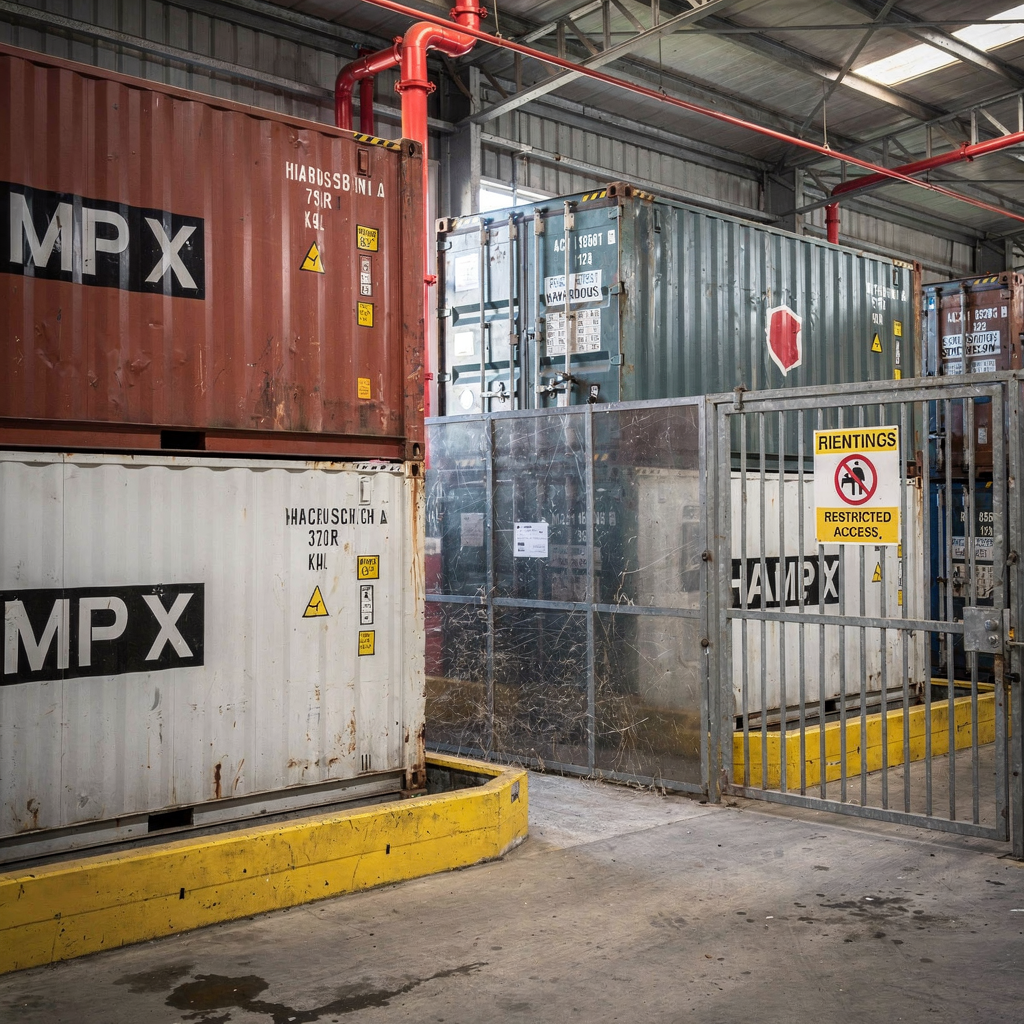
Hazardous Cargo Documentation and Terminal Storage Areas
First, documentation must accompany every hazardous shipment. For example, the lading and shipping papers must list UN numbers, proper shipping names, packing groups, and emergency contacts. Also, Safety Data Sheets must be on file and available to emergency responders. Next, transport emergency cards and in-transit emergency information improve first-responder speed. Terminals often require that containers must show placards and that any transport unit with combustible materials be clearly marked.
Then, discuss storage design. Terminals create designated storage zones with fire suppression, spill containment, and controlled access. Also, some areas have fixed fire extinguishing and fire detection systems capable of reaching and piercing the freight container in extreme cases. For certain loads, the CFR and SOLAS-derived guidance say that freight containers or barges containing hazardous materials are stowed only in zones equipped with proper suppression. Additionally, materials are stowed on deck only when permitted by regulation and when the barge is on board with proper safety gear.
Next, specify safeguards. For example, storage bays use bunded floors, ventilation, and secondary containment for liquid leaks. Also, access control limits who may enter hazardous zones and enforces PPE rules. Terminals mandate that hazardous materials must be secured and that they must be braced and dunnaged to prevent movement. If a package has an odd shape, required if the shape of the package could cause instability, handlers add vertical restraints. Finally, removal of packages in case of fire requires trained crews and planned procedures. For more on planning to reduce rehandles and protect yard flow while keeping safety high, see our piece on balancing stowage quality and crane productivity balancing stowage and productivity.
FAQ
What defines hazardous goods in inland container terminals?
Hazardous goods are materials that can harm people, property, or the environment. They include explosives, flammable liquids, toxic agents, corrosives, oxidisers, and miscellaneous hazardous items listed by international and national codes.
Which international rules apply to hazardous cargo stowage?
The IMDG Code and the CTU Code lead for ocean and packing rules, while UNECE recommendations and ILO guidance harmonise multimodal moves. National laws like the electronic code of federal regulations adapt them for inland contexts.
How should incompatible cargo be segregated?
Use segregation tables from the IMDG Code and national regulations to keep, for example, oxidisers away from flammable liquids. Also, acids and bases should remain separate and organic peroxides deserve special stacking rules.
What documentation must accompany a hazardous shipment?
Shippers must supply a shipping paper or lading with UN numbers, proper shipping names, packing groups, emergency phone numbers, and Safety Data Sheets. Additionally, transport emergency cards speed up first-responder actions.
How do terminals manage storage areas for hazardous cargo?
Terminals designate zones with spill containment, fixed fire extinguishing and fire detection systems where required, and restricted access. Also, they use bunded floors, ventilation, and PPE enforcement to lower risks.
Are special permits needed for certain classes?
Yes. Some loads, such as class 9 or certain organic peroxides, require additional permits or route approvals. National agencies issue these permits based on safety and public risk assessments.
What training do handlers need for hazardous cargo?
Handlers need training on packing, PPE, emergency response, and chemical hazards. They must also practice drills so that removal of packages in case of fire follows established procedures.
How do terminals prevent cargo from shifting during transport?
They use proper packing, bracing, and dunnaging, and follow stuffing patterns that preclude shifting of the load. Also, vertical restraints and secure lashing prevent shifting in any direction.
Can AI help with hazardous stowage planning?
Yes. AI agents like those from Loadmaster.ai can simulate yard states and test stowage plans in a digital twin to reduce rehandles and improve safety. They can enforce rules and keep operations consistent across shifts.
Where can I find the legal texts for hazardous cargo rules?
Primary sources include the IMDG Code, the CTU Code, UNECE recommendations, and the electronic code of federal regulations. Also, OSHA and related federal notices like 55 fr 52689 and 41 fr 16110 clarify amendments and enforcement. For practical implementation, review CTU Code guidance here and UNECE tables here.
our products
 stowAI
 stackAI
 jobAI
jobAI
Innovates vessel planning. Faster rotation time of ships, increased flexibility towards shipping lines and customers.
Build the stack in the most efficient way. Increase moves per hour by reducing shifters and increase crane efficiency.
Get the most out of your equipment. Increase moves per hour by minimising waste and delays.
stowAI
Innovates vessel planning. Faster rotation time of ships, increased flexibility towards shipping lines and customers.
stackAI
Build the stack in the most efficient way. Increase moves per hour by reducing shifters and increase crane efficiency.
jobAI
Get the most out of your equipment. Increase moves per hour by minimising waste and delays.