
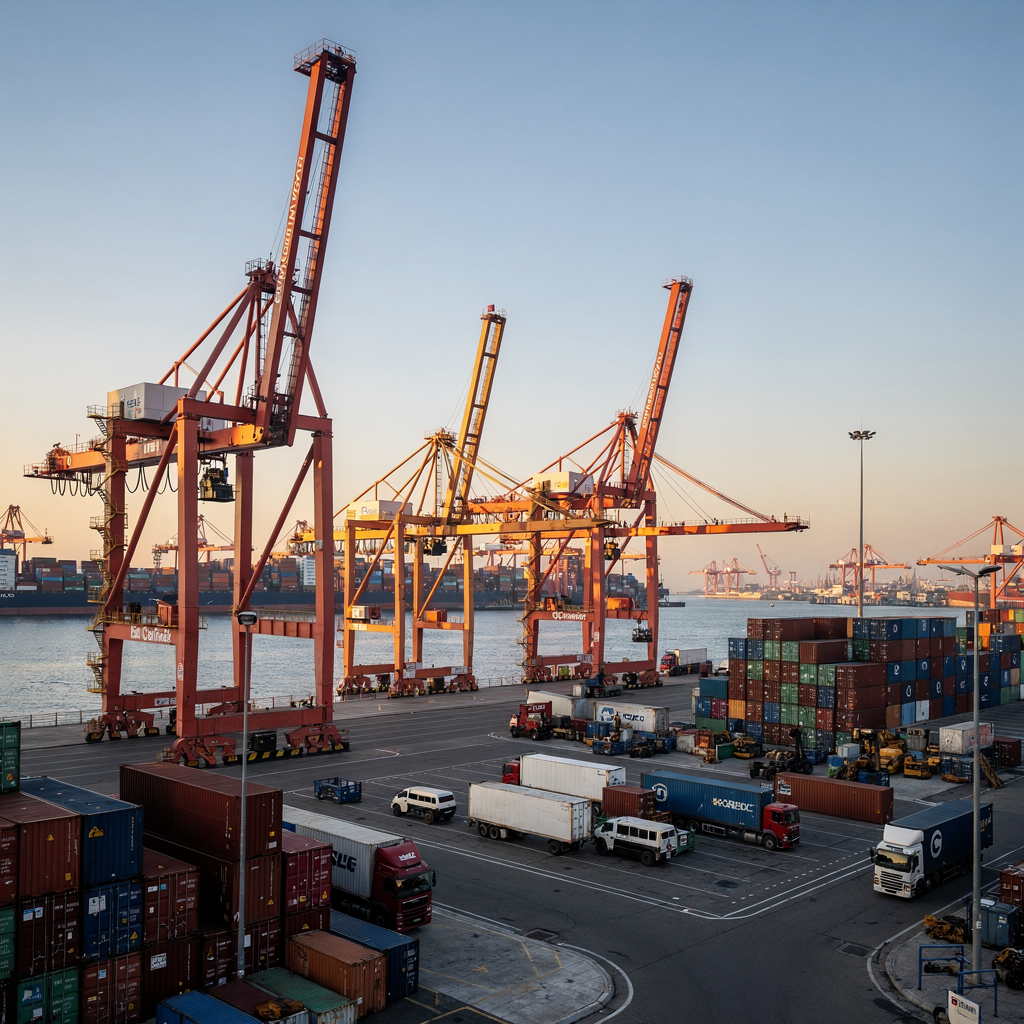
Operation Basics: Understanding Gross Crane Rate
First, understand that the gross crane rate, often abbreviated GCR, measures moves per gross hour per crane and includes working time, idle time, and waiting time. Next, this metric matters because it directly affects vessel turnaround and overall terminal throughput. For example, a recent Port of Melbourne review reported terminal figures spanning 22.6 to 32.9 gmph, which shows clear variation between operators and highlights room to improve Port of Melbourne – Container Capacity Review – Final Report. Then, when planners and managers track GCR they can prioritise actions that reduce berth time and speed up ship service.
Firstly, GCR captures the gross time a quay unit consumes. Secondly, because it folds in idle and waiting periods, the metric reveals hidden losses that simple moves-per-working-hour numbers miss. Therefore, terminals that aim to lift throughput must address both movement speed and the interruptions that drag the figure down. For example, terminals with higher GCRs typically deliver shorter vessel stays and lower berth congestion which benefits both shipping lines and terminal operators Le-Griffin (2006).
Furthermore, measuring GCR supports targeted investments. For instance, if a set of quay units shows frequent technical stops, then maintenance or equipment upgrades may be the best next step. In contrast, if idle time predominates, then changes to scheduling or yard feeding will matter more. Additionally, comparing GCR across shifts and between terminals helps terminal operators evaluate best practices and adapt them locally. Finally, to make decisions with confidence, teams should combine GCR with yard KPIs and gate metrics, and they should use simulation tools to test scenarios before making costly investments — see simulation guides for planning and capacity work for more context best container terminal simulation software for planning.
Operation Scheduling: Optimising Crane Deployment
First, matching the right number of quay units to vessel size and cargo volume reduces wasted time and supports continuous work. Next, planners should aim for crane deployment that minimises gaps between moves, and that keeps equipment active as long as it is safe to do so. For example, efficient scheduling adjusts crane positioning as discharge and load patterns unfold across the vessel, so crew movement and unnecessary shifters fall. Moreover, this approach raises the chance of sustained high moves per hour and improved berth occupancy rates. Le-Griffin emphasised that “the number and movement rate of quayside container cranes are critical factors influencing terminal productivity” Le-Griffin (2006), and planners should treat that guidance as operational priority.
Secondly, a staged deployment plan helps. First stage places cranes by predicted peak blocks, second stage shifts them as the ship list changes, and third stage prepares for the next vessel. Then, by sequencing moves to reduce lane crossings and crane interference, teams protect flow and lower idle windows. Additionally, careful berth occupancy planning keeps multiple vessels moving, and that balances quay workload against yard capacity. For readers who want to test alternative berth and crane layouts before rolling changes out, simulation tools provide a low-risk environment; see our materials on berth scheduling optimisation and terminal performance modelling for practical examples simulation tools for port berth scheduling optimisation terminal performance modelling software.
Finally, remember that shipping patterns shift. Therefore, schedules must adapt, and planners need decision support that recommends crane numbers rather than static rules. In practice, shifting from reactive firefighting to proactive allocation reduces rehandles and keeps moves per hour higher. Consequently, terminal operators who adopt flexible deployment see steadier performance across shifts and improved service delivery to shipping lines.
Drowning in a full terminal with replans, exceptions and last-minute changes?
Discover what AI-driven planning can do for your terminal
Operation Reliability: Enhancing Crane Accessibility and Maintenance
First, technical downtime is one of the fastest ways to erode gross performance. Next, every unscheduled stop removes potential moves from the hour and extends vessel stays. Therefore, terminals must treat accessibility and technical resilience as core priorities. For example, improved spare parts management and targeted preventive checks reduce the frequency and duration of breakdowns. Additionally, predictive maintenance tools that ingest equipment telemetry allow teams to act before faults produce long outages, and Kalmar’s big-data research shows that “taking into account the technical data of cranes can optimize the accessibility rate level, thereby improving overall productivity” Kalmar research.
Secondly, real-time monitoring helps operations spot trends. First, telemetry flags abnormal motor currents, second it shows brake wear, and third it surfaces hydraulic anomalies. Then, maintenance crews can pre-empt failures during planned windows rather than interrupting ship service. Moreover, accessibility depends on simple things too: clear staging areas, unobstructed roads for truck access, and coordinated pilotage for the next vessel. In that light, the yard and quay teams should align workflows to preserve crane uptime and to improve container handling speed.
Finally, combining telemetry with digital twins and simulation allows teams to evaluate scenarios and to prioritise investments. For instance, modelling the impact of a single frequent fault demonstrates whether a spare parts purchase yields a faster ROI than a staffing change. In practice, terminals that invest in both technical monitoring and improved access often see measurable lifts in moves per hour and in long-term service reliability. For guidance on representing equipment and failures in simulation, see our technical pages on equipment scheduling simulation solutions and how to model yard operations terminal equipment scheduling simulation solutions how to model container yard operations.
Operation Intelligence: Implementing Decision Support Systems
First, Decision Support Systems (DSS) ingest real-time data on vessel arrivals, yard congestion, and equipment status, and then they translate that information into practical actions. Next, a DSS can propose dynamic crane schedules, adjust berth allocations, and suggest sequencing that balances quay throughput with yard flow. For example, a 2021 study showed that a DSS helps maintain resilient ports by improving berth occupancy and by lifting gross moves per hour A decision support system for maintaining a resilient port (2021). Then, operators can act on recommendations to reduce idle time and to keep quay units productive.
Secondly, modern DSS tools combine short-term forecasting with optimisation. First, they predict vessel arrival windows and likely exchange volumes, second they estimate yard impacts, and third they recommend crane counts and positions to avoid bottlenecks. Then, when unexpected delays occur, the system replans rapidly, which reduces firefighting and keeps the team focused on execution. Additionally, closed-loop optimisation that trains policies against KPIs yields more robust choices; for example, reinforcement learning agents can learn to balance quay productivity with yard congestion, and Loadmaster.ai uses such agents to support planners who require adaptable policies without relying solely on historical data.
Finally, the practical benefits are tangible. A DSS reduces decision latency, increases berth occupancy where safe, and raises moves per hour by coordinating multi-domain actions. Therefore, implementing a DSS pays off not only in improved metrics but also in predictable service for shipping lines. For teams that want to test DSS logic before deployment, simulation-case studies and TOS integration examples show how to validate algorithms in a sandboxed environment simulation case studies TOS simulation integration examples.
Drowning in a full terminal with replans, exceptions and last-minute changes?
Discover what AI-driven planning can do for your terminal
Operation Sustainability: Electrification and Green Technologies
First, many ports now plan to shift quay units and yard equipment to electric power to reduce emissions and to improve operational resilience. Next, electric cranes and shore-power connections eliminate fuel supply interruptions and reduce engine-related failures that previously reduced gross performance. For instance, the research into electrification and green port initiatives highlights both environmental and operational gains from electrified infrastructure UNCORRECTED PROOF – Electrification of container terminals. Then, with fewer onsite fuel logistics, terminals often experience fewer unscheduled stops and simplified daily checks.
Secondly, electric units deliver more consistent performance in many climates because they avoid the variability of combustion engines. First, fewer warm-up and cool-down cycles cut mechanical stress, second they enable more precise torque control for lifts, and third they often require simpler maintenance regimes. Consequently, electrification can improve equipment availability and the accessibility rate for quay units, and that supports higher moves per hour. Additionally, sustainability targets and regulatory pressures mean that green investments also create alignment with wider port strategies and with customer expectations from shipping lines.
Finally, integrating renewable energy and energy storage improves resilience further. For example, onsite batteries smooth demand spikes and keep cranes running during short grid events, which reduces service interruptions. Moreover, when terminals pair electrification with smarter scheduling, they can save both energy and operational cost. For readers who plan capital decisions, simulation tools for capacity investment and terminal modelling help evaluate trade-offs between electrification, new equipment, and layout changes terminal simulation software for capacity investment decisions.
Operation Workforce: Training, Metrics and Continuous Improvement
First, skilled operators and coordinated teams convert tools into tangible productivity gains. Next, continuous training and practical drills help operators follow best-practice sequences that reduce rehandles and that keep moves consistent. Additionally, performance metrics and clear KPIs make it easy to spot deviations from standards and to target coaching. For example, linking hourly move targets to yard flow KPIs clarifies trade-offs and encourages teamwork rather than siloed behaviour. Then, when supervisors pair training with incentives, teams often sustain better results across shifts.
Secondly, measured feedback supports rapid improvement cycles. First, daily shift reviews that show move counts and delay causes allow supervisors to improve plans for the next shift. Second, targeted coaching on specific tasks, such as efficient pick sequences or faster rigging, reduces minutes lost per move. Third, cross-training enables teams to flex when peaks or breakdowns occur, which reduces the need for emergency staff moves. Moreover, combining human expertise with AI-based agents yields better outcomes; for example, reinforcement learning can produce execution policies that respect operator constraints while improving overall productivity, and Loadmaster.ai’s StowAI, StackAI and JobAI agents are designed to augment planners, strategists and dispatchers without replacing local knowledge.
Finally, quantify the potential impact. For instance, Port of Melbourne data shows terminals with GCRs near 22.6 gmph sitting well below peers at 32.9 gmph, which implies that targeted operational and workforce measures could lift performance by up to 40% in some contexts Port of Melbourne review. Therefore, a programme that mixes training, better scheduling, technical upkeep, and data-driven decision support will usually deliver sustained gains. In addition, use simulation and small pilots to evaluate proposed changes before wider rollout, so you can measure benefits with minimal disruption and so your team can adopt improvements confidently simulations for terminal planning.
FAQ
What is the gross crane rate and why does it matter?
The gross crane rate measures moves per gross hour per quay crane and includes working, idle, and waiting time. It matters because it links directly to vessel turnaround times and terminal throughput, and because improving the figure shortens berth stays and raises capacity.
How can scheduling changes improve crane performance?
Scheduling that matches crane numbers to vessel size and cargo volume reduces idle windows and keeps quay units active. Dynamic sequencing and berth occupancy planning also lower crane interference and decrease rehandles, which together boost moves per hour.
What role does maintenance play in keeping cranes available?
Proactive maintenance and predictive analytics reduce unscheduled stops and extend availability. Real-time telemetry allows teams to spot issues early and to perform fixes during planned windows, so vessel service suffers less interruption.
How do Decision Support Systems help terminal planners?
DSS tools ingest real-time data on arrivals, yard status, and equipment and then recommend schedules and allocations that balance quay and yard priorities. They reduce firefighting, speed up decisions, and help keep cranes productive when conditions change.
Are electrified cranes more reliable than diesel units?
Electrified cranes often deliver more consistent performance and require different maintenance, which can reduce certain failure modes. Additionally, shore power and battery systems lower fuel logistics and can reduce short interruptions caused by fuel supply issues.
What workforce steps yield the biggest gains?
Continuous training, shift reviews, cross-training, and performance incentives consistently lift outcomes. Combining human skills with AI-driven guidance helps teams make better plans and execute them more reliably.
How can terminals test changes before wide rollout?
Use simulation and digital twins to evaluate berth plans, equipment upgrades, and scheduling rules in a sandbox. Simulations reduce risk, show likely benefits, and help prioritise investments before committing capital or operational changes.
What is the impact of improving gross crane rate on vessel turnaround?
Raising gross moves per hour shortens vessel berth time and increases terminal throughput, which lowers per-call cost for shipping lines and improves port competitiveness. Even modest gmph gains can translate into meaningful berth time reductions.
How does Loadmaster.ai fit into crane productivity programmes?
Loadmaster.ai provides reinforcement learning agents that augment planners, yard strategists, and dispatchers to balance quay productivity, yard congestion, and driving distance. The approach trains in a digital twin, so teams can deploy policies that adapt to changing mixes without relying solely on historical data.
What first steps should a terminal take to improve crane productivity?
Start by measuring GCR accurately and by reviewing the largest delay causes, then combine scheduling adjustments, maintenance improvements, and targeted training. In parallel, use simulation and decision-support pilots to validate changes before broader implementation.
our products
 stowAI
 stackAI
 jobAI
jobAI
Innovates vessel planning. Faster rotation time of ships, increased flexibility towards shipping lines and customers.
Build the stack in the most efficient way. Increase moves per hour by reducing shifters and increase crane efficiency.
Get the most out of your equipment. Increase moves per hour by minimising waste and delays.
stowAI
Innovates vessel planning. Faster rotation time of ships, increased flexibility towards shipping lines and customers.
stackAI
Build the stack in the most efficient way. Increase moves per hour by reducing shifters and increase crane efficiency.
jobAI
Get the most out of your equipment. Increase moves per hour by minimising waste and delays.