
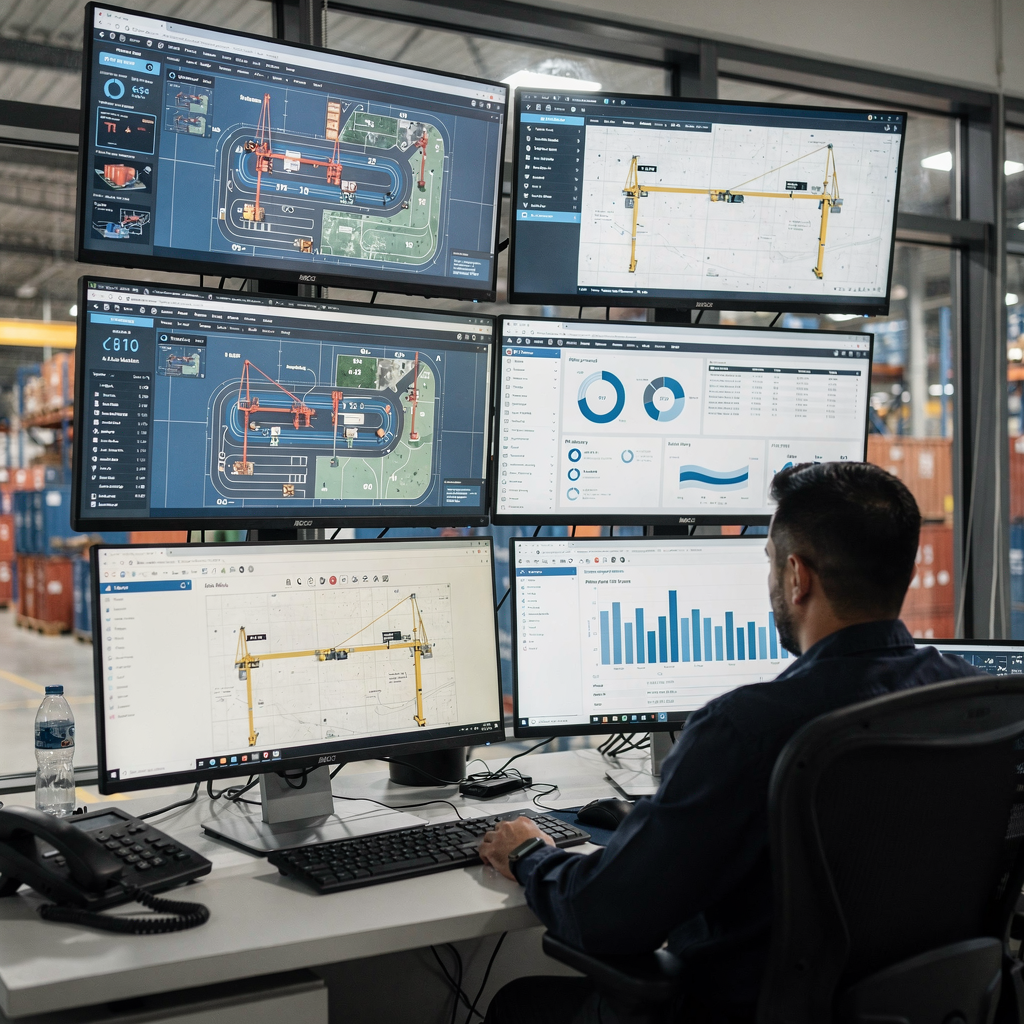
terminal: Understanding GMPH and Its Impact on Throughput
Gross Moves Per Hour (GMPH) measures how many container moves a terminal executes each hour. It counts loading, unloading, and stacking. GMPH therefore gives a clear numeric view of throughput. For planners and terminal operators, GMPH links directly to berth management, yard flow, and vessel turnaround. First, calculate GMPH by dividing total gross moves during a shift by shift hours. Next, adjust for breaks, equipment outages, and planned idle time to get an operational GMPH. This metric helps to align daily targets with long-term goals for container terminal productivity and efficiency.
The relationship between vessel size and required GMPH is strong. Larger ships create intense short-term peaks at the quay. In fact, the International Transport Forum notes that “Peaks in yard operations are directly linked to the size of the vessel, necessitating enhanced GMPH to avoid bottlenecks and delays.” Source: ITF. Consequently, a terminal must balance quay crane allocation, yard space, and truck cycles. If the terminal cannot raise GMPH during peak berth windows, berth time increases and schedule reliability falls. That raises costs for shipping lines and for the terminal itself.
Benchmark figures vary by type of terminal and level of automation. Manual and conventionally managed terminals commonly see GMPH in the 20–30 moves per hour range, while modern automated terminals can reach 40 moves per hour or more. For example, industry reports show automated sites exceeding 40 moves/hr, and some yards report spikes up to 50 moves/hr during peak shifts Source: INFORM and ITF. These benchmarks set expectations for terminal design and staffing models.
To improve terminal productivity, leaders must focus on operational levers. First, refine quay crane sequences to lower idle time. Second, optimize yard stacking to reduce internal truck travel. Third, synchronize gate flows to avoid shift spikes. For decision support on capacity and layout, digital twins and simulation guide choices. You can explore simulation-based capacity planning in detail through resources such as our digital-twin use cases and simulation models for terminals container terminal capacity planning and simulation models for automated terminals. These tools help translate GMPH targets into practical operating rules and investments.
container terminals: Benchmarking Performance Metrics
Benchmarking helps terminals set realistic GMPH goals. Small container terminals typically run fewer quay cranes and have lower crane intensity. As a result, they see lower GMPH than mid-size facilities. Mid-size container terminals often deploy more cranes and a larger yard footprint, which improves moves per hour during steady states. Mega-ship terminals face high peaks when large vessels call. Those peaks can produce short bursts of up to 50 moves per hour. The International Transport Forum ties those spikes to vessel size and yard demand, and it explains why terminals must scale operations during calls ITF.
Comparing performance across type of terminal requires consistent measurement. Use standard hour definitions, include all gross moves, and report equipment availability. When terminals follow that approach, operators can track improvements and identify best practices. For instance, if one mid-size terminal reaches an average GMPH near 35 during peak windows, others can study its quay crane scheduling and yard rotation to replicate gains. That kind of cross-site learning often relies on simulation and controlled experiments.
Simulation shows how improving GMPH by even a modest amount yields large benefits. Research indicates that a 10% GMPH improvement can cut vessel turnaround time by several hours and thereby lower cost. See studies that discuss port congestion and vessel turnaround improvements for supporting evidence Source: Cardiff Thesis. Therefore, investing in process changes and automation may pay back quickly via reduced berth time and higher throughput.
For terminals planning investments, consider metrics beyond GMPH. Measure dwell time, yard density, and average truck cycle time. Use integrated key performance indicators to capture both quay and yard dynamics. When you do, you will see how crane throughput correlates with container terminal productivity and how small changes unlock larger gains. Our work at Loadmaster.ai uses reinforcement learning to train agents in digital twins. As a result, terminals obtain robust policies that improve crane utilization and reduce rehandles. To explore related ROI insights, see our analysis on automation project returns ROI of port operations automation.
Drowning in a full terminal with replans, exceptions and last-minute changes?
Discover what AI-driven planning can do for your terminal
operational process at container terminal: Identifying Critical Bottlenecks
Mapping the operational chain helps to reveal constraints. Start with quay crane operations, then follow moves into yard stacking and finally through truck and gate cycles. Each step affects GMPH. Quay crane performance limits how quickly containers leave the vessel. If cranes wait for yard space, they idle. Likewise, if yard stacking lags, trucks queue and quay moves slow. For this reason, terminals must measure time employed in the operations and adjust resource allocation.
Key delays often come from equipment idling and yard congestion. Idle cranes mean lost throughput. Idle yard trucks mean longer vessel dwell. Moreover, complex interactions among quay cranes, RTGs, or straddles increase the risk of rehandles. Simulation studies, such as CAST terminal tools and INFORM case analyses, identify where those rehandles arise and how to cut them CAST and INFORM. By modeling flows, planners find choke points that are hard to see on the yard floor.
Use simulation to test solutions before deployment. A credible simulation reproduces quay crane cycles, truck trip times, and stacker behavior. Then it runs scenarios that change crane intensity, shift patterns, and stack policies. Simulation can show, for instance, how integrated scheduling of handling between quay and yard reduces rehandles. It can also test a dynamic space allocation method for outbound containers to limit distance and improve productivity. For terminals interested in simulation-led planning, see our resources on digital twin testing and simulation models digital twin strategy testing and using simulation for capacity planning.
Finally, human resources management matters. Skill mix, shift handovers, and dispatcher decision-making can create variability. Terminals that add visual dashboards, clearer protocols, and real-time decision support reduce this variability. Loadmaster.ai applies reinforcement learning agents to close loops between quay planning, yard strategy, and execution. As a result, shifts move from firefighting to deliberate, repeatable actions that limit bottlenecks and increase container terminal productivity.
optimizing the operational process: Technology Integration
Technology integration drives measurable improvements in GMPH and in overall terminal performance. Advanced Terminal Operating Systems (TOS) provide real-time control of resources and tasks. They assign work, track equipment, and measure performance. When combined with analytics, a TOS becomes the nerve center for terminal optimization. In practice, terminals couple TOS with automation and decision support to raise crane throughput and reduce idle time.
Automation options include automated guided vehicles (AGVs), automated quay cranes, and remote-control lifting systems. These systems reduce human variability and increase steady-state throughput. For example, automated terminals often reach GMPH levels above 40 moves per hour, compared with 20–30 moves/hour in manual sites ITF. DNV highlights that “With modern applications for ship management, terminals can manage vessels in a smarter, greener, and safer way, significantly improving operational efficiency and GMPH.” DNV. Clearly, digital systems support safer and faster operations.
Simulation supports planning and what-if analysis. Digital twins let teams simulate millions of decisions. That lets reinforcement learning agents learn robust policies without relying on historical data. Our platform trains StowAI, StackAI, and JobAI inside a sandbox twin. Then it validates policies before live deployment. For terminals adopting this path, see our work on multi-agent AI and on simulation models for automated operations multi-agent AI and simulation models. These resources explain how agents learn to balance crane productivity, yard quality, and travel distance.
To move from pilot to scale, ensure TOS-agnostic integration and clear APIs. Then set operational guardrails that preserve safety and governance. Finally, track performance changes through short experiments. When teams follow that cycle, terminals convert technical investments into higher moves per hour, better berth utilization, and more predictable throughput. This approach supports a single terminal optimization goal while protecting long-term yard health.
Drowning in a full terminal with replans, exceptions and last-minute changes?
Discover what AI-driven planning can do for your terminal
optimizing the operational process: Workforce and Equipment Coordination
Optimizing the operational process requires strong coordination between people and machines. First, plan labour shifts so skill mixes match peak demand. Second, allocate crane crews and yard staff to minimize handover losses. Third, create shift plans that protect continuity during high-intensity windows. Human resources management plays a core role because even automated systems need skilled operators and supervisors.
Crane-truck synchronisation reduces idle time. For example, synchronisation schemes slot trucks to specific quay crane cycles and to yard pickup windows. That lowers waiting at the quay and reduces crane idle minutes. Also, sequencing algorithms reduce shifters and rehandles. At Loadmaster.ai, our JobAI coordinates moves across quay, yard, and gate so equipment stays busy and trucks spend less time waiting. This coordination increases terminal productivity and shortens berth time.
Communication platforms help teams share intent and exceptions. Simple measures include clear shift handover notes, real-time dashboards, and mobile alerts. More advanced platforms provide decision support and automated job bundles. These systems allow dispatchers to assign tasks quickly, and they let supervisors track crane intensity and yard balance. For terminals wanting to cut crane idle time, our research and tools provide practical tactics and links to methods for improving execution reducing crane idle time.
Finally, cross-training staff increases resilience. When operators rotate across quay and yard roles, the terminal gains flexibility. That helps during equipment outages and during unusual vessel mixes. Together, better scheduling, smarter synchronisation, and stronger communication shorten the start of operations and sustain high performance across shifts. These actions produce steadier GMPH and reduce reliance on any single planner’s tribal knowledge.
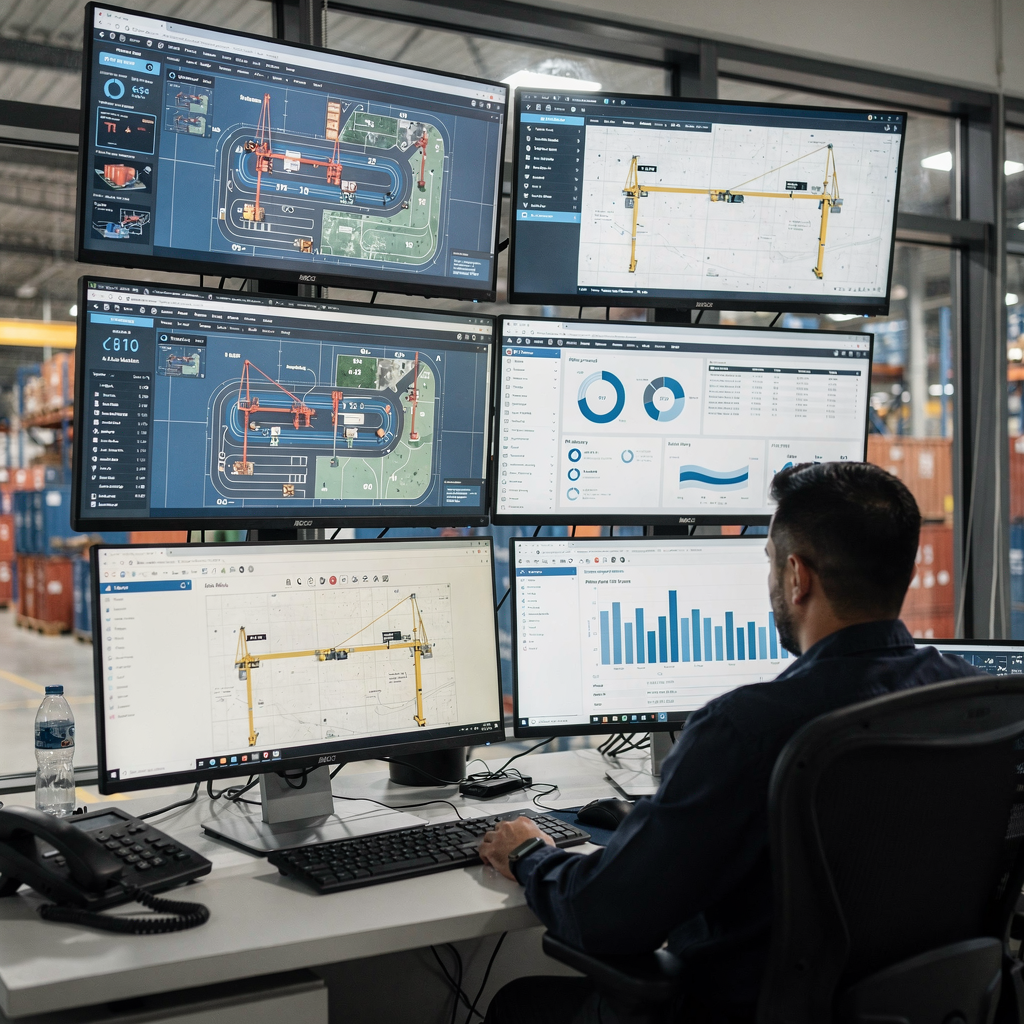
operational process at container terminal: Data-Driven Decisions and Sustainability
Data drives better resource allocation and more sustainable choices. Port Community Systems (PCS) provide reliable, real-time data flows between stakeholders. With consistent data, planners adjust quay crane schedules, gate windows, and yard allocation dynamically. A case study on PCS notes that “PCS implementation leads to more reliable data acquisition, which is crucial for optimizing terminal throughput and reducing operational costs.” Source: IADB.
Analytics-led resource allocation helps boost GMPH while managing energy use. For example, predictive models can prioritise moves that reduce driving distance and that balance RTG workloads. That lowers fuel consumption and improves container terminal productivity. Also, optimized sequencing decreases the need for rehandles. As a result, terminals save energy and reduce emissions per move. For terminals aiming to test these ideas, our cloud and edge AI analysis explains architectures that work with PLC and telemetry data cloud versus edge AI and event-driven AI architectures.
Energy-efficient practices include fuel switching and electrification. Independent studies show that LNG can reduce shipping GHG emissions by up to 21% in some routes, and terminals explore green power and shore-side electrification to lower footprint LNG study. Yet, environmental measures must align with productivity targets. Therefore, combine green investments with operation-centric metrics to ensure that sustainability does not degrade throughput.
Looking ahead, terminals will integrate AI decision support with sustainability goals. Optimization models that include energy, cost, and throughput objectives will emerge. At Loadmaster.ai, we train reinforcement learning agents on digital twins so policies respect operational KPIs and energy constraints. This approach yields plans that maintain high GMPH while reducing travel and unnecessary moves. For further reading on terminal capacity planning with digital twins, see our guide on container-terminal capacity planning capacity planning with digital twins.
FAQ
What is GMPH and why does it matter?
GMPH stands for Gross Moves Per Hour. It measures the total number of container moves a terminal completes each hour and serves as a direct indicator of terminal throughput and efficiency. Higher GMPH reduces berth time and improves schedule reliability for carriers.
How does vessel size affect terminal GMPH?
Larger vessels create high peaks of demand at the quay. Those peaks require more coordinated crane work and yard flow. If the terminal cannot scale GMPH during calls, berth time increases and congestion follows.
What benchmarks should container terminals use for GMPH?
Benchmarks vary by automation and scale. Manual terminals often average 20–30 moves per hour, while automated terminals frequently exceed 40 moves per hour. Terminals should track both steady-state averages and peak-window performance.
Can a small GMPH improvement cut vessel turnaround time?
Yes. Studies show that a 10% GMPH improvement can reduce vessel turnaround by several hours. That reduction translates into cost savings and better berth utilization for the terminal and shipping lines.
What are common bottlenecks in the operational process at container terminal?
Typical bottlenecks include crane idle time, yard congestion, and truck queuing at the gate. Poorly synchronised quay, yard, and gate cycles also create rehandles and longer moves. Simulation helps identify and address these chokepoints.
How can simulation help improve terminal performance?
Simulation models recreate quay cycles, truck trips, and stacking behavior so teams test what-if scenarios before changes go live. Tools like CAST and INFORM have shown how simulation pinpoints rehandle causes and space allocation problems. Simulation reduces risk and speeds decision-making.
What role do TOS and automation play in terminal optimization?
Terminal Operating Systems and automation increase real-time control and consistency. TOS assigns tasks and monitors equipment. Automation, such as AGVs and automated cranes, reduces human variability and can lift GMPH significantly when implemented with good integration.
How important is workforce coordination for GMPH?
High importance. Shift scheduling, skill mix, and clear handovers reduce variability and errors. Synchronising crane crews with truck arrival windows and yard staff increases equipment utilization and reduces idle minutes.
How do data systems and PCS improve decisions?
Port Community Systems provide reliable, real-time data to all stakeholders. That data enables dynamic adjustments to quay crane schedules, yard allocation, and gate slots. Better data reduces surprises and supports smoother operations.
What sustainability strategies align with improving GMPH?
Strategies include electrifying yard equipment, optimizing sequences to reduce travel, and adopting low-carbon fuels where appropriate. Combining energy targets with throughput KPIs ensures that greening efforts do not sacrifice productivity.
our products
 stowAI
 stackAI
 jobAI
jobAI
Innovates vessel planning. Faster rotation time of ships, increased flexibility towards shipping lines and customers.
Build the stack in the most efficient way. Increase moves per hour by reducing shifters and increase crane efficiency.
Get the most out of your equipment. Increase moves per hour by minimising waste and delays.
stowAI
Innovates vessel planning. Faster rotation time of ships, increased flexibility towards shipping lines and customers.
stackAI
Build the stack in the most efficient way. Increase moves per hour by reducing shifters and increase crane efficiency.
jobAI
Get the most out of your equipment. Increase moves per hour by minimising waste and delays.