
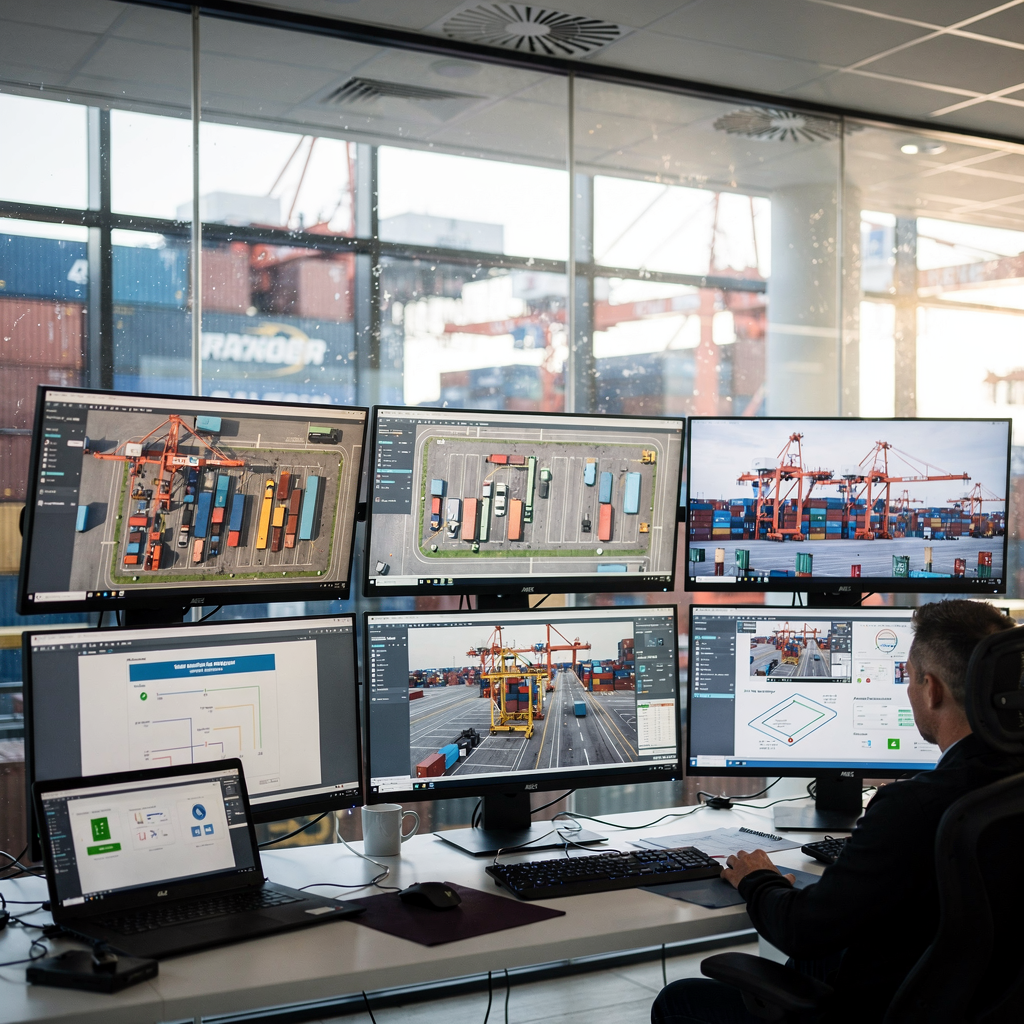
Understanding the terminal operating system and tos Landscape
A terminal operating system (TOS) sits at the heart of a container terminal. It schedules vessel calls and assigns moves, and it tracks containers from gate to quay. It also holds embedded fleet control logic in many legacy deployments, and that coupling shapes how the terminal runs. The embedded logic often acts as a central planner and as a central nervous system for on-site equipment. But this monolithic approach brings measurable limits. Upgrades take months, and vendor lock-in can block innovation. As a result, operator teams face a single-point failure that can halt daily operations and raise risk across the quay, yard, and gate.
Separating fleet control from the core TOS removes the single-point failure and allows independent upgrade cycles. For example, ports that have moved to modular topologies report a roughly 15% reduction in downtime when fleet control is decoupled and maintained separately. This statistic explains why forward-thinking terminal operators prioritise resilience. Loadmaster.ai uses this modular view when it designs reinforcement learning agents that operate alongside an existing TOS, and that approach keeps the core terminal operating system stable during iterative improvements.
There are further operational pains with a tightly integrated setup. Planners and dispatchers wrestle with firefighting, and planner knowledge often stays tribal. The result is inconsistent outcomes and increased inefficiency. Therefore it pays to separate concerns. A lightweight fleet controller can focus on high-frequency decisions and short decision cycles. The TOS can then focus on strategic sequencing, stowage and documentation. This split allows terminals to digitalise parts of the workflow without risking the enterprise systems that manage billing, customs, and berth assignment.
For terminal staff and operator teams this split also clarifies roles. The TOS remains the system of record for container availability and cargo manifests, and fleet control becomes the execution layer for container handling and equipment control. This reduces the cognitive load on planners, and it creates scope for data-driven optimisation and for real-time visibility into the yard state. It also enables the introduction of digital twins to simulate changes before live deployment, and to measure business value before full-scale rollout.
Building a digital ecosystem for smarter terminal operations
To make modular architectures work, terminals must build a coherent digital ecosystem. This ecosystem needs well-defined middleware, stable APIs, and strong data governance. Middleware acts as the translator between a modern TOS and specialised equipment controllers. It ensures data exchange without forcing one vendor to drive all decisions. API standards allow different modules to speak a common language, and they make it easier for external systems to plug in. For guidance on simulation-led planning that supports such ecosystems, see our article on simulations for terminal planning.
Communication protocols carry real-time data and telemetry from cranes, AGVs and gate systems. Standards such as MQTT, AMQP, and secure RESTful APIs are common. They deliver data streams and telemetry to both the fleet controller and the TOS. Consistency checks are crucial. Systems must validate timestamps, sequence numbers, and message integrity to avoid conflicting commands. Thus middleware should provide buffering, replay, and transactional guarantees so that data exchange is reliable under load.
Security sits at the centre of any distributed design. With multiple nodes and with connected internet of things devices, terminals must defend against unauthorised access. Use segmented networks and mutual TLS. Use role-based access controls and logged audit trails so that every command is trackable in the control room and in dashboards. Penetration testing and routine security patches are required to protect critical data and to preserve operational performance. A secure design also prepares the terminal for regulatory compliance and for future digital transformation projects.
Data architecture matters too. Digital twins and large data models need clean operational data and consistent data flow. A well-designed pipeline will support real-time visibility, and it will feed machine learning models and simulation environments with the right data. Loadmaster.ai trains RL agents inside a sandbox digital twin, and then integrates them with live middleware during deployment to avoid any impact on the existing TOS. This allows terminals to test new optimisation strategies safely and to measure benefits before full rollout.
Drowning in a full terminal with replans, exceptions and last-minute changes?
Discover what AI-driven planning can do for your terminal
Integrating container terminal and container transport workflows
Integration between the container terminal and container transport workflows must be modular and event-driven. The yard handler, the gate systems, and the quay operations all generate events. A decoupled design routes these events to specialised modules. The TOS remains responsible for vessel planning and cargo manifests, and the fleet control handles equipment moves and local allocation. This separation speeds response and reduces the risk that a local bottleneck will cascade into broader disruption.
AI-driven AGVs and crane automation provide clear gains when they coordinate through defined interfaces. For instance, crane-to-truck handovers rely on precise timing and on accurate container availability data. With the right data exchange, cranes can sequence lifts to minimise rehandles, and AGVs can be routed to reduce driving distance. Terminals that adopt modularisation report up to 30% higher equipment utilisation because specialised controllers optimise travel paths and task batches locally.
Workflow mapping is essential. Map the day-to-day operations from arrival at the gate through to the quay. Identify touchpoints where the TOS needs to inform the fleet controller about container handling priorities. Provide a compact interface for container transport partners and for intermodal handoffs so that arrival forecasts and freight manifests feed into the same planning picture. For terminals that want to explore simulation-driven coordination, our simulation tools for berth scheduling and optimisation can model the impact of different sequencing rules before they are applied live.
Operationally, the integration reduces inefficiency and improves transparency and visibility across the stack. Shared event logs and shared telemetry let operators trace why a move was delayed. Stakeholder coordination becomes simpler. Gate staff, planners and the control room can see the same timeline. This reduces friction and enables continuous optimisation of container handling patterns. Over time, terminals can tune rules to balance quay productivity, yard congestion and driving distance so that the whole supply chain benefits.
Driving optimisation and optimization in fleet control
Optimisation in a decoupled architecture can operate at different cadences. The fleet controller runs high-frequency cycles and it makes decisions in seconds. The TOS runs slower cycles and it plans in hours. This separation allows each system to use the most appropriate algorithms and computing power. For example, reinforcement learning agents can make fine-grained allocation choices in real time, and planners can set long-term KPI weights that guide those agents.
Real-time decision-cycle frequency matters. In monolithic designs, the TOS often bottlenecks decision-making at low frequency. By contrast, a specialised fleet controller can react to transient events such as a sudden berth delay or to a broken crane. Case studies show that task allocation can be up to 20% faster in systems where control is separated and where local optimisation agents run autonomously.
Scalability is a further benefit. Adding a new vehicle type or integrating a new crane model should not force TOS downtime. With modular interfaces, terminals can register new equipment to the equipment control module and then let the fleet controller learn optimal patterns. Loadmaster.ai demonstrates this with three agents—StowAI, StackAI and JobAI—that coordinate across quay and yard without altering the existing TOS. Their learning happens in a digital twin and then in guarded live runs, and that reduces risk while improving operational performance.
Optimisation also reduces rehandles and travel distances. By balancing objectives—such as crane productivity versus yard congestion—controllers generate solutions that are better for the whole terminal. These solutions bring measurable gains in terminal efficiency and in business value. The combination of reinforcement learning, simulation and audit trails enables terminals to introduce multi-objective optimisation without sacrificing safety or explainability.
Drowning in a full terminal with replans, exceptions and last-minute changes?
Discover what AI-driven planning can do for your terminal
Implementing best practices for efficiency across the terminal
Adopting decoupled architectures requires a set of practical best practices. First, define clear, versioned interfaces. APIs should be stable and documented so that vendor-agnostic modules can be swapped in. Second, build robust middleware that handles retries, message ordering and data collection. Third, create test sandboxes and use digital twin technology to validate changes before live rollouts. These measures reduce disruption and help teams verify measurable gains.
Maintenance and upgrade routines must be adapted. Schedule fleet-controller updates independently and maintain backward-compatible interfaces with the existing TOS. This allows safe deployment of new optimisation algorithms and of automation features. For terminals that need discrete-event simulation to validate operational changes, see our simulation case studies which illustrate how simulated interventions perform under stress.
Operator training and the design of the control room are also important. Equip planners and terminal staff with dashboards that show both high-level KPIs and low-level telemetry. Provide explainable decision logs and audit trails so that every allocation and every re-route can be reviewed. Use these logs to run continuous improvement cycles and to feed data analytics and machine learning models. The aim is to create a feedback loop where the right data flows back into planning and where the terminal can leverage insights to reduce bottleneck risk.
Finally, standardise vendor contracts to ensure vendor-neutral data exchange. Encourage vendors to support common interfaces so that the terminal remains agile and so that new digital tools can be integrated without heavy customisation. These best practices make upgrades less risky, and they protect enterprise systems while enabling innovation across their operations.
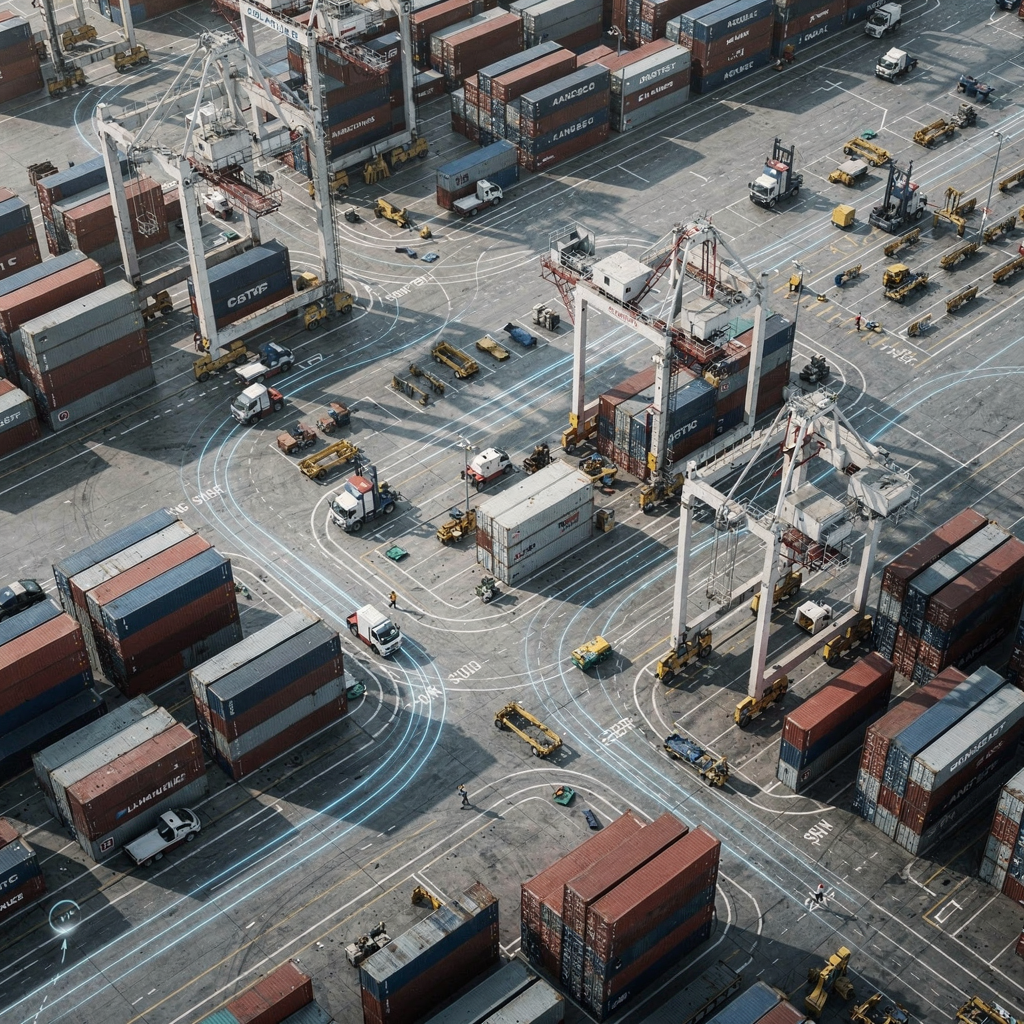
Future-Proofing terminal operating with efficiency across networks
Resilience should guide future investments. A resilient architecture keeps core cargo functions running even if the fleet control layer is offline. By design, the TOS can continue to manage bookings, manifests and billing while reduced automation modes handle essential container handling. This separation minimises the impact of a fleet-controller outage on daily operations, and it supports rapid recovery.
KPIs must evolve to reflect multi-terminal and network-level performance. Measure not only moves per hour but also container availability, yard balance, and cross-terminal throughput. Define measurable targets for operational efficiency that look beyond local crane rates to include downstream effects on the supply chain. Digital twins help here: they let planners simulate scenarios and test resilience strategies before real-world deployment. For research on AI and swarm coordination concepts that influence future designs, see the CNA report on AI, Robots, and Swarms.
Emerging trends will shape how terminals upgrade. Edge computing brings computing power closer to cranes and AGVs so that decision latency drops. Swarm intelligence enables coordinated fleets that share goals and adapt to queue patterns. Digital twin technology and big data models support rapid retraining and provide the operational data needed for robust machine learning. Together, these trends allow the terminal to optimise across networks and to reduce inefficiency in real time.
Finally, the business value is clear. A modular, decoupled design reduces vendor lock-in, shortens time-to-value for new automation features, and improves transparency and visibility across the yard. Terminals that invest in these capabilities can expect better utilisation, fewer rehandles, and steadier performance across shifts. For organisations that want to explore simulation and RL integrations, our work on reinforcement learning for port operations outlines how simulation-led training can deliver safe, high-impact optimisation without lengthy historical data requirements.
FAQ
What does it mean to decouple fleet control logic from a TOS?
Decoupling means separating the decision-making that controls vehicles and cranes from the core terminal operating system. The TOS remains the system of record for manifests and vessel planning, while a specialised fleet controller executes high-frequency equipment moves and allocation.
What operational gains can terminals expect from decoupling?
Terminals can expect gains in equipment utilisation and reduced downtime, and measured improvements include reports of up to 30% higher equipment utilisation and reduced downtime by around 15%. These benefits arise from local optimisation and faster reaction to berth and yard events.
How do middleware and APIs help in a decoupled design?
Middleware provides buffering, transaction guarantees, and protocol translation so that the fleet controller and TOS can exchange critical data reliably. APIs define stable interfaces so that vendors and external systems can integrate without deep customisation.
Is security harder with a distributed architecture?
Security becomes more important but remains manageable. Use segmented networks, mutual TLS, role-based access controls and audit trails. Regular testing and patching are essential to protect critical data and control channels.
Can reinforcement learning work without historical data?
Yes. Reinforcement learning can be trained in a digital twin environment to generate experience, and then the learned policy can be safely deployed with operational guardrails. This avoids dependency on large historical datasets and helps overcome data gaps.
Will a decoupled system cause more downtime during upgrades?
No. One of the main benefits is the ability to update the fleet controller independently, which reduces the need for TOS downtime. Independent deployment cycles mean less risk to day-to-day operations during upgrades.
How does this approach affect planner roles and control rooms?
Planners and terminal staff shift from firefighting to overseeing policy and KPIs, and control rooms gain clearer dashboards and audit trails. This raises transparency and supports better decision-making in daily operations.
What are the first steps for a terminal exploring decoupling?
Start with a modular data architecture and simple APIs. Deploy a sandbox digital twin to test strategies and to validate measurable outcomes before live rollout. Simulation-led pilots reduce risk and demonstrate business value.
How does decoupling support multi-terminal networks?
Decoupled controllers and shared data models allow terminals to coordinate across networks without centralising every decision. This enables better allocation of resources and improves cross-terminal throughput and resilience.
Where can I learn more about simulation and deployment options?
Explore resources on simulation tools, case studies and reinforcement learning integration to see how pilots have been run and measured. For practical examples, start with simulation tools for berth scheduling and our reinforcement learning studies that show safe deployment paths.
our products
 stowAI
 stackAI
 jobAI
jobAI
Innovates vessel planning. Faster rotation time of ships, increased flexibility towards shipping lines and customers.
Build the stack in the most efficient way. Increase moves per hour by reducing shifters and increase crane efficiency.
Get the most out of your equipment. Increase moves per hour by minimising waste and delays.
stowAI
Innovates vessel planning. Faster rotation time of ships, increased flexibility towards shipping lines and customers.
stackAI
Build the stack in the most efficient way. Increase moves per hour by reducing shifters and increase crane efficiency.
jobAI
Get the most out of your equipment. Increase moves per hour by minimising waste and delays.