
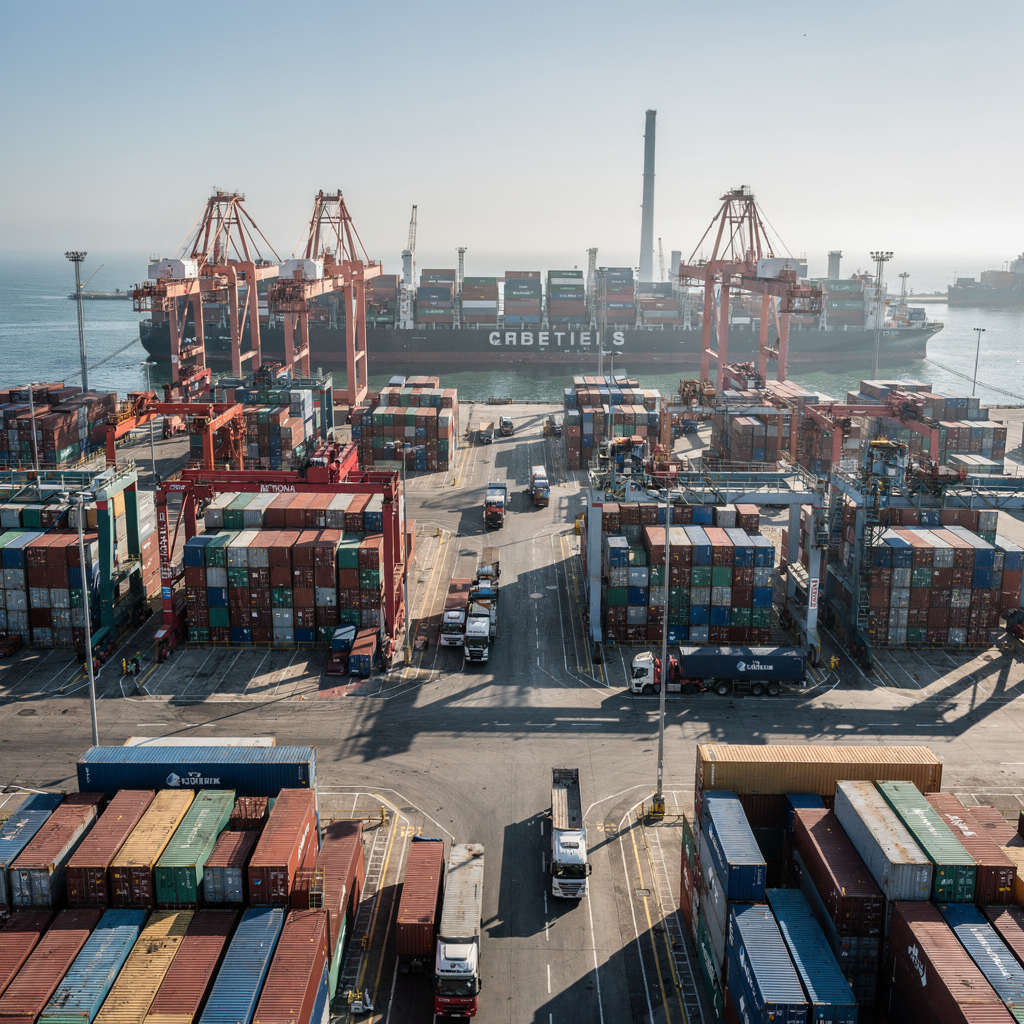
simulation in container terminal operations
Simulation plays a central role in modern container terminal planning. First, discrete event methods map queues, resource contention, and asset cycles. Next, agent-based approaches capture decisions made by individual cranes, trucks, and yard planners. Then, system dynamics shed light on feedback loops and aggregate flows. Together these three families form a set of tools that helps planners evaluate schedules, layout changes, and investment choices. For example, discrete event models represent quay moves as a sequence of events, and agent-based models represent yard drivers as decision makers. This mix of techniques supports analysis of CONTAINER TERMINAL OPERATIONS across busy days and rare disruptions. In practice, model builders combine methods to balance detail and run-time. AnyLogic is notable because it supports discrete event, agent-based, and system dynamics in a single environment, which helps teams switch perspectives quickly AnyLogic: Simulation Modeling Software Tools & Solutions.
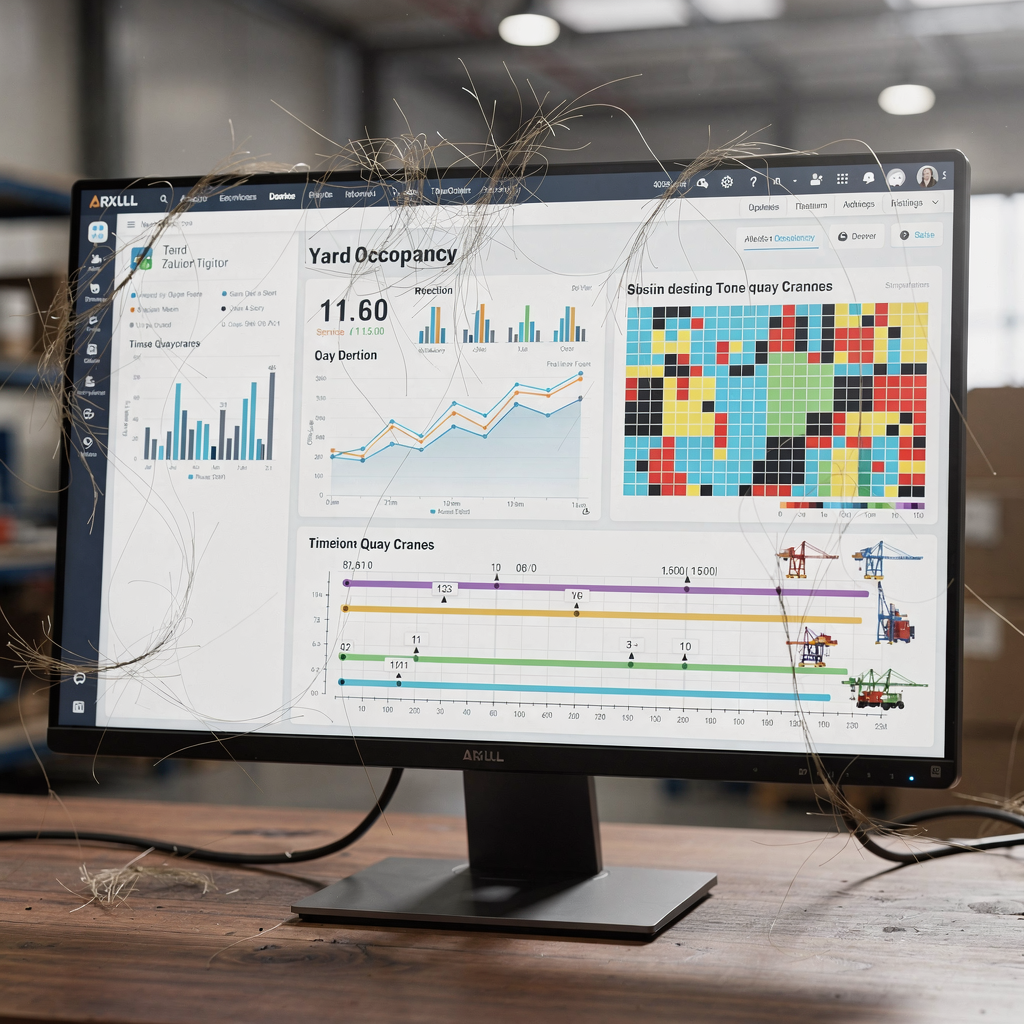
Simulation is used to enhance throughput and to reduce delays. For instance, graph-theory based work shows reductions in maximum completion times by up to 25% when truck schedules are optimized and conflicts are resolved Collaborative optimization of truck scheduling in container terminals. Also, traffic-focused simulation can lower port congestion by around 18% when gate flows and truck arrivals are smoothed Traffic Simulation Model for Port Planning and Congestion Prevention. These numbers matter to operators because delays translate to demurrage, missed vessel windows, and higher operating costs. In yard management, simulation helps visualize stacking rules, reshuffles, and occupancy patterns. In addition, model runs can test rail interaction assumptions, such as batch arrivals of railcars, and the impact of railcar handling sequences on yard throughput. Planners who need practical guidance can read our step-by-step guide to how to simulate container terminal operations, which covers inputs, calibration, and validation. Finally, combining simulation with scenario testing supports robust strategy selection for both short-term operations and long-term layout or investment choices.
Key features of simulation software for terminal planning
Effective simulation software must offer a set of core capabilities. First, multi-method modeling helps when systems are complex. Tools that blend discrete event and agent behavior let teams capture both resource schedules and local decision rules. AnyLogic and Arena are examples where multi-method support provides flexibility and depth; writers note that AnyLogic’s multi-method approach enables detailed study of interactions and resource allocation “AnyLogic’s multi-method simulation approach enables terminal planners”, and Arena has been used from single-dock studies to large terminal projects Arena Simulation Software in Port & Terminal. Second, deep process mapping is essential. A good application maps crane cycles, truck turn times, berth arrivals, and yard moves. That lets planners evaluate crane scheduling, truck pooling, and berth sequencing with confidence. Third, integration with live telemetry and GIS enhances realism. When simulation software ingests TOS messages and yard telemetry it can reproduce real-world variability and validate scenarios against recent data. For readers who manage Terminal Operating Systems, our comparison of TOS vs simulation is a useful reference and shows how simulation complements TOS planning TOS vs simulation differences explained.
Other features to evaluate include 3D visualisation for stakeholder buy-in, batch-run capabilities for statistical confidence, and support for custom rules or automation logic. For example, 3D views help operators visualize quay and yard interactions, and batch runs let planners quantify confidence intervals on turnaround metrics. Many terminals also need modules for intermodal connections and rail scheduling; these require the software to model rail arrival patterns, railcar dwell, and marshalling. Finally, look for extensibility so simulation tools can integrate bespoke agent controllers, such as reinforcement learning agents. Our company uses simulation to train RL agents against explainable KPIs, and that combination of a digital twin and simulated training delivers policy improvements without relying only on historical data. For guidance on enterprise tools, see our review of enterprise simulation tools for port logistics.
Drowning in a full terminal with replans, exceptions and last-minute changes?
Discover what AI-driven planning can do for your terminal
Building a model and prediction of throughput and delays
Building a robust model starts with good inputs. First, collect vessel schedules, crane cycle times, truck arrival patterns, gate throughput, and yard rules. Second, transform that data into a calibration dataset and define logic for crane assignments, truck sequencing, and yard placement. Third, validate the model by replaying recent operational days and comparing key metrics. Validation ensures the model reflects real-world behaviour and supports credible prediction. For prediction, common targets include dwell time, queue lengths, and overall turnaround. Predictive techniques range from deterministic calculation to stochastic replication. For example, Monte Carlo runs help quantify variability in service times, and discrete event sampling produces distributions of delay. Use of statistical outputs allows planners to compare alternatives using quantifiable metrics.
When forecasting throughput and delays, measure the right KPIs. Focus on turnaround time, equipment utilization, and moves per hour. Studies show that integrated simulation and decision frameworks can improve equipment utilization by 12–15% when combined with multi-criteria decision methods An integrated simulation and AHP-entropy-based NR-TOPSIS. Also, simulation-driven scheduling reduced container handling time up to 15% in research using specialized terminal tools Modeling and simulating processes in optimizing port activities. To produce reliable predictions, run many replications and then assess both mean and tail behaviour. That lets planners anticipate extreme congestion and evaluate mitigation strategies. For a practical walkthrough on capacity and planning models see our resource on terminal capacity planning software. Finally, include sensitivity testing for key uncertainties. Test variations in vessel arrival, gate surges, and equipment failure. This approach helps to quantify trade-offs between quay productivity and yard congestion and to make strategic recommendations for investment or operational change.
case studies of port simulation software deployments
Real-world deployments highlight how simulation tools deliver measurable gains. FlexTerm has been used in several European ports to assess crane sequencing and yard handling. In user feedback, operators say that FlexTerm “provides a realistic and detailed simulation environment that closely mirrors real-world terminal dynamics” which improved decision making for yard and crane schedules FlexTerm user feedback. Reported outcomes include up to a 15% reduction in container handling time when crane and truck schedules were optimized with the model. Next, Arena was applied in a major Asian terminal to test layout changes and resource sharing, and the implementation yielded improvements in throughput by roughly 15% through better resource scheduling and congestion management Arena case note. These improvements translated into faster vessel service, and operators could test alternative quay assignments before committing to costly infrastructure changes.
Lessons learned are consistent across deployments. First, short simulation cycles and focused scenario sets produce actionable insights faster than overly detailed, one-off models. Second, layout changes often deliver more value than small operational tweaks when congestion is structural. Third, modelling must include human workflow and shift patterns to avoid optimistic performance estimates. For terminals exploring digital twin or optimisation pilots, combining simulation with decision frameworks such as AHP-entropy and NR-TOPSIS can help choose layouts and facilities with quantified trade-offs layout selection research. Operators also benefit from tools that integrate with their TOS. For practical guidance, our article on terminal optimisation digital twin explains how to link simulation outputs to operational control and continuous improvement. Finally, we observed that using simulated training to develop AI policies, rather than only fitting past data, produces more robust strategies when vessel mixes change or unexpected disruptions occur. This approach is central to reinforcement learning pipelines that train in a digital twin before deployment.
Drowning in a full terminal with replans, exceptions and last-minute changes?
Discover what AI-driven planning can do for your terminal
Comparative analysis of terminal simulation software
Choosing the right tool requires balanced evaluation. AnyLogic, FlexTerm, and Arena each have strengths and weaknesses. AnyLogic offers great flexibility and supports multi-method simulation modeling, which makes it strong for custom or complex projects. FlexTerm is focused on terminal workflows and often gives fast returns for yard and crane scheduling studies. Arena is known for robust discrete event engines and wide adoption across ports and terminals. One review notes that “Arena’s simulation capabilities have proven invaluable in identifying bottlenecks and testing terminal layout changes before physical implementation” which reflects its adoption in large projects Arena quote.
Scalability is a key factor. AnyLogic scales well for multi-block, multi-terminal networks, and it supports co-simulation and custom extensions. FlexTerm can be quicker to model for single terminals but may require customization for non-standard rules. Arena scales across enterprise projects and integrates with common data sources. Ease of use varies: some teams prefer GUI-based mapping in FlexTerm and Arena, while others seek the scripting power of AnyLogic for advanced tactics. Customisation and integration also matter. Evaluate whether the vendor supports APIs to connect to your TOS and telemetry. For readers comparing TOS and simulation interactions, our guide on simulation and optimisation tools for TOS covers common integration patterns. Cost-benefit insights are often project-specific. However, industry papers report efficiency gains such as 10–20% better throughput from better resource scheduling when simulations informed the changes throughput improvement. When choosing terminal simulation software, consider scalability, ease of modelling, and the ability to run many scenarios quickly. Also, assess whether the vendor offers simulation services or training so internal teams can expand capability over time.
industry optimisation process and future trends to simulate terminal operations
The industry is moving from static planning toward continuous optimisation. One emerging trend is combining simulation with multi-criteria decision methods like AHP-entropy-based NR-TOPSIS to evaluate layout and facility choices. Such hybrid workflows help quantify trade-offs between quay productivity and yard congestion AHP-entropy NR-TOPSIS study. Another trend is the integration of AI-driven prediction and digital twin frameworks. Reinforcement learning agents can be trained in a simulated digital twin to produce policies that adapt to unseen vessel mixes and disruptions. Our company uses this approach: we spin up a digital twin, train RL agents, and then deploy agents with operational guardrails; this produces consistent gains in fewer rehandles and higher crane utilization without relying solely on historical data.
Automation and smart port ecosystems will require simulation to evaluate automated vessel scheduling, remote crane operation, and automated stacking cranes. Simulation tools will need to model automation dynamics and human-in-the-loop decision points. Additionally, AI-based prediction models will be used to forecast arrivals and gate surges, and then the simulation will evaluate mitigation strategies. For longer-term planning, simulation supports development options and investment choices by quantifying benefits under different demand scenarios. Planners should also expect more cloud-native simulation services and co-simulation with traffic models and rail planners, which will help assess intermodal flows and railcar sequences. Lastly, simulation will be central to tests that visualize outcomes in 3D and to quantify system resilience. For teams planning pilots, our resources on terminal decision support simulation and on enterprise simulation tools for port logistics explain how to combine simulation, AI, and operations into deployable strategies. The future will demand flexible modeling, rapid scenario evaluation, and the ability to turn simulated policies into operational controls that reduce delays and identify bottlenecks.
FAQ
What is the best way to choose simulation software for a busy terminal?
Start by defining the objectives such as reducing delays, improving quay productivity, or evaluating layout changes. Then assess tools for multi-method modeling, integration with your TOS, and the vendor’s support for scenario runs and training.
How does simulation help reduce vessel waiting time?
Simulation lets planners test berth allocation, crane schedules, and yard flows before changes are made. By quantifying the impact of alternative berth and quay assignments, simulation can cut waiting and improve berth utilization.
Can simulation work with my Terminal Operating System?
Yes. Most enterprise tools support APIs and EDI to ingest TOS messages and telemetry. For integration patterns and examples see our guidance on simulation and optimisation tools for TOS simulation and optimisation tools for TOS.
How accurate are predictions from terminal models?
Accuracy depends on input data quality, model fidelity, and validation. Running many replications and validating against recent operational days improves confidence in predictions and helps quantify uncertainty.
Are there ready-made port simulation software solutions for quick studies?
Yes. Specialist tools like FlexTerm are suited for rapid terminal studies and can produce quick wins in crane and truck schedules. Larger platforms like Arena and AnyLogic offer more flexibility for custom projects.
What metrics should I track when running scenario analysis?
Focus on turnaround time, equipment utilization, dwell and queue lengths, and moves per hour. Also track tail metrics to understand rare but costly congestion events.
Is it possible to train AI controllers in simulation?
Absolutely. Reinforcement learning agents can be trained against a digital twin to learn policies without relying on historical data. This approach enables cold-start deployments and robust responses to novel conditions.
How do I validate a model before trusting its recommendations?
Validate by replaying recent operations, comparing KPIs, and conducting sensitivity tests. Calibration against multiple days and including human workflow rules enhances model credibility.
Can simulation help with rail and intermodal planning?
Yes. Simulation can model rail arrival patterns, marshalling, and gate interactions to assess intermodal throughput and the impact on yard operations. This helps planners optimize intermodal connections.
What are common pitfalls when starting simulation projects?
Common pitfalls include excessive model detail that slows iteration, lack of clear objectives, and poor integration with operational data. Begin with focused scenarios, validate early, and iterate toward more complex studies.
our products
 stowAI
 stackAI
 jobAI
jobAI
Innovates vessel planning. Faster rotation time of ships, increased flexibility towards shipping lines and customers.
Build the stack in the most efficient way. Increase moves per hour by reducing shifters and increase crane efficiency.
Get the most out of your equipment. Increase moves per hour by minimising waste and delays.
stowAI
Innovates vessel planning. Faster rotation time of ships, increased flexibility towards shipping lines and customers.
stackAI
Build the stack in the most efficient way. Increase moves per hour by reducing shifters and increase crane efficiency.
jobAI
Get the most out of your equipment. Increase moves per hour by minimising waste and delays.