
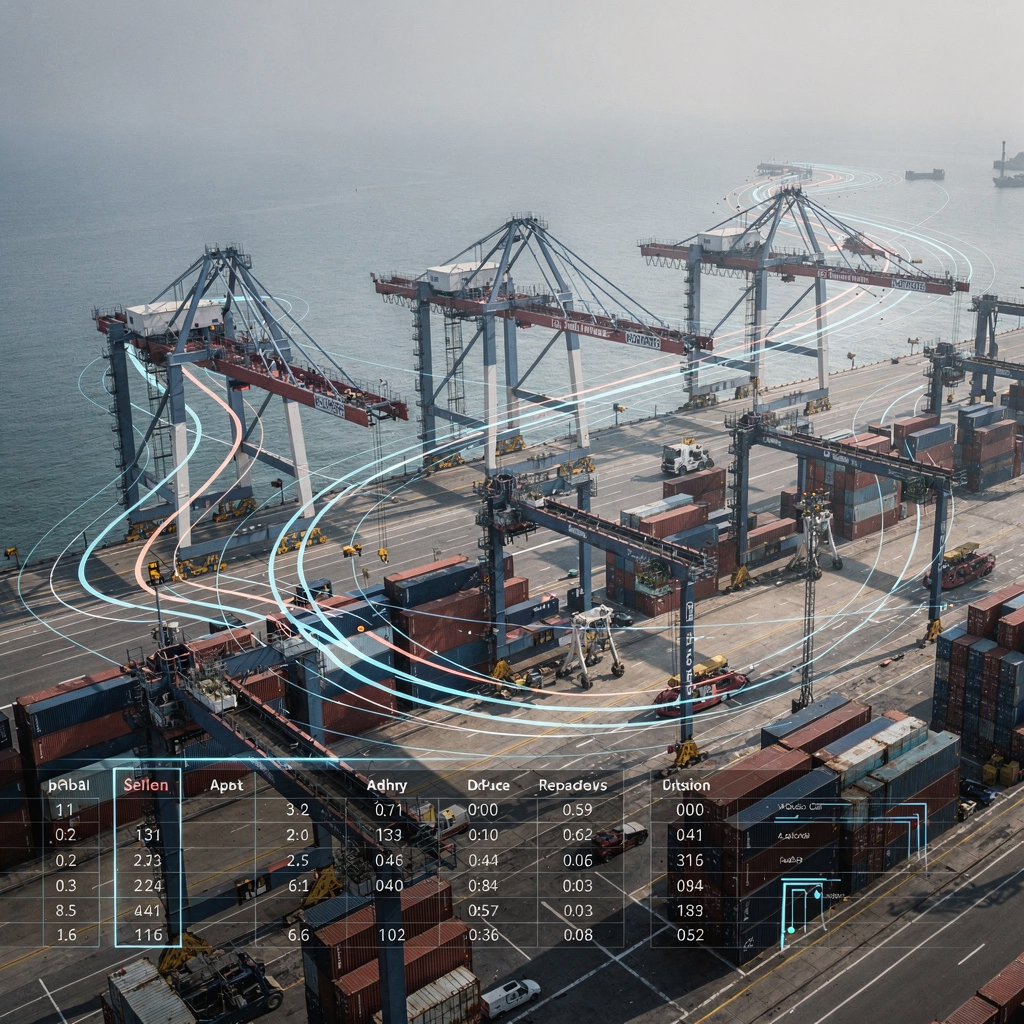
container terminal: The Rise of Automated Crane Split Planning
Crane split planning allocates work among multiple cranes to raise throughput and cut idle time in a modern container terminal. It maps tasks, timings, and positions so that each crane works in sync. This process sits at the heart of a fully automated container terminal that aims to improve the efficiency of loading and unloading operations. Recent market analysis shows the automated container terminal market exceeded USD 10.2 billion in 2023, and it is projected to grow at a CAGR of about 7% through 2032 (market estimate). That growth reflects higher global trade and surging e-commerce volumes, plus pressure to reduce operational cost at busy ports.
Key drivers include increased container movements and the need to reduce the number of delays at berths. Terminal operators face labour shortages and tighter margins. They therefore adopt systems that automate assignment, coordination, and reporting. Advanced planning tools and optimization algorithms now integrate with a terminal operating system, or TOS, to create executable schedules. These systems help terminal managers balance berth allocation, yard operations, and quay crane scheduling problems. The result is faster container transfers and fewer rehandles. For a deep technical view on container stacking and yard choices, see our guide on container stacking optimization (container stacking techniques).
Automation also supports resilience. For example, digital twins let planners test disruption scenarios before live deployment. Discrete event simulation and greedy randomized adaptive search procedure trials let teams explore trade-offs between quay productivity and yard density. This mix of techniques helps to minimize the number of shifters and to optimize the arrangement of containers across the yard. Operators that automate processes see steadier performance across shifts and less dependence on single expert planners. The change lifts overall terminal performance, and it helps ports remain competitive as vessel sizes and call patterns evolve.
crane: AI-Driven Scheduling and Conflict Avoidance
AI assigns tasks to multiple cranes in real time. Reinforcement learning and other adaptive methods predict future arrivals and adjust assignments fast. In practice, AI reduces idle time and avoids conflicts by forecasting where each crane will be minutes ahead. This approach substitutes static rules with policies that learn through simulation. Loadmaster.ai trains RL agents in a digital twin so they learn to balance quay moves with yard flow and gate peaks. The agents then suggest allocation strategies that a human planner can approve. This closed-loop design improves crane productivity while keeping operational cost in check.
Machine learning models analyze container info and vessel planning details. They use those inputs to generate sequences that minimize unnecessary moves. That reduction cuts rehandles and lowers driving distances for internal vehicles. The software also helps with crane double moves when a pair of cranes must coordinate for a heavy lift. Operators get a clear plan so that each crane knows the next target. For real-world examples of synchronized automation, see the overview of autonomous container terminal operations (AI Autonomous Container Terminal Operations).
Conflict avoidance matters for safety and throughput. The planner sees simulated crane paths and can adjust timing to prevent overlap. Systems that integrate internet of things telemetry and a modern control system deliver the necessary visibility. IoT sensors report crane positions, loads, and motor health. Predictive maintenance then schedules service before failures cause delays. Together, these elements support robust terminal operation and improve terminal productivity. Terminal operators who adopt AI-driven schedules reduce downtime and speed vessel turnarounds.
Drowning in a full terminal with replans, exceptions and last-minute changes?
Discover what AI-driven planning can do for your terminal
terminal planning: Digital Twins and Simulation in Crane Allocation
Digital twin technology simulates crane behavior, yard flows, and vessel interactions. Planners use the twin to run scenario tests before they change live schedules. This method helps to analyze throughput under peak demand and to measure resilience when a crane goes offline. Discrete event simulation models the sequence of moves and predicts the impact of different crane splits on overall performance. Terminal planning that uses both digital twins and DES gains insight without risking live operations.
Simulation also supports sustainability. Optimized crane paths mean fewer empty moves, and that reduces energy use and emissions. Terminals can therefore improve their environmental footprint while they raise productivity. Several academic and industry studies illustrate the sustainability gains that come from optimized crane allocation (digital twin and sustainability research). These results make a clear case for investment in advanced planning and testing tools.
Integration is crucial. A digital twin must mirror the TOS and vessel plan, and it must accept updates from yard planning modules. Loadmaster.ai’s approach builds a sandbox twin that trains agents on KPI-driven objectives. This setup lets the AI learn policies without relying on historical data. That capability matters for terminals with little clean history. It also helps to protect institutional knowledge when senior staff leave. For more on ASC scheduling and how automated stacking cranes fit into terminal strategy, see our piece on ASC job scheduling (ASC job scheduling).
stowage plan: Seamless Integration with Yard and Quay Operations
A stowage plan guides how a vessel will be loaded and where containers will stow in the bay. The plan must match yard planning and remaining berth time. When planners align the stowage plan with terminal job sequences, they reduce the number of rehandles at the quay. Automated stacking cranes and AGVs then execute moves that mirror the stow. That alignment speeds loading and unloading operations and reduces dwell time for inbound containers.
Effective stowage planning also addresses the container ship stowage problem and the container ship loading problem. These problems focus on weight distribution, center of gravity, and the sequence of loading at the quay. Planners use advanced planning tools to place containers so the vessel remains stable and so the next port of call is served efficiently. Solving these constraints helps to minimize the number of extra reshuffles in the yard. It also improves the arrangement of containers to shorten handling times when the vessel arrives at its destination port.
Automation ties the stowage plan to yard operations and terminal operating software. A strong TOS handshake enables the exchange of container locations, ETA updates, and gate bookings. That exchange keeps internal transport jobs flowing and helps to reduce empty travel. For deeper discussion on reducing fuel and optimizing equipment moves in yard operations, review our article on saving fuel in terminal operations (reducing fuel consumption).
Drowning in a full terminal with replans, exceptions and last-minute changes?
Discover what AI-driven planning can do for your terminal
control system: Real-Time Data and Automation in Port Operations
Modern control systems ingest telemetry from cranes, trucks, and gate scanners in real time. They feed that data into orchestration layers and TOS modules. The flow lets dispatchers and JobAI-style agents coordinate moves with up-to-the-minute accuracy. Predictive analytics flag likely breakdowns, and predictive maintenance acts before faults affect operations. This approach reduces unexpected downtime and keeps quay crane operations smooth.
IoT devices report motor currents, sway, and position. That internet of things visibility helps to prioritize maintenance without disrupting active cranes. The control system also maintains safety constraints so that no plan violates lifting limits or spatial separations. Terminal managers can therefore enforce guardrails while AI searches for better policies. The output is measurable: fewer rehandles, shorter driving distances, and improved crane productivity. For more about measuring ROI from AI deployments and the balance between quay and yard, see our ROI research on AI in terminals (measuring ROI of AI).
Standardisation of processes in the control system reduces human error. The TOS and the automation system coordinate to deliver consistent execution across shifts. That consistency reduces firefighting and lets planners focus on strategic improvements. The control system thus supports a shift from reactive to proactive terminal management. Operators see lower operational cost and steadier outcomes even when vessel mixes change quickly.
smart port: Future Outlook and Market Growth in Maritime Logistics
Industry experts note that AI in crane split planning raises terminal throughput while protecting yard health. A senior operator said that AI integration “has transformed our operational capabilities, allowing us to handle higher volumes with greater precision and less downtime” (senior operator quote). Such endorsements show why investment continues across regions. Market forecasts project steady expansion through 2032 and beyond, with new investment in emerging hubs that need smarter intermodal links.
Environmental benefits also drive the change. Smarter container handling reduces fuel use and emissions. Terminals that adapt see lower energy per move and fewer excess gantry cycles. Supply chain stakeholders then gain more predictable ETAs and decreased dwell at gates. For further reading on sustainable port operations and AI use cases, check our sustainable port operations guide (sustainable port operations).
Looking ahead, terminals will combine adaptive agents, better TOS integrations, and more automated container handling equipment. These changes make fully automated workflows more attainable. The aim will remain to improve terminal performance, protect investments, and speed vessel turnarounds. Teams that adopt closed-loop advanced planning will reduce the number of rehandles and will improve the operation of quay cranes. That progress supports resilient supply chains and a smarter port network that serves global trade.
FAQ
What is crane split planning?
Crane split planning divides quay work among available cranes to increase efficiency. It assigns sequences to each crane so moves are balanced and collisions are avoided.
How does AI improve crane scheduling?
AI forecasts demand and tests many assignment options quickly. It then selects schedules that reduce idle time and lower rehandles.
What is a digital twin and how is it used in terminals?
A digital twin is a virtual model of the terminal that mirrors equipment and flows. Planners use it to simulate scenarios and to validate changes before live execution.
Can automated stacking cranes integrate with crane split plans?
Yes, ASCs can operate under coordinated plans that align yard picks with quay timing. Integration shortens container transfer intervals and improves yard balance.
What role does the TOS play in these systems?
The TOS acts as the transactional backbone for bookings and moves. It exchanges container info and job lists with optimization modules to keep execution consistent.
Is predictive maintenance necessary for automated terminals?
Predictive maintenance helps avoid unexpected downtime and keeps cranes running. It uses IoT data to schedule service before faults occur.
How do terminals measure the benefit of automation?
Terminals track metrics such as moves per hour, rehandles, and gate dwell time. They often measure energy per move and operational cost to judge ROI.
Does automation replace all human operators?
No. Automation reduces routine tasks and shifts staff focus to supervision and exception handling. Human expertise remains important for strategic decisions.
What is the quay crane scheduling problem?
The quay crane scheduling problem concerns sequencing and allocation of crane tasks to maximise throughput. Solving it requires balancing load, safety, and berth timing.
How do AI agents handle new or rare scenarios?
Reinforcement learning agents train in simulated scenarios to learn robust policies. That method prepares them for rare events without relying entirely on historical data.
our products
 stowAI
 stackAI
 jobAI
jobAI
Innovates vessel planning. Faster rotation time of ships, increased flexibility towards shipping lines and customers.
Build the stack in the most efficient way. Increase moves per hour by reducing shifters and increase crane efficiency.
Get the most out of your equipment. Increase moves per hour by minimising waste and delays.
stowAI
Innovates vessel planning. Faster rotation time of ships, increased flexibility towards shipping lines and customers.
stackAI
Build the stack in the most efficient way. Increase moves per hour by reducing shifters and increase crane efficiency.
jobAI
Get the most out of your equipment. Increase moves per hour by minimising waste and delays.