
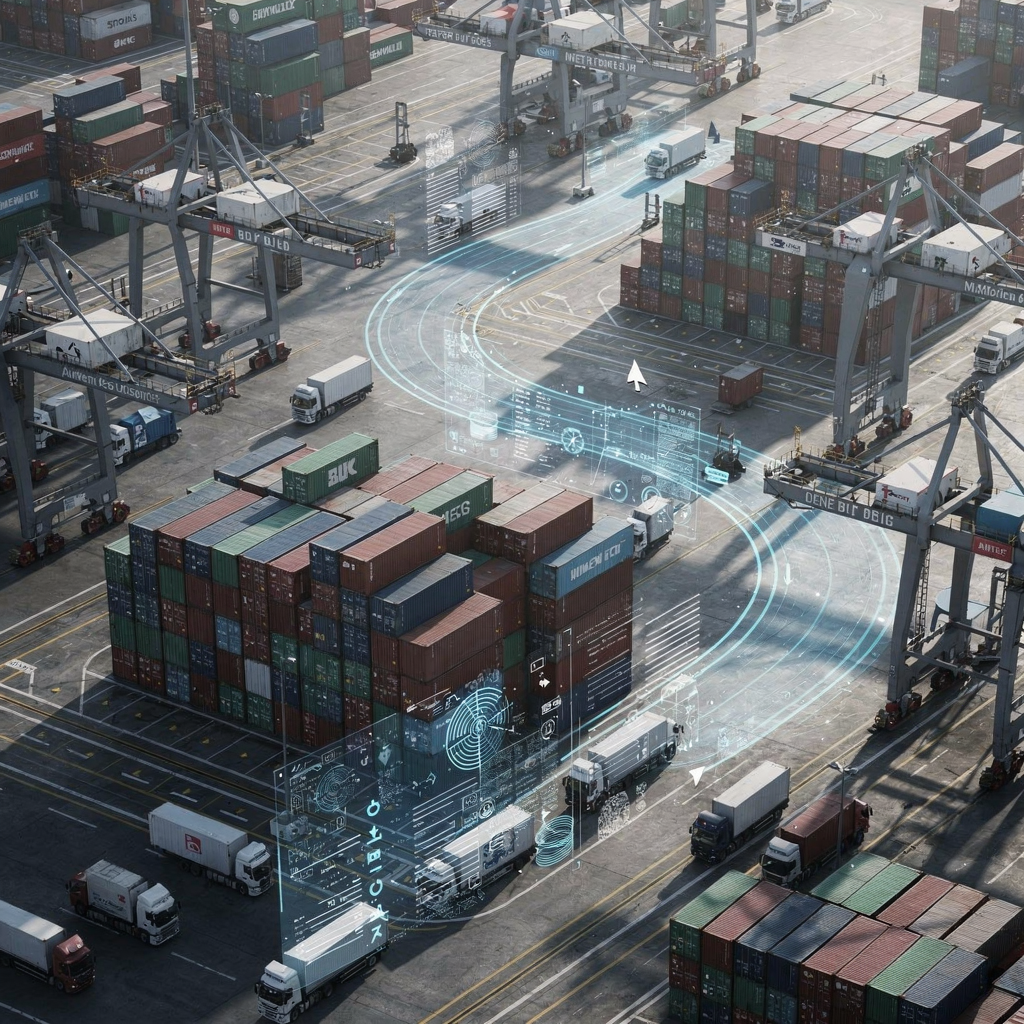
port logistics and operational management in ports
Port logistics teams manage complex flows of container traffic every day. First, planners juggle vessel arrival lists, gate windows, and yard layouts. Then, yard strategists assign blocks, and operators steer yard cranes and trucks. These tasks shape the core of port management and determine throughput, schedule adherence, and operational efficiency. Traditional port methods rely on rule-based systems and planner experience. However, those approaches struggle when container volumes spike or when a shipping lines change vessel mixes. For example, planners often firefight changes instead of planning ahead, which creates extra rehandles, longer driving distances, and uneven workloads for operators.
Key performance indicators include yard occupancy, handling time, vessel turnaround and quay productivity. These KPIs show when a terminal works well and when it needs attention. Yard occupancy ties directly to yard space and container dwell. Handling time affects quay productivity and the speed that cargo leaves the terminal. Vessel turnaround connects to the broader supply chain and impacts shipping lines. A single missed schedule can cascade into delays across hinterland links and reduce overall port throughput.
Rule engines and static heuristics cannot easily balance many objectives at once. They can protect quay cranes at the expense of yard congestion. They can also optimize past choices rather than explore new plans that improve terminal efficiency. This makes performance inconsistent across shifts and dependent on individual experience. By contrast, modern approaches that combine simulation and AI offer dynamic strategies that can adjust in real-time, predict container flows, and reduce rehandles. For more on moving from dated rules to modern control, see this guide on from rule-based planning to AI optimization in port operations.
Operators and terminal operators need tools that help with yard management, not replace their judgement. Additionally, planners need better decision support to reduce delay and improve schedule reliability. The traditional port model leaves hidden costs in the form of extra moves, idle equipment, and lost gate throughput. Using a combination of simulation techniques and explainable AI, port operators can reduce that waste. Loadmaster.ai, for instance, trains agents inside a digital twin so planners can test new strategies safely before live deployment, and the approach reduces dependence on historical data that often carries past mistakes.
ai simulation with digital twin for container optimization
AI-driven simulation gives ports a sandbox to try new yard planning rules and to predict container flows. With a digital twin the yard mirrors real-time conditions, equipment status, and container placement. This lets planners see the likely result of choices before they commit. Simulation supports predictive analytics and enables policies that adapt when arrivals slip or gate peaks occur. In practice, a digital twin models yard cranes, trucks, gate lanes, and stack states so agents can learn to coordinate complex tasks.
Machine learning and reinforcement learning power the core decision models in the twin. Machine learning models detect patterns in container arrival profiles, while reinforcement learning explores long-term trade-offs between quay productivity and yard congestion. These AI systems train on millions of simulated decisions, so the model learns robust responses even with limited historical data. That approach avoids copying past mistakes, and therefore it can improve terminal efficiency from day one. If you want technical detail on starting with a simulation-first method, this resource on simulation-first AI for inland container terminal optimization is a practical read.
Simulation then becomes the testbed for optimization strategies. AI algorithms refine stacking policies, container allocation rules, and scheduling heuristics inside the twin. As a result, the terminal can optimize moves per container, reduce unnecessary reshuffles, and lower driving distances. Also, the twin feeds back real-time telemetry so models adapt to equipment faults or gate surges. Planners and operators can therefore experiment with different stowage mask patterns and measure the impact on handling operations, lead time, and throughput without risking live disruption.
Besides improving efficiency, simulation supports compliance and governance. For example, teams can validate operational rules and export audit trails for the EU AI Act or for terminal audits. A practical implementation often integrates with existing terminal operating systems; see how interfaces for data exchange can make that integration smoother in this article on interfaces for data exchange with existing port operations TOS. Finally, simulation reduces the need to rely solely on historical data, and it allows terminals to predict container volumes and allocate resources proactively while preserving operator control.
Drowning in a full terminal with replans, exceptions and last-minute changes?
Discover what AI-driven planning can do for your terminal
container terminal optimization through container stowage mask patterns
Stowage mask patterns codify how containers should stack and where they should sit to serve future moves. In a container terminal, these masks act as templates that guide container placement, protect weight limits, and reduce moves per container. Creating effective masks blends domain expertise with AI and machine learning. First, experts define constraints like container type, dwell, and crane reach. Next, AI explores mask variations in simulation to test trade-offs between quay productivity and yard congestion. The result is a set of masks that minimize reshuffles and improve space use.
AI algorithms tune these masks by searching policy space and by learning from simulated outcomes. Reinforcement learning agents evaluate policies against explainable KPIs so planners keep operational guardrails. As masks are validated, AI suggests container placement and container allocation that align with vessel calls and gate windows. When a mask protects containers likely to load soon, the terminal avoids costly restows. When a mask groups like-destination boxes, the terminal shortens intra-yard moves.
Quantitatively, studies and industry reports show meaningful gains. For example, AI-driven yard optimization can reduce handling times by up to 25%, which shortens vessel turnaround and raises throughput (source). Also, machine learning models that incorporate stowage mask patterns have demonstrated improved yard space utilization by roughly 15–20% (source). These figures matter for terminals that face high container volumes and limited expansion options, because better utilization defers costly real estate projects and increases cargo processing capacity.
To operationalize masks, terminal operators feed them into the TOS and use AI policies to guide execution. This approach supports container tracking and reduces container dwell. It also helps with container transshipment and export container handling by grouping likely moves. If you want a focused view of vessel planning that links to stowage choices, see container terminal vessel planning explained.
Finally, combining stowage masks with a digital twin lets the terminal validate new strategies safely. Teams can measure effects on container loading, yard crane sequencing, and gate throughput. The iterative loop of simulate, evaluate, refine ensures masks remain effective as vessel patterns change and as AI adoption grows.
yard management, yard cranes and yard crane scheduling for container stack optimization and schedule reliability
Coordinating yard cranes reduces moves per container and cuts idle time. Active yard management balances crane tasks across blocks so that no crane sits idle while its neighbor is overloaded. Good schedules align yard crane tasks with vessel arrivals and yard layouts. They minimize unnecessary travel and protect future plans. In practice, this means the yard strategist assigns containers to blocks that match planned crane cycles. The dispatcher then follows a schedule that maintains steady crane utilization and reduces delay.
Yard crane scheduling relies on a mix of rules and dynamic allocation. AI systems advise on job sequencing, lane assignments, and next-best-move decisions. These suggestions come from simulation-trained agents that understand the terminal’s layout and KPI priorities. They compute schedules that reduce crane interference and that optimize container stack order. As a result, terminals see fewer rehandles, lower driving distances, and higher crane moves per hour.
Schedule reliability improves when the yard integrates gate and quay data in real-time. A schedule that ignores gate surges risks creating bottlenecks. Conversely, schedules that adapt can protect vessel schedules and keep gates flowing. Industry data supports this: using AI for yard operations can cut delays and handling time, improving process efficiency according to a McKinsey survey that found operational gains up to 30% for companies applying AI to operations (source). Additionally, AI-driven yard optimization has been shown to reduce container handling times by as much as 25% (source), which directly supports on-time vessel departures.
Technically, yard crane scheduling often employs adaptive heuristics plus policy-driven AI. JobAI-style agents coordinate moves across quay, yard, and gate to cut wait times and keep equipment busy. This reduces the number of shifters and improves terminal efficiency. With better schedules, terminal operators and port operators can meet TOC targets and protect the quay during peak calls. For details on equipment responsiveness and integration, review this study on improving equipment responsiveness through PLC-integrated AI systems.
Drowning in a full terminal with replans, exceptions and last-minute changes?
Discover what AI-driven planning can do for your terminal
applications of ai in terminal operating and supply chain planning
Applications of AI span yard block assignment, resource allocation, and broader supply chain planning. AI-based decision support helps terminal operators choose the best yard block for inbound boxes, aligns container allocation with quay plans, and staggers gate appointments. These models use predictive analytics to forecast congestion and to recommend preventive action. They inform operator decisions while preserving human oversight and explainability.
Integration with terminal operating systems matters. When a TOS and AI exchange data smoothly, the terminal achieves seamless execution from planning to truck dispatch. APIs, EDI feeds, and telemetry links enable the digital twin to stay current and to update policies in near real-time. For practical guidance on integrating with existing TOS, see interfaces for data exchange with existing port operations TOS. This integration supports using simulation outputs directly in daily operations and reduces friction during go-live.
Upstream and downstream effects are substantial. Better container allocation at the terminal eases congestion on the hinterland, reduces truck idle time, and improves rail scheduling. The port becomes a more reliable node in the supply chain. AI also helps predict container volumes so shipping lines and carriers can plan capacity more accurately. These benefits extend beyond a single terminal and improve resilience for the overall port ecosystem.
AI capabilities here include predictive analytics, demand forecasting, and dynamic allocation. Machine learning models support short-term forecasts while reinforcement learning provides robust multi-objective control. For terminals considering a shift from historical models to simulation-trained agents, review the practical roadmap on terminal operations digitalization roadmap. The combination of simulation and live feedback helps terminals reduce empty container moves, cut fuel use, and lower emissions, which supports greener logistics and better port efficiency.
implementing ai for a smart port: benefits of ai for maritime container handling
Implementing AI starts with data collection and with clear KPI definition. First, inventory yard maps, equipment telemetry, and gate logs. Next, set weights for objectives like fewer rehandles, higher crane utilization, or shorter driving distances. Then, spin up a digital twin and train agents with reinforcement learning against those KPIs. This process produces policies that work from cold start and that refine online as the terminal runs live traffic.
Teams should use AI in a staged rollout. Begin with a pilot block, then scale to more blocks once the model proves safe and effective. Loadmaster.ai follows a similar path: create a sandbox digital twin, train StowAI, StackAI, and JobAI agents, and then validate outcomes before production. The result is measurable improvement in overall terminal metrics and stable performance across shifts.
Measurable benefits include lower fuel use, fewer moves, and reduced emissions. Studies show AI adoption in logistics is growing rapidly, with a projected AI CAGR above 40% through 2026 (source). Moreover, experts state that combining domain knowledge with artificial intelligence unlocks proactive planning and resilience; Vanessa Pérez Miranda highlights the transformative potential of combining AI with stowage knowledge: “AI technologies, when combined with domain-specific knowledge such as stowage mask patterns, enable ports to transition from reactive to proactive management” (quote).
Finally, the future of AI points toward fully autonomous yards and standardised platforms by 2030. Implementing AI will enable ports to coordinate movements across multiple terminals, reduce delay, and improve schedule reliability. While challenges remain in data integration and explainability, the benefits of AI reduces waste and raises terminal efficiency. For teams preparing for this shift, resources on digitalization and staged implementation and on brownfield versus greenfield automation explain practical steps and trade-offs.
FAQ
What is a digital twin and how does it help container terminals?
A digital twin is a virtual replica of a terminal that mirrors real-time yard layouts, equipment, and container states. It helps teams test scheduling and yard strategies safely, and it supports simulation techniques that predict outcomes before changes hit live operations.
How do stowage mask patterns reduce rehandles?
Stowage mask patterns define preferred stacking templates based on expected moves and dwell. They protect high-priority containers and group boxes with similar destinations, which reduces reshuffles and lowers handling operations.
Can AI improve vessel turnaround times?
Yes. AI can optimize quay-to-yard sequences and schedule yard cranes to minimize idle time, which helps ships depart on time. For example, AI-driven optimization has been shown to reduce handling times by up to 25% (source).
Do terminals need historical data to implement AI?
No. Reinforcement learning agents can train in a digital twin without using historical data. This allows terminals to start from a cold start and avoid copying past inefficiencies.
How does AI affect gate and hinterland performance?
AI improves container allocation and predicts peaks, which smooths truck flows and reduces gate congestion. That eases rail and road links and enhances the broader supply chain.
What role do yard cranes play in container optimization?
Yard cranes execute the stacking and reshuffle tasks that determine moves per container. Smart scheduling aligns crane tasks with vessel and gate schedules, improving utilization and reducing delays.
Is AI safe and explainable enough for regulators?
Yes, if implemented with constraints and audit trails. Systems that include explainable KPIs and guardrails support governance and make it easier to meet standards such as the EU AI Act.
How quickly can a terminal see benefits from AI?
Terminals often see gains during pilot deployments, because simulation-trained agents provide useful policies from day one. Performance improves further as models refine with live feedback.
Will AI replace human operators and planners?
No. AI supports and augments human decision-makers. It reduces firefighting and helps operators make faster, more consistent choices while preserving human oversight.
Where can I learn more about implementing AI in my terminal?
Start with practical resources on terminal digitalization and TOS integration. For example, see guides on integrating AI with existing systems and on simulation-first approaches to terminal optimization at Loadmaster.ai.
our products
 stowAI
 stackAI
 jobAI
jobAI
Innovates vessel planning. Faster rotation time of ships, increased flexibility towards shipping lines and customers.
Build the stack in the most efficient way. Increase moves per hour by reducing shifters and increase crane efficiency.
Get the most out of your equipment. Increase moves per hour by minimising waste and delays.
stowAI
Innovates vessel planning. Faster rotation time of ships, increased flexibility towards shipping lines and customers.
stackAI
Build the stack in the most efficient way. Increase moves per hour by reducing shifters and increase crane efficiency.
jobAI
Get the most out of your equipment. Increase moves per hour by minimising waste and delays.