
ai in container terminals: an overview
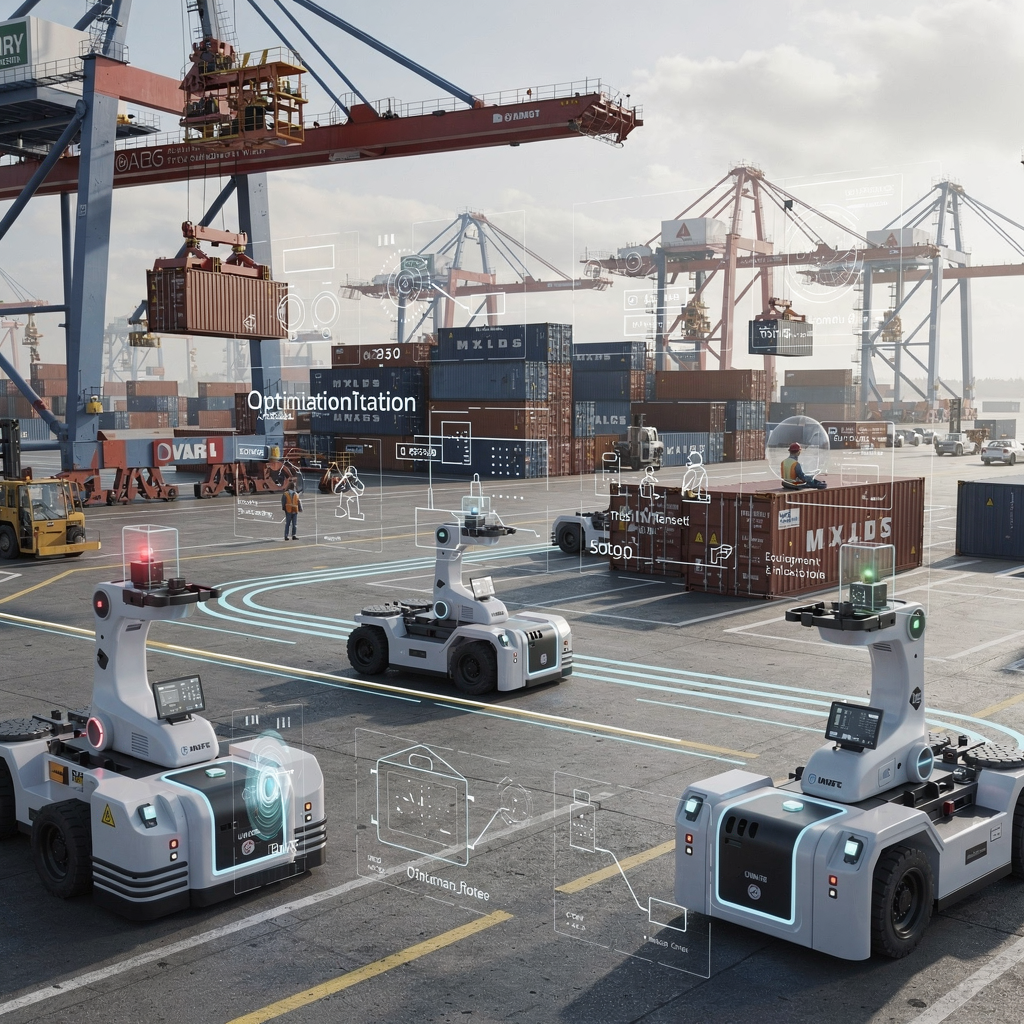
AI in container terminals refers to the use of advanced software, algorithms, and learning agents to manage equipment, plan moves, and react to disruptions in real time. AI sits alongside human planners and terminal operating systems. It helps teams and machines work toward the same KPIs, and it helps reduce firefighting during peaks. In modern maritime logistics the role of AI has grown rapidly. It now supports planning for quay cranes, automated guided vehicles, straddle carriers, and yard handlers. The mix of manual and automated processes makes the problem complex. Terminals must balance quay productivity, yard congestion, and driving distance. AI can weigh these trade-offs and propose executable plans. For example, studies using data from large ports have shown that AI-based scheduling can improve equipment utilization by up to 15–20% at some terminals Port of Antwerp productivity study. That translates to faster container throughput and lower cost per move. Terminals combining humans and machines face additional challenges. They must synchronize handoffs between an operator and automated container systems. AI provides consistent prioritization and fewer rehandles. It also predicts peaks in container demand and adapts resources. The application of AI in container environments ranges from simple forecasting to complex reinforcement learning agents that learn policies in simulation. These agents act when rules fail or when the future departs from past experience. AI improves resilience by handling vessel arrival shifts and sudden equipment failure. The technology also supports terminal operators with dashboards and explainable suggestions. For readers who manage a terminal, there are practical tools that integrate with your terminal operating systems and TOS APIs. If you want to learn more about how RL agents are trained for deepsea operations, see our detailed resource on reinforcement learning for deepsea container port operations reinforcement learning for deepsea container port operations. Overall, AI reduces idle time, raises throughput, and lowers operational costs while keeping the operator in the loop.
application of ai in container equipment pool optimization
Machine learning and data mining power demand forecasts for equipment pools. They analyze sensor streams, TOS logs, and vessel schedules to predict container demand and equipment load. These forecasts help terminals plan the right mix of quay cranes, automated guided vehicles, and straddle carriers. Simple supervised models forecast peaks in container volume. Advanced approaches use reinforcement learning to create policies that decide which equipment to assign, and when to reposition assets. Reinforcement learning is trained in digital twins. It evaluates millions of simulated scenarios and learns priorities that balance multiple KPIs. This avoids copying past mistakes and instead finds better strategies. In practice, dynamic scheduling algorithms reassign equipment as conditions change. They issue short-term commands and longer-term plans. The system can shift a crane from unloading to a critical straddle job within minutes. Predictive maintenance models also contribute to equipment pool optimization. By predicting faults before they occur, these models reduce downtime and lower maintenance costs. Terminals that implement predictive maintenance see fewer emergency repairs and steadier equipment availability. Data sources include RTOS logs, sensor feeds, and external vessel ETA updates. Clean, validated real-time data improves the accuracy of machine learning outputs. But not all terminals have ample historical data. That is a common pain point. Loadmaster.ai addresses this with sim-trained agents that do not require long historical logs. We spin up a digital twin and generate training experience. This cold-start approach delivers usable policies from day one, and then the AI refines itself on live feedback. The result is a closed-loop optimization where StowAI, StackAI, and JobAI cooperate to reduce rehandles and keep equipment busy. For more on stacking techniques that tie directly into equipment assignment, see our container terminal container stacking optimization techniques resource container stacking optimization. In short, application of AI in container equipment pools blends forecasting, dynamic scheduling, and predictive maintenance to optimize resource use and reduce delays.
Drowning in a full terminal with replans, exceptions and last-minute changes?
Discover what AI-driven planning can do for your terminal
ai and container handling: improving terminal operation efficiency
AI synchronizes manual and automated equipment to reduce delays and improve flow. Terminals with mixed crews often struggle to match quay crane pace with yard availability. AI systems bridge that gap. They coordinate crane sequences with yard placement and inland truck appointments. Studies show mixed terminals can reduce operational delays by 10–12% when AI coordinates cross-equipment job prioritization and schedules in real time Efficiency and productivity report. AI provides decision support for berth planning, yard routing, and job sequencing. The tools take into account human constraints, such as required breaks or operator certifications. They also respect equipment limitations and safety limits. Real-time decision support works from live feeds. The system ingests terminal operating systems data, equipment telemetry, and vessel ETAs. Then it offers recommended actions that an operator can accept or adjust. This reduces firefighting and lets planners focus on exceptions. Integration challenges remain. One challenge is data quality. Automated systems can produce noisy or unstructured streams, and sensors can fail in harsh environments. Strong data validation is essential. Human oversight is another necessity. Operators must trust the AI and understand its choices. Explainable outputs and audit trails help build that trust. Loadmaster.ai builds policies that operate within clear operational guardrails. Our approach emphasizes safe-by-design controls and explainable KPIs so terminal operators can audit decisions and comply with regulations. Finally, implementation must consider the terminal operating system and gateway integration. A robust implementation links the AI planning layer to the terminal operating system with secure APIs. For a technical discussion on decoupling fleet control from TOS logic, see our article on decoupling fleet control logic from TOS in terminal operations architectures decoupling fleet control logic from TOS. With the right integration, AI reduces truck wait, minimizes rehandles, and improves overall terminal operation efficiency.
ai technologies for maritime container terminal operations
Core ai technologies include neural networks, multi-agent coordination, and optimisation heuristics. These drive real-time control and planning in modern container terminals. Neural networks learn patterns in sensor feeds and TOS logs. Multi-agent systems coordinate multiple equipment units. They let cranes, AGVs, and stackers act as collaborators. Optimisation heuristics still play a role. They provide fast, explainable baselines that the AI can improve on. The range of ai technologies deployed in ports includes predictive maintenance models, demand forecasting, and reinforcement learning policies. Reinforcement learning agents learned in digital twins can surpass historical rule-based planners by testing non-intuitive strategies safely. For example, terminals that tried simulation-trained policies reported equipment utilisation gains of 15–20% in controlled studies Port of Antwerp data. Data inputs are diverse. They include sensor feeds, terminal operating system logs, yard cameras, and carrier EDI messages. These help predict container arrival patterns and container demand. For terminals with limited history, advanced AI can be trained in simulation first and refined online. This reduces dependency on long historical records. The approach supports rapid deployment in both automated container terminals and mixed operations. Safety-aware planning is important for high-hoist and heavy lifts. AI must respect operator safety and equipment limits. Loadmaster.ai published research on safety-aware AI planning for high-hoist operations to guide integrations with existing TOS and equipment telemetry safety-aware AI planning. For terminals seeking a modular path, explore our guide to terminal operating systems and integration patterns at the terminal operating system TOS resource terminal operating systems integration. Overall, these ai models improve scheduling, reduce idle time, and increase container throughput while allowing operators to keep control.
Drowning in a full terminal with replans, exceptions and last-minute changes?
Discover what AI-driven planning can do for your terminal
role of ai in container stacking at the container port
AI-driven stacking strategies change how terminals maximise yard density and limit reshuffles. Good stacking reduces unnecessary moves and protects future plans. AI looks ahead. It evaluates which containers to place where based on vessel stow plans, truck appointments, and expected container dwell time. This forecast container placement approach cuts rehandles. It also supports empty container repositioning plans and faster container retrieval when trucks arrive. In mixed manual/automated yards, AI recommends placements that ease human work and suit automated guided vehicles and straddle carriers. The comparison between manual and automated stacking shows trade-offs. Manual stacking can be flexible but depends on operator judgement and varies by shift. Automated stacking is consistent but needs precise planning. AI bridges the gap by generating plans that both humans and machines can follow. This reduces shift-to-shift inconsistency and preserves tribal knowledge. The quay crane assignment is tightly linked to stacking decisions. When stacks are balanced, quay cranes run at higher productivity and the number of shifters falls. AI also optimizes truck appointment systems to smooth gate peaks. Loadmaster.ai’s StackAI focuses on placement and reshuffles to balance the yard, minimize travel, and protect future plans, which yields measurable reductions in driving distance and rehandles. For a deeper dive into stacking technique trade-offs and simulation-tested approaches, see our container terminal container stacking optimization techniques guide container stacking optimization techniques. AI also contributes to gate-side decisions at container freight stations and supports inland container flows to reduce dwell time and lower congestion. Using ai planning alongside the terminal operating system and a port community system improves coordination with carriers and hinterland partners. Overall, role of AI in container stacking links quay planning to yard health and helps terminals achieve better moves per hour with fewer disturbances.
smart port logistics: modern container terminals automate and optimize
The smart port concept ties digital systems together to improve end-to-end port logistics. A smart port uses sensors, TOS, and AI to orchestrate flows across berth, yard, gate, and hinterland. This creates smoother container flows and faster container retrieval at scale. AI-based equipment pools are central to this idea. They enable the port to optimize container movements, container throughput, and gate processing. For example, intelligent job allocation reduces truck wait times and improves truck-turn time. Smart ports also tackle port congestion with predictive analytics and optimized appointment windows. Sustainability is part of the smart port agenda. AI helps reduce fuel consumption in yard operations through route planning and opportunity charging strategies for electric AGVs. The maritime industry now considers digitalization a lever for emissions reduction. Maersk emphasizes that digitalization and automation reduce emissions as operations shift to greener fuels Most Innovative Companies in Maritime 2025. Future trends point to increased automation, more advanced ai solutions, and tighter links to inland logistics. Terminals will adopt multi-objective control to balance quay speed with yard efficiency and gate throughput. Loadmaster.ai’s JobAI and StowAI are examples of AI that operate with guardrails, are cold-start ready, and integrate with a container terminal operating system or TOS via APIs. If you want practical examples of solving terminal congestion with predictive analytics, review our research on solving terminal operations congestion with predictive analytics predictive analytics for congestion. The smart container port will combine automation, human oversight, and advanced AI to meet future container volume and sustainability goals while keeping operators and communities aligned.
FAQ
What is AI-based equipment pool optimization?
AI-based equipment pool optimization uses algorithms and learned policies to assign and schedule terminal equipment like cranes, AGVs, and straddle carriers. It aims to reduce idle time, lower cost per move, and improve overall terminal operation performance through intelligent decision-making.
How does machine learning forecast equipment demand?
Machine learning models analyse historical TOS logs, sensor feeds, and vessel schedules to predict peaks and troughs in container demand. These forecasts inform staffing levels, equipment allocation, and maintenance planning to avoid bottlenecks.
Can AI help mixed manual and automated terminals work together?
Yes. AI synchronizes human operators and automated container systems by generating coordinated plans and recommendations. It reduces rehandles and aligns quay crane sequences with yard placements so both humans and machines stay productive.
What are the key data sources for AI in terminals?
Key sources include terminal operating systems, equipment telemetry, yard camera feeds, and carrier ETAs. Clean, validated real-time data improves model accuracy and allows AI to react to live changes.
Does AI replace human planners?
No. AI augments planners by handling routine optimization and proposing executable plans. Human operators retain oversight and can adjust AI recommendations to meet local constraints and safety requirements.
What are common challenges when implementing AI?
Challenges include data quality, trust in AI outputs, integration with the existing terminal operating system, and ensuring safety constraints are respected. Addressing these requires robust validation, explainability, and stepwise deployment.
How quickly can a terminal benefit from AI?
With simulation-trained agents, terminals can see benefits from day one without needing large historical datasets. Online refinement and live feedback then improve performance steadily over time.
Can AI reduce container dwell time?
Yes. AI that integrates gate scheduling, stack placement, and quay planning can lower container dwell time by reducing reshuffles and improving retrieval speed. This helps trucks turnaround faster and eases yard congestion.
Are there safety considerations when using AI for heavy lifts?
Certainly. AI planning must include hard constraints for hoist limits, operator safety, and equipment ratings. Solutions built with safety-aware planning and audit trails support safe operations and compliance.
Where can I learn more about practical AI deployment in terminals?
Explore specialist resources and case studies on reinforcement learning for deepsea container port operations and on container stacking optimization techniques. These pages explain simulation training, TOS integration, and measured operational gains in real terminals reinforcement learning for deepsea container port operations container stacking optimization techniques terminal operating systems integration.
our products
 stowAI
 stackAI
 jobAI
jobAI
Innovates vessel planning. Faster rotation time of ships, increased flexibility towards shipping lines and customers.
Build the stack in the most efficient way. Increase moves per hour by reducing shifters and increase crane efficiency.
Get the most out of your equipment. Increase moves per hour by minimising waste and delays.
stowAI
Innovates vessel planning. Faster rotation time of ships, increased flexibility towards shipping lines and customers.
stackAI
Build the stack in the most efficient way. Increase moves per hour by reducing shifters and increase crane efficiency.
jobAI
Get the most out of your equipment. Increase moves per hour by minimising waste and delays.