
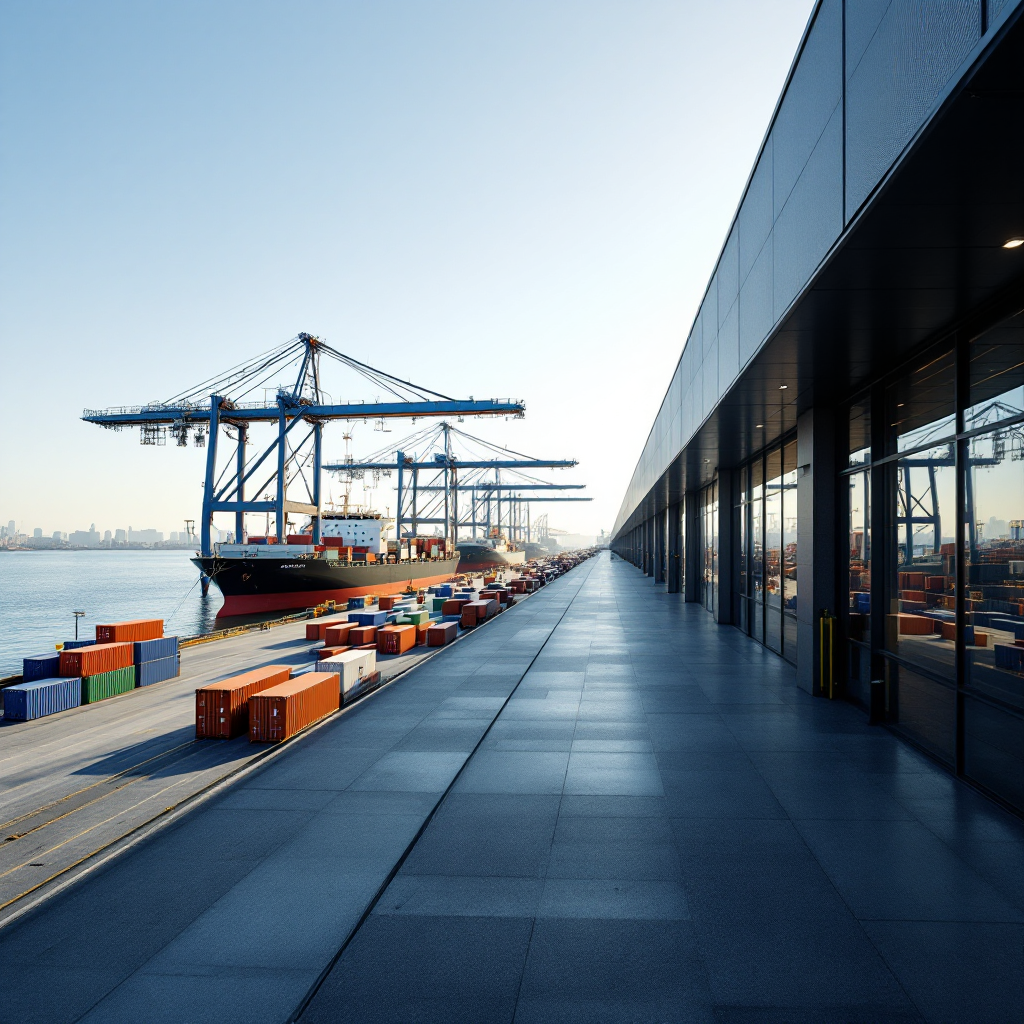
literature review of the Quay Crane Scheduling Problem
The quay crane scheduling problem sits at the center of operational research for deepsea ports and container terminals. First, the QCSP asks how to sequence and time container loading and unloading tasks assigned to quay cranes so that vessels spend as little time as possible at the berth. Second, the problem combines precedence constraints, spatial interference constraints, and resource limits into a single optimization problem. As a result, the problem is NP-hard for realistic instance sizes and thus resists exact, fast solutions for very large ships and complex terminal layouts. For a clear academic summary of this classification and its implications, see the comprehensive review of the Quay Crane Scheduling Problem here.
Key performance metrics steer research and practice. Vessel turnaround time remains the headline KPI because it ties directly to berth productivity and shipping schedules. Make-span, or total completion time for all vessel-related tasks, drives resource planning. Crane utilisation and idle time reveal cost efficiency because quay cranes represent major capital and operational expense. Studies report that optimized approaches can cut turnaround by up to 20–30% and yield make-span gains near 15–25% in many scenarios, which translates directly to throughput improvements and cost savings here.
Historically, research moved from exact mixed integer programming and linear programming model techniques toward metaheuristics and hybrid approaches. Early work relied on mixed integer programming and branch-and-bound for small instances. Later, researchers introduced genetic algorithm and particle swarm optimization, and then hybridized them with local search to scale to dozens of quay cranes and hundreds of tasks. More recent work integrates uncertainty modeling, stability constraints, and surrogate models to handle real-time needs; see recent advances on surrogate models for QCSP here. Finally, the literature emphasizes integrated approaches that combine berth allocation and quay crane assignment and scheduling to reflect operational interdependencies and practical constraints here.
crane constraints and operational challenges
Deepsea container terminal operations face hard constraints that shape any scheduling strategy. Task precedence limits which moves can occur simultaneously because many containers must be handled in a prescribed order. Next, crane interference and safety margins prevent neighboring quay cranes from operating too close at the same time. This spatial coupling forces scheduling windows and buffer zones, and it raises the importance of robust planning under uncertainty. For example, an unexpected delay in handling time for a single bay can cascade across adjacent cranes and extend vessel stay.
Operational uncertainties add another layer of complexity. Weather, equipment faults, and variable container handling times generate stochastic behavior that wrecks naive plans. For that reason, researchers model stochastic processing times and propose robust scheduling and scheduling under uncertainty techniques that trade some optimality for stability. One stream of work integrates unidirectional movement rules to avoid crossing and interference, and another uses stability constraints to maintain predictable crane sequences see stability constraints. Both streams aim to keep disruption small while preserving near-optimal performance.
Safety and physical layout also matter. Crane spacing, rail limitations, and berth length constrain the number of quay cranes that can serve a single vessel. Terminal managers must decide on the number of quay cranes to deploy for each call while avoiding interference. At the same time, yard-side restrictions such as yard crane availability and quay-to-yard transfer rates influence feasible throughput and the realized berth productivity. To bridge quay and yard operations, terminals increasingly adopt real-time job scheduling for autonomous equipment and systems that allow adaptive scheduling decisions when conditions change. For practical treatment of predictive repositioning and non-productive moves reduction in container terminals, see applications at loadmaster.ai predictive equipment repositioning.
Drowning in a full terminal with replans, exceptions and last-minute changes?
Discover what AI-driven planning can do for your terminal
container terminal berth allocation and integration
Berth allocation and quay crane interactions determine how well a terminal converts ship calls into throughput. First, berth allocation models assign time windows and positions along the quay to arriving vessels. Second, the resulting berth plan constrains which quay cranes can serve which vessel segments and at what times. Consequently, solving berth allocation separately from crane sequencing can generate suboptimal schedules. Integrated approaches therefore couple berth allocation and quay crane assignment and scheduling into a single framework to capture operational trade-offs.
Integrated scheduling frameworks often aim to maximize throughput while minimizing penalties such as delayed departures or crane repositioning. Researchers have developed continuous berth allocation and quay models and discrete berth allocation problem and quay formulations. Those integrated formulations reduce total service time because the model can select berth positions that enable better crane splits and fewer interference events. For a detailed review of how berth and quay crane models interact, see the integrated berth allocation and quay research here.
Case study: Rotterdam adapted its quay infrastructure and operational rules to accommodate mega-ships. Port planners lengthened quays, upgraded crane reach, and reworked yard flows to serve ships that carry tens of thousands of TEUs. Those investments required new scheduling rules and larger-scale QC assignment and scheduling models to manage the number of quay cranes needed per call. Planners used scenario testing and hybrid approaches to validate schedules before operational rollout. For terminals seeking practical guidance on crane split optimization and tandem sequencing, see our applied algorithms resource crane split optimization. In addition, integrating vessel and yard planning helps close the loop between berth choices and yard capacity; a strong example is available at integrating vessel planning and yard planning.
genetic algorithm and other metaheuristic approaches
Metaheuristic algorithms dominate large-scale QC scheduling research because they scale well and find high-quality schedules fast. The genetic algorithm family and hybrid approaches often outperform pure exact methods on real-world instances. For example, using a hybrid genetic algorithm that couples population search with effective local improvement heuristics delivers consistent make-span and turnaround improvements in many benchmarks. One study reported make-span reductions of roughly 15–25% versus traditional heuristics see study. Such results show that hybridization and careful representation of crane moves matter.
Other metaheuristics also add value. Particle swarm optimization has been tested for QCSP and can find competitive solutions, particularly when tuned for continuous decision variables like crane positions. Teaching-Learning-Based Optimization (TLBO) offers another metaheuristic that focuses on knowledge transfer between solution candidates. In addition, surrogate models speed up evaluation for very large instances by approximating expensive simulation steps; a recent surrogate strategy demonstrates strong computational efficiency on large-scale cases surrogate model.
Researchers compare approaches on two fronts: solution quality and computational time. Hybrid genetic and TLBO variants often reach near-optimal schedules in minutes for dozens of cranes and hundreds of moves. By contrast, exact mixed integer programming and linear programming model approaches struggle as size grows. Still, mixed integer programming remains useful for small critical segments and benchmarking. For mixed approaches connecting planning and execution, see the resources on yard crane scheduling and dispatching and AI-driven equipment allocation at loadmaster.ai yard crane scheduling and AI-driven allocation.
Practitioners must choose an approach that balances optimal solution quality and runtime constraints. For terminals that require real-time adjustments, dynamic scheduling and adaptive scheduling mechanisms often pair well with metaheuristics because they allow fast rescheduling when delays occur. Finally, in some studies, authors such as Wang et al and yu et al explore hybrid and stability-aware methods; reference to wang et al and yu et al can guide further reading on stability-constrained QC assignment and scheduling problem research.
Drowning in a full terminal with replans, exceptions and last-minute changes?
Discover what AI-driven planning can do for your terminal
influence of various factors on scheduling performance
Scheduling effectiveness depends on many interacting factors. The arrival of mega-ship calls and rising TEU volumes change the scale and shape of the problem. When a vessel brings 15,000–20,000 TEUs, terminals must allocate more quay cranes and coordinate them tightly to avoid long delays. As a result, the number of quay cranes serving a vessel becomes a primary decision variable that affects both handling time per TEU and overall sequence feasibility. Terminals that fail to scale crane deployment risk increased vessel turnaround and congestion.
Processing time variability matters too. When handling time per bay or per container varies, schedule stability declines. Researchers therefore test robust scheduling and quay crane assignment under uncertainty to maintain consistent performance. For concrete methods, some teams apply stochastic models and robust optimization to buffer schedules against delays. These techniques reduce the chance of severe interference and maintain reasonable crane usage rates across scenarios.
Physical quay layout and crane spacing also shape options. Long quays allow more flexible assignment and crane splits, while short quays constrain simultaneous operations. Quay-to-yard transfer capacity and availability of automated guided vehicles or yard cranes can create bottlenecks that upstream schedules must respect. For deeper analysis of non-productive moves and gross moves per hour influences, consult the study on factors affecting gross moves per hour gross moves per hour.
Other technical factors include the choice between tandem and twin-lift operations, which increase effective handling rates but raise coordination demands. Also, the scheduling problem under the influence of environmental constraints such as tides and pilot windows can limit feasible service windows. As terminals adopt automated container terminals and integrate digital twins, they gain the ability to simulate many what-if scenarios quickly. Combining simulation with optimization yields practical scheduling strategies that balance throughput and robustness.
Conclusions and future research directions
Research into efficient quay crane scheduling has delivered measurable operational benefits. Quantitative studies show up to 20–30% reductions in vessel turnaround and up to 25% make-span improvements when advanced methods are applied and tuned for real terminals see quantitative review. In practice, hybrid approaches and metaheuristics provide robust schedules while mixed integer programming and linear programming model tools remain useful for smaller planning problems and benchmarks. The optimal solution for a given terminal will depend on its scale, layout, and tolerance for rescheduling.
Looking forward, several directions for future research deserve priority. First, real-time scheduling and digital twins can close the gap between planning and execution. Second, scheduling under uncertainty and robust scheduling methods that accept stochastic handling time distributions will reduce disruption risk. Third, holistic integration with yard planning, automated guided vehicles, and terminal operations will let terminals harmonize seaside operations in container terminals with inland workflows. For concrete design choices when integrating vessel and yard planning, see the integration resource integrating vessel and yard planning.
Finally, AI and deep learning can support surrogate evaluation and fast decision-making in adaptive scheduling and dynamic scheduling contexts. Additionally, directions for future research include better human-in-the-loop systems that combine automated schedule proposals with operator review. By automating repetitive data lookups and routing, we help planners spend more time on high-value scheduling choices and less on administrative triage. Overall, the field moves toward integrated, real-time, and robust systems that help terminals scale for larger ships and higher demand while keeping safety and cost efficiency high. Researchers and operators who pair advanced optimization problem techniques with practical automation will find the best long-term gains.
FAQ
What is the quay crane scheduling problem?
The quay crane scheduling problem asks how to assign and sequence loading and unloading tasks to quay cranes to minimize vessel service time and resource costs. It combines task precedence, crane interference, and timing constraints and is NP-hard for realistic terminal sizes.
How much can optimized scheduling reduce vessel turnaround time?
Optimized scheduling has reduced vessel turnaround by reported ranges of 20–30% in academic studies. These gains come from better crane utilisation, fewer interference events, and improved make-span performance study.
Which algorithms work best for large terminals?
Metaheuristics such as genetic algorithm, hybrid approaches, particle swarm optimization, and TLBO scale well for large instances. Hybrid genetic strategies that combine global search and focused local improvements often deliver strong practical results.
Why integrate berth allocation with crane scheduling?
Integrating berth allocation and quay crane assignment and scheduling avoids suboptimal decisions that arise when those problems are solved separately. Joint models let terminals choose berth positions that reduce crane interference and improve overall throughput integrated study.
How do uncertainty and variability affect schedules?
Variability in handling time, weather, and equipment reliability can break planned sequences and cause delays. Methods for scheduling under uncertainty and robust scheduling add buffers and stability constraints to keep disruption small and predictable.
Can terminals use real-time adjustments?
Yes. Dynamic scheduling and adaptive scheduling tools let operators reschedule when delays occur. Combining fast metaheuristics with surrogate models supports near-real-time changes without heavy computational cost surrogate work.
What role does quay layout play in scheduling?
Quay length, crane spacing, and rail constraints limit the number of quay cranes that can operate simultaneously and shape feasible crane splits. Terminals with longer quays enjoy more flexibility in assigning cranes to multiple vessel bays.
Are automated solutions useful for scheduling?
Automated container terminals and automation for yard handling reduce downstream bottlenecks and improve the reliability of quay schedules. Automation also enables consistent data for optimization tools and faster execution of reschedules.
How do terminals measure success for scheduling changes?
Terminals track vessel turnaround time, make-span, crane utilisation, and handling time per TEU as primary metrics. They also monitor non-productive moves and yard congestion to ensure upstream changes do not shift problems elsewhere rehandle strategies.
What should be priorities for future research?
Priorities include real-time scheduling with digital twins, scheduling under uncertainty, and deeper integration of berth allocation and quay crane assignment. Also, coupling optimization with operational automation and better human-in-the-loop tools will improve adoption and impact.
our products
 stowAI
 stackAI
 jobAI
jobAI
Innovates vessel planning. Faster rotation time of ships, increased flexibility towards shipping lines and customers.
Build the stack in the most efficient way. Increase moves per hour by reducing shifters and increase crane efficiency.
Get the most out of your equipment. Increase moves per hour by minimising waste and delays.
stowAI
Innovates vessel planning. Faster rotation time of ships, increased flexibility towards shipping lines and customers.
stackAI
Build the stack in the most efficient way. Increase moves per hour by reducing shifters and increase crane efficiency.
jobAI
Get the most out of your equipment. Increase moves per hour by minimising waste and delays.