
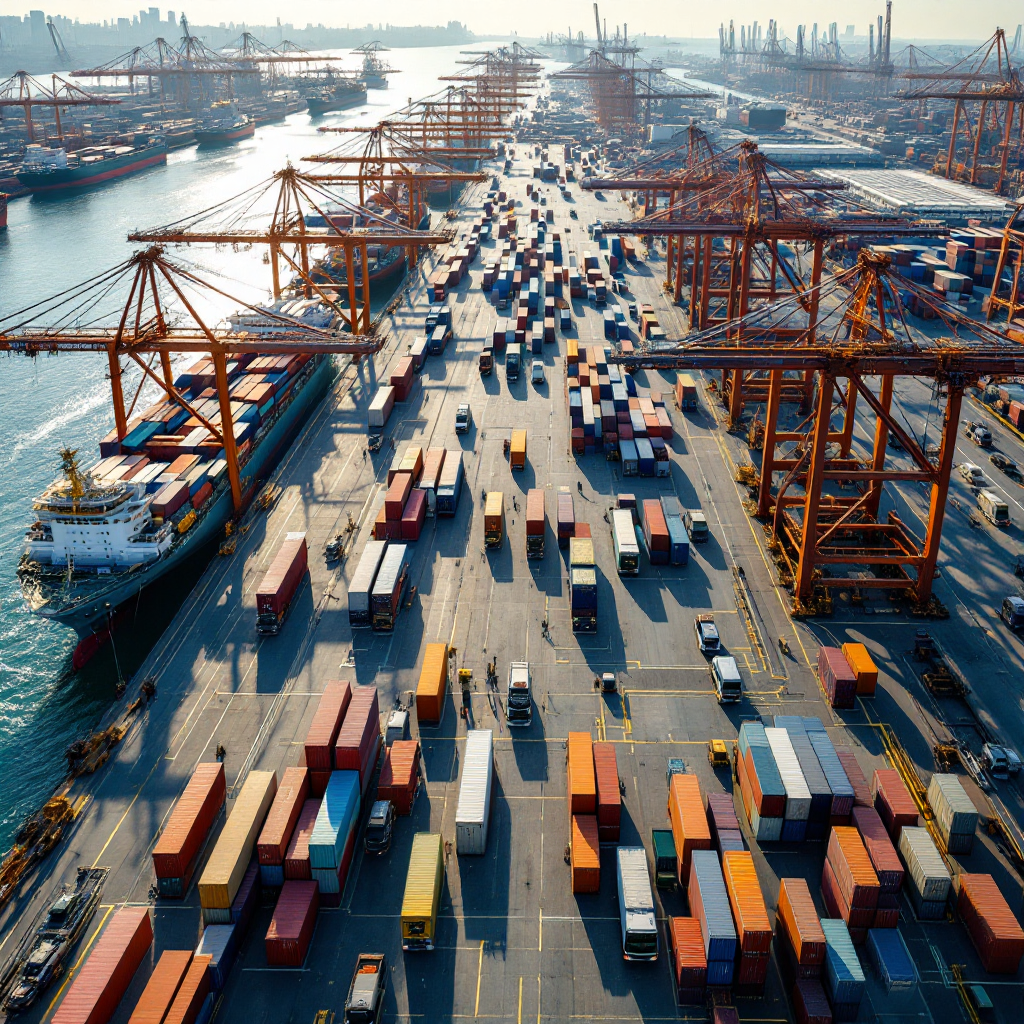
container terminal planning: Integrating vessel stowage and yard layout
Container terminal planning sits at the crossroads of vessel stowage and yard layout. First, planners must coordinate ship stowage with yard STACK locations and yard truck flows. Second, they must reduce costly extra moves and speed up vessel TURNAROUND. Research shows that an integrated approach can cut rehandling by up to 20–30% when ship and yard plans are optimized together (Integrated Containership Stowage Planning). This figure highlights why container terminal planning has moved from theory to urgent practice.
To achieve that reduction, terminals increasingly use a mixed-integer programming model that jointly considers berth assignment, yard storage and crane cycles. The programming model encodes constraints such as stacking rules, container locations and the capacity of a container stack, and it treats departure time windows as decision variables. For uncertainty, the model can include stochastic parameters and robust rules to protect vessel schedules against delay. Recent papers present MILP variants that link quay and yard decisions, and they report measurable gains in throughput and lower operational cost (An integrated model for berth and yard planning).
Operators see practical benefits. For example, combining berth allocation with yard STACK layout reduces unnecessary crane moves. Consequently, quay CRANE cycles become more predictable and yard CRANE repositioning falls. In addition, the container terminal gains clearer arrival and departure sequencing, which helps the terminal manager and terminal operators to assign staff and equipment more effectively.
Finally, integrated planning must respect quay geometry, intermodal transfer paths, and loading and unloading constraints on board. To get there, teams use mixed integer programming models, scenario testing, and iterative data-driven refinement. As recent research emphasizes, “the altering nature of planning decisions affects operational efficiency in seaport container terminals” (Planning decision alterations and container terminal efficiency), so dynamic, joint approaches outperform siloed tactics.
container terminal: Key performance indicators for integrated operations
Key performance indicators change when planning connects berth and yard. Berth utilisation often improves by 10–15% when berth allocation and yard planning are combined under uncertainty. One study that models berth and yard space under stochastic arrival and volume scenarios documents these gains (Integrated berth and yard space allocation under uncertainty). Therefore, terminals that measure utilisation, dwell time and crane productivity see clear improvement.
Throughput increases follow from fewer rehandles. For example, terminals that reduce rehandling see faster loading operation and unload cycles. That outcome shortens vessel calls and lowers operational cost. In addition, reduced moves cut emissions and help decarbonization goals at the port. The throughput benefit also appears in yard occupancy metrics: integrated berth and yard allocation lowers peak stacking and smooths yard STORAGE demands, which reduces the number of containers stalled in the yard.
Mega-ships drive peaks in terminal activities. They bring surges in marine container volumes that push yard operations and extend dwell time. Integrated berth allocation and quay crane sequencing can smooth those peaks. Hence, planners model the berth allocation problem with an eye toward arrival and departure clustering, and they include the quay crane scheduling problem in the same planning horizon. As a result, yard trucks and yard cranes get clearer instructions, and gate flows avoid large sudden spikes. Recent industry analysis on mega-ships confirms the link between ship size and yard dwell spikes (The Impact of Mega-Ships).
Metrics that matter include crane productivity per hour, average dwell per TEU, number of containers moved per vessel call, and operational efficiency on gate cycles. For managers seeking related HOW-TO guidance on yard layout and flow, see our primer on container terminal yard optimization fundamentals. In short, the right KPIs reveal where an integrated plan delivers real value, and they allow the terminal manager to quantify savings and justify further optimization investments.
Drowning in a full terminal with replans, exceptions and last-minute changes?
Discover what AI-driven planning can do for your terminal
terminal operation: Managing uncertainty in vessel arrivals and container flows
Uncertainty in arrival and departure times causes major bottlenecks in terminal operation. Ships can be early or late. Weather, congestion and feeder delays alter vessel schedules and the number of containers arriving. Consequently, planners face fluctuating demand for quay CRANE time, yard storage and yard trucks. To cope, terminals move from static plans to rolling schedules that react to new information.
Integrated scheduling problem formulations can incorporate stochastic arrival profiles. For instance, a model for the integrated berth treats arrival and departure as random variables and optimizes resource assignment under that uncertainty. This approach produces more robust berth planning and fewer emergency reshuffles. In parallel, terminals apply the integrated berth allocation and quay concepts to prevent local bottlenecks from becoming systemic disruptions.
Real-time updates make a meaningful difference. When a vessel reports a changed ETA, a terminal can reassign quay crane sequences and retime yard pickups so the container flow remains smooth. Terminal Operating Systems that centralize vessel schedules, yard inventory and gate moves enable these changes. They also feed analytics modules that flag likely bottlenecks hours ahead. For more on machine-led prediction, see our coverage of machine learning use cases in port operations.
Decision makers use scenario trees and parameter sensitivity analysis to evaluate risk. They set buffers around departure time and consider the cost trade-off between idle quay time and extra rehandling. If a large feeder delay hits, the plan rebalances yard storage and stack heights, so throughput remains steady. Research has demonstrated that integrating berth and yard allocation under uncertainty improves berth utilisation and reduces costly reshuffles (Integrated berth and yard space allocation).
Finally, communications matter. Automated email agents can reduce manual triage in operations and help operators respond to updated vessel schedules faster.
terminal operators: Collaboration and stakeholder roles
Collaboration sits at the heart of successful dockside operations. Terminal operators, shipping lines, truckers, and rail partners must share accurate schedules and container locations. Joint optimisation of ship stowage plans and yard pickup sequences reduces rehandling both on board and ashore. Collaborative optimization studies show clear reductions in combined ship and yard moves when teams coordinate (Collaborative Optimization of Vessel Stowage Planning).
The Analytic Hierarchy Process helps clarify priorities. That method gives a structured view of what matters when yard storage and berthing choices conflict. A terminal manager can then set rules that reduce contention between quay CRANE crews and yard truck cycles.
Operational roles must align. For example, quay supervisors should exchange real-time pick lists with yard masters. Gate teams must confirm arrival manifests and expected loading operation sequences. Close coordination between cranes and yard ensures that container handling flows from ship to stack to truck with minimal idle time. Moreover, planning operation meetings that include shipping agents and intermodal carriers improve arrival and departure predictability.
To formalise collaboration, terminals often adopt service-level agreements with shipping lines and trucking operators. These agreements define acceptable dwell windows and who pays for extra moves when plans change. They also give the terminal the authority to prioritize moves that reduce overall bottlenecks. For a practical view on reducing rehandles, terminals can consult our guide on strategies to reduce container rehandles.
Finally, leadership must champion data sharing. When stakeholders trust the same dataset, decisions speed up and errors fall. Tools that automate communication, like AI-driven email agents, free human teams to focus on complex trade-offs. As an outcome, the entire port ecosystem benefits from fewer delays and more predictable container flows.
Drowning in a full terminal with replans, exceptions and last-minute changes?
Discover what AI-driven planning can do for your terminal
operator: Decision-support tools and automation
Operator tools now span from berth planning dashboards to automated stacking algorithms. Terminal Operating Systems centralize vessel schedules, yard inventory and gate moves. They provide the live view operators need to assign quay crane shifts and yard CRANE tasks. Through an integrated berth allocation and quay module, planners can reduce guessing and assign resources with confidence.
Artificial intelligence and predictive analytics power many modules. AI-driven demand forecasts suggest when to pre-position containers, and predictive equipment repositioning reduces non-productive moves. For instance, algorithms can optimize crane split across bays and predict when a yard truck will be late. Using these signals, operators better sequence loading and unloading operations and reduce stacking churn. See related work on predictive repositioning here: predictive equipment repositioning.
Automated terminals report faster crane cycles and lower dwell time after deploying closed-loop decision support. In those facilities, yard STORAGE and yard trucks are coordinated by a central logic that minimizes travel distances and waits. A mixed-integer programming model often underpins assignment logic while AI refines parameters for real traffic patterns. Additionally, some studies explore using a particle swarm algorithm for scheduling and routing to complement traditional integer solvers; indeed, using a particle swarm appears in recent methods for crane and truck sequencing.
Case studies also highlight email automation as a force multiplier. When the operator receives data-grounded messages rather than raw inbox clutter, response time drops and planning quality rises. As a result, team members can focus on exception handling and continuous improvement rather than routine triage.
Finally, operators must combine human oversight with automated proposals. Tools should present clear trade-offs, such as the cost of a late departure versus extra rehandling moves. Transparent decision aids drive trust and encourage adoption by terminal staff. Over time, this blend of AI and planner judgment raises terminal efficiency and reduces operational cost.

analytics: Real-time data for continuous improvement
Analytics turn data into actionable insights. Live data feeds from cranes, gate scanners and vessel AIS enable predictive analytics to anticipate bottlenecks. Dashboards that track dwell time, crane utilisation and yard occupancy give teams the early warning they need. Consequently, terminals can shift from reactive firefighting to proactive management.
Predictive models use parameters such as arrival variances, stacking heights, and the number of containers bound for each discharge to forecast congestion. When analytics flag a future peak, the terminal can alter the berth allocation and quay crane assignment in advance. That step reduces the chance of a bottleneck and preserves throughput. For an explanation of how predictive models help port scheduling, review this study on berth call optimisation (berth call optimization strategies).
Continuous improvement relies on closed loops. After each vessel call, systems compare planned crane operations to measured performance. The analytics module then adjusts parameters for the next planning cycle. Over months, this feedback reduces average dwell and improves terminal efficiency. Also, analytics support reporting for stakeholders and regulators interested in the efficiency of port activities and emissions from containerized flows.
Recent research stresses digital readiness and the role of TOS in integration (Digital Port Transformation). Terminals that adopt end-to-end analytics see better decision quality and faster recovery from disruption. Finally, analytics help to define future research directions, including hybrid models that combine MILP cores with AI parameter tuning. Such research by liu et al and others charts the path for smarter berth planning and yard management.
FAQ
What is the benefit of integrating vessel stowage and yard layout?
Integrating vessel stowage and yard layout reduces rehandling and shortens vessel turnaround. It improves throughput and lowers operational cost by aligning quay crane cycles with yard STORAGE and truck flows.
How much can rehandling be reduced with integrated planning?
Studies report rehandling reductions up to 20–30% when ship stowage and yard pickup sequences are optimised together (research). That reduction translates into faster loading operation and unload times.
Which KPIs matter for container terminal performance?
Key indicators include berth utilisation, crane moves per hour, average dwell time per TEU, and yard occupancy. These KPIs show where integrated approaches deliver measurable gains.
How do terminals handle uncertain vessel schedules?
Terminals use stochastic models and rolling schedules that adapt to updated vessel schedules. Real-time data feeds and decision-support tools allow planners to reassign resources quickly when ETAs change.
What role do terminal operators play in integration?
Terminal operators coordinate quay, yard and gate teams and implement collaborative plans. They ensure data flows and service-level agreements support efficient container handling and avoid bottlenecks.
Can AI help with berth and yard planning?
Yes. Artificial intelligence can forecast container flows, suggest optimal crane allocations, and tune parameters in mixed-integer models. AI complements mathematical optimization to improve day-to-day decisions.
What is a mixed-integer programming model in this context?
A mixed-integer programming model encodes discrete choices, such as berth assignment, and continuous variables like crane times. It helps solve complex planning problems like berth allocation and quay crane assignment.
How do terminals measure success after implementing integrated planning?
Success is measured by reduced rehandles, improved berth utilisation, shorter turnaround, and better throughput. Analytics dashboards help monitor these metrics continuously.
What communication tools support integrated planning?
Terminal Operating Systems, linked data feeds, and automated email agents ensure timely information exchange. Tools that create structured data from email speed up coordination across stakeholders.
Where can I learn more about yard optimisation techniques?
Practical resources and case studies are available, including guides on container terminal yard optimization fundamentals and strategies to reduce container rehandles. These resources explain methods for stacking, routing, and scheduling in detail.
our products
 stowAI
 stackAI
 jobAI
jobAI
Innovates vessel planning. Faster rotation time of ships, increased flexibility towards shipping lines and customers.
Build the stack in the most efficient way. Increase moves per hour by reducing shifters and increase crane efficiency.
Get the most out of your equipment. Increase moves per hour by minimising waste and delays.
stowAI
Innovates vessel planning. Faster rotation time of ships, increased flexibility towards shipping lines and customers.
stackAI
Build the stack in the most efficient way. Increase moves per hour by reducing shifters and increase crane efficiency.
jobAI
Get the most out of your equipment. Increase moves per hour by minimising waste and delays.