
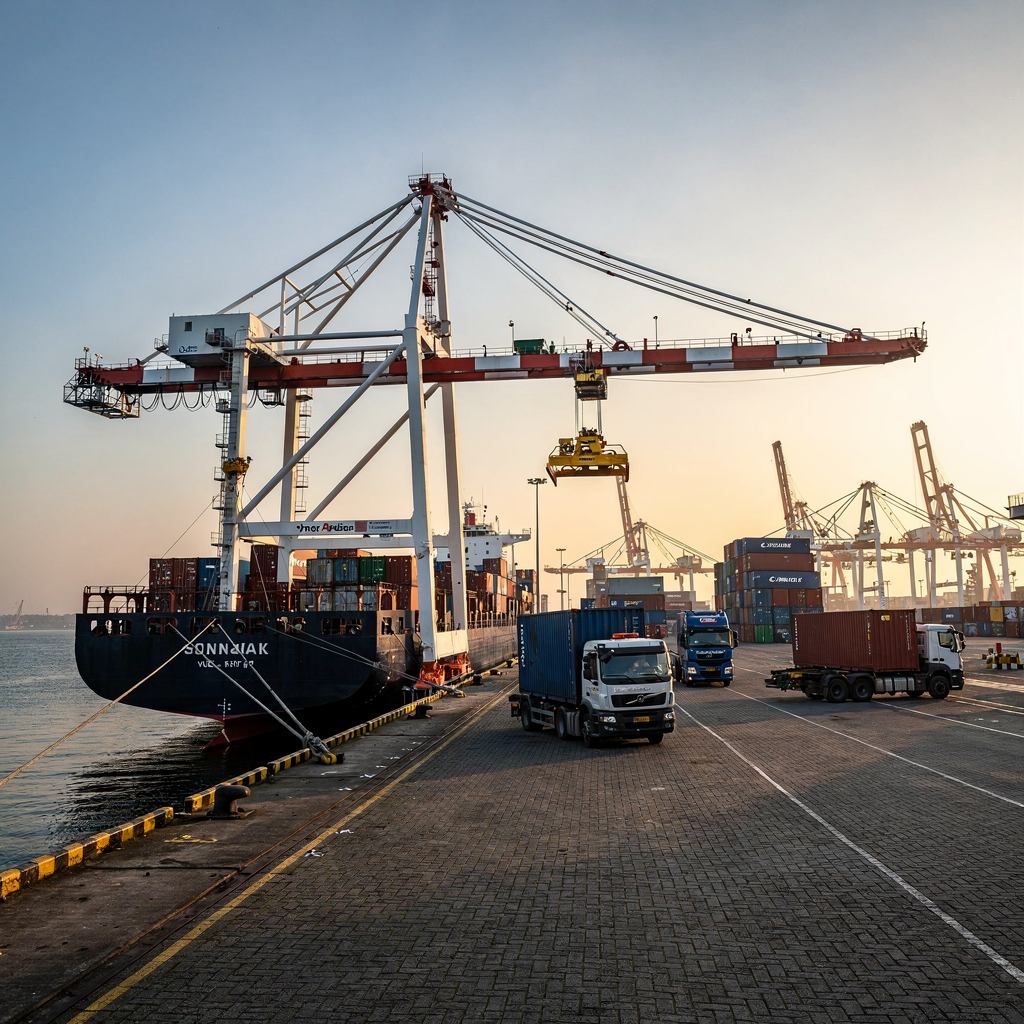
crane: Introduction to ship-to-shore crane and its impact on container handling
The ship-to-shore crane sits at the heart of modern container handling. First, a crane moves containers between a vessel and the quay. Next, it places boxes onto trucks, onto yard stacks, or onto rail wagons. Therefore, this machine shortens ship turnaround and raises throughput. For context, the global STS market exceeded roughly USD 3.45 billion in 2024, and it is forecast to grow at a CAGR near 5.2% to 2033 (projected to 2033). Also, the super-post panamax segment already commands a major share as terminals prepare for the largest container ships (market note).
In operation, an STS uses a trolley and a spreader to pick and lower cargo from deck to dock. The spreader locks to the container, then the trolley traverses the girder. Then the hoist lifts the load. Because of this sequence, a well-specified crane and a skilled operator shorten port stays. Meanwhile, modern STS cranes add remote-control and sensors. Consequently, terminals can improve safety and cut errors. Our team at Loadmaster.ai studies these interactions and models how AI can coordinate quay moves with yard flows. In addition, our ability to simulate a digital twin helps terminals test layouts before committing expensive equipment or civil works.
Today, terminals that invest in high performance crane systems gain a competitive edge in global trade. For example, when a terminal upgrades its quay layout and buys modern container cranes, it often reduces berth time and increases moves per hour. Subsequently, this translates into better maritime logistics and lower costs for carriers. Finally, the ship-to-shore crane remains central to the supply chain, since it directly links ship’s deck operations with landside distribution. For more on STS specifications and lifecycle support see our detailed guide to STS crane.
port: The vital role of port infrastructure in efficient sts operations
Quay design shapes how effectively a crane can transfer containers. First, the quay footprint must accept the girder span and the crane rail. Next, the foundations, and then the grid of rails, must carry heavy loads from the gantry. Therefore, a quay crane needs a well-designed landside and waterside interface to move containers without delay. Also, shore power, generator back-up, voltage regulation, and cable reel routing are part of the electrical plan. These mechanical and electrical elements sustain continuous service and protect equipment. For terminals contemplating modernization, rail replacement, or deeper berths, planning these systems early reduces downtime and construction risk.
Modern port upgrades do more than add equipment. They change how a terminal sequences vessels, staggers yard work, and balances traffic. For example, a redesigned rail alignment can shorten transfer distances and thus lower travel times for straddle carriers. Similarly, a straightened yard road can reduce shifter hours. Terminals that modernize both quay and yard see real improvements in port productivity and in berth turnaround. In one recent study, modernization campaigns reduced average turnaround by measurable percentages where quay cranes were integrated with automated gate flows (market research).
In practice, upgrades also include digital systems that coordinate crane cycles with truck arrivals. For instance, Loadmaster.ai deploys RL agents that optimize job sequencing to protect quay service during peaks, and to shift priorities when landside congestion rises. Thus, planners can go from firefighting to planning. If you want technical guidance on crane rates and benchmarking, see our work on gross crane rate benchmarks. 
Drowning in a full terminal with replans, exceptions and last-minute changes?
Discover what AI-driven planning can do for your terminal
sts: Understanding different types of sts cranes and their applications
STS come in sizes and classes tuned to ship dimensions. Standard models fit small feeder ships. Panamax cranes serve the old locks and the classic beam widths. Post-Panamax and super-post-Panamax cranes lift higher and reach farther to access cells near the ship’s centerline. As ships increase capacity, terminals shift to cranes with longer outreach and higher hoist speeds to serve container vessels. Outreach affects how many bays a single crane can cover. Meanwhile, lift capacity governs how many loaded boxes a crane can safely raise at once. For the largest container ships, super-post panamax cranes are standard equipment on new berths (industry analysis).
Besides span and lift, operators choose between rail-mounted and rubber-tyred gantries at the quay edge. A rail-mounted design provides stability and high moves per hour, whereas a lower-footprint, low-profile solution can fit tighter spaces. Some terminals also employ tandem lifts for specific cargo, which requires a matched tandem spreader and certified procedure. When selecting a gantry, planners weigh outreach against berth density and the expected mix of container sizes. In addition, hoist design, trolley drive, and brake systems influence cycle time and energy use.
When terminals plan equipment purchases, they should compare total life costs. That means assessing maintenance, spare parts, and support. It also means checking who supplies critical components, since security concerns about foreign-made machinery appear in some markets (security review). For practical advice on matching STS capabilities to operational goals, explore our notes on container terminal simulation, which helps predict how different crane mixes affect yards and truck flows.
key features: Exploring the key features of ship-to-shore crane for speed and precision
Key features determine how a crane performs under pressure. First, modern STS cranes integrate automation and remote operation, which reduce operator exposure and human error. Second, IoT sensors and a digital twin support predictive maintenance, so downtime falls and components last longer. For example, vibration and temperature readings from a sensor network can trigger an inspection before a failure occurs. Third, energy-efficient drives and regenerative braking lower consumption, and they return power to the grid during downward cycles. Together, these aspects improve reliability and lower operating costs.
Also, advanced control systems tune trolley acceleration, jerk limits, and hoist profiles to cut sway and speed up cycles. A precise spreader and automatic locking reduce time at the ship’s deck. In addition, safety interlocks and anti-collision logic let multiple cranes work in tandem while protecting personnel. When paired with software that sequences moves, cranes can transition smoothly between lifts, load planning, and repositioning tasks. Importantly, automation here refers to assisted and supervised modes, rather than full replacement of the human in the loop.
Finally, many modern container cranes include features to reduce their footprint and emissions. Low-profile booms, efficient generators, and flexible electric power options enable operation in constrained docks and in ports with strict emissions rules. These high-performance features align with broader advancements in technology that support greener maritime logistics and a longer service life for valuable assets.
Drowning in a full terminal with replans, exceptions and last-minute changes?
Discover what AI-driven planning can do for your terminal
features and benefits: Operational features and benefits of our sts solution
Our STS solution focuses on measurable gains. First, faster loading and unloading mean ships spend less time at berth. As a result, turnaround time and total cost per call fall. Second, high reliability and 24/7 service support increase availability and extend component life. Third, modular parts and broad spare-parts availability lower lead times for repairs. Combined, these features reduce total cost of ownership while boosting moves per hour.
Practically, our offering links the crane control stack to terminal decision logic. For example, Loadmaster.ai coordinates crane sequences with yard moves to avoid unnecessary rehandles and to balance workloads. This coordination improves port productivity and reduces shifter travel. In addition, our agents protect quay service during busy arrivals, and they shift focus when the landside becomes constrained. The result is more consistent performance across shifts, fewer surprises, and lower energy use.
Beyond software, the STS package includes robust spreaders, reliable hoists, and trolley systems designed for long duty cycles. Our engineering partners provide mechanical and electrical specifications tailored to the waterside environment. Also, we support training programmes and long-term service contracts. If you want to trial the equipment in your layout, we can arrange a pilot deployment to demonstrate how a modern container STS reduces dwell and improves flow. For details on scheduling and execution, see our solutions on job scheduling for quay and yard. 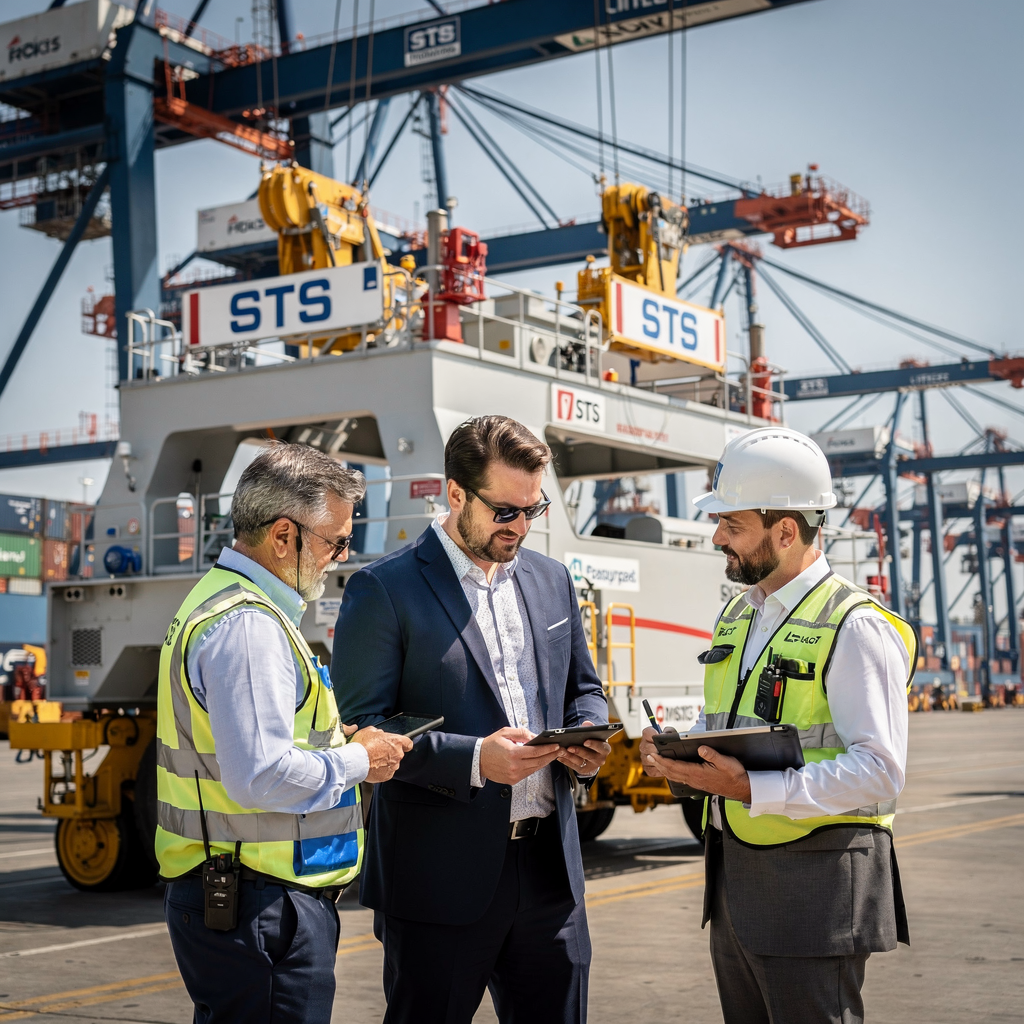
learn more about our sts: Next steps to optimise your terminal with our sts
If you want to learn more about our STS offerings, start with a site survey. First, we review your quay, rails, and electrical supply. Second, we map landside workflows and check gate throughput. Third, we run a sandbox simulation so you can see projected gains before committing capital. Then, our team proposes a pilot plan that pairs equipment, service, and AI-driven sequencing. Learn more about our sts and how to book a survey by contacting our experts; we also provide tailored project proposals and finance options for qualifying terminals.
We support a range of financing models, together with training programmes for operators, technicians, and planners. In addition, our long-term service contracts include parts provisioning, remote monitoring, and scheduled inspections. When terminals combine modern STS hardware with intelligent control agents, they often observe fewer rehandles, shorter driving distances, and steadier crane utilization. For guidance on scaling AI across port operations and on system integration, view our resource on scaling AI across port operations. Finally, to explore operational analytics and telematics integration, see our article on big data analytics. If you are ready, request a demo and our team will prepare a tailored proposal to optimise your dock and yard flows. learn more about our sts.
FAQ
What is a ship-to-shore crane and why is it important?
A ship-to-shore crane is a large gantry that transfers containers between a ship and the quay. It is important because it directly affects berth turnaround and the speed at which containers move into the terminal and onto onward transport.
How do quay upgrades impact crane performance?
Quay upgrades such as reinforced rails, improved electrics, and extended berths allow cranes to operate at full capacity. These upgrades also reduce maintenance risks and can increase moves per hour.
What types of STS models exist?
There are standard, Panamax, post-Panamax and super-post-Panamax models, each with different outreach and lift capabilities. Terminals choose models based on the size of container vessels they handle and berth spacing.
Can automation improve safety at the quayside?
Yes, automation and remote-operation modes reduce operator exposure to hazards and lower human error. They also enable precise control of the trolley and hoist for safer handling.
How does predictive maintenance work for cranes?
Predictive maintenance uses sensors to detect wear, temperature changes, and vibration patterns before failures occur. This approach reduces unexpected downtime and extends component life.
What benefits come from combining STS with intelligent terminal software?
Combining hardware with AI-driven scheduling improves coordination between quay and yard, which reduces rehandles and shortens truck turnaround. It also stabilises performance across shifts and lowers operational cost.
Are there financing options for new crane purchases?
Yes, many vendors and integrators offer financing, leasing, and phased deployment to spread capital costs. In addition, pilot programmes can validate ROI before full investment.
How do terminals handle security concerns about equipment origin?
Terminals assess supplier provenance and component sourcing as part of procurement and risk management. They may impose extra inspections or choose alternate suppliers when needed.
What role does energy recovery play in crane design?
Regenerative braking and efficient drives return energy to the grid and lower fuel or electric power consumption. These measures cut emissions and reduce running expenses.
How can I arrange a demo or site survey?
Contact the equipment provider or an integrator to schedule a site survey and pilot plan. For AI coordination and scheduling pilots, see Loadmaster.ai’s demonstration and simulation services which can model outcomes before purchase.
our products
 stowAI
 stackAI
 jobAI
jobAI
Innovates vessel planning. Faster rotation time of ships, increased flexibility towards shipping lines and customers.
Build the stack in the most efficient way. Increase moves per hour by reducing shifters and increase crane efficiency.
Get the most out of your equipment. Increase moves per hour by minimising waste and delays.
stowAI
Innovates vessel planning. Faster rotation time of ships, increased flexibility towards shipping lines and customers.
stackAI
Build the stack in the most efficient way. Increase moves per hour by reducing shifters and increase crane efficiency.
jobAI
Get the most out of your equipment. Increase moves per hour by minimising waste and delays.