
Maritime Supply Chain and Container Port Terminal Operation
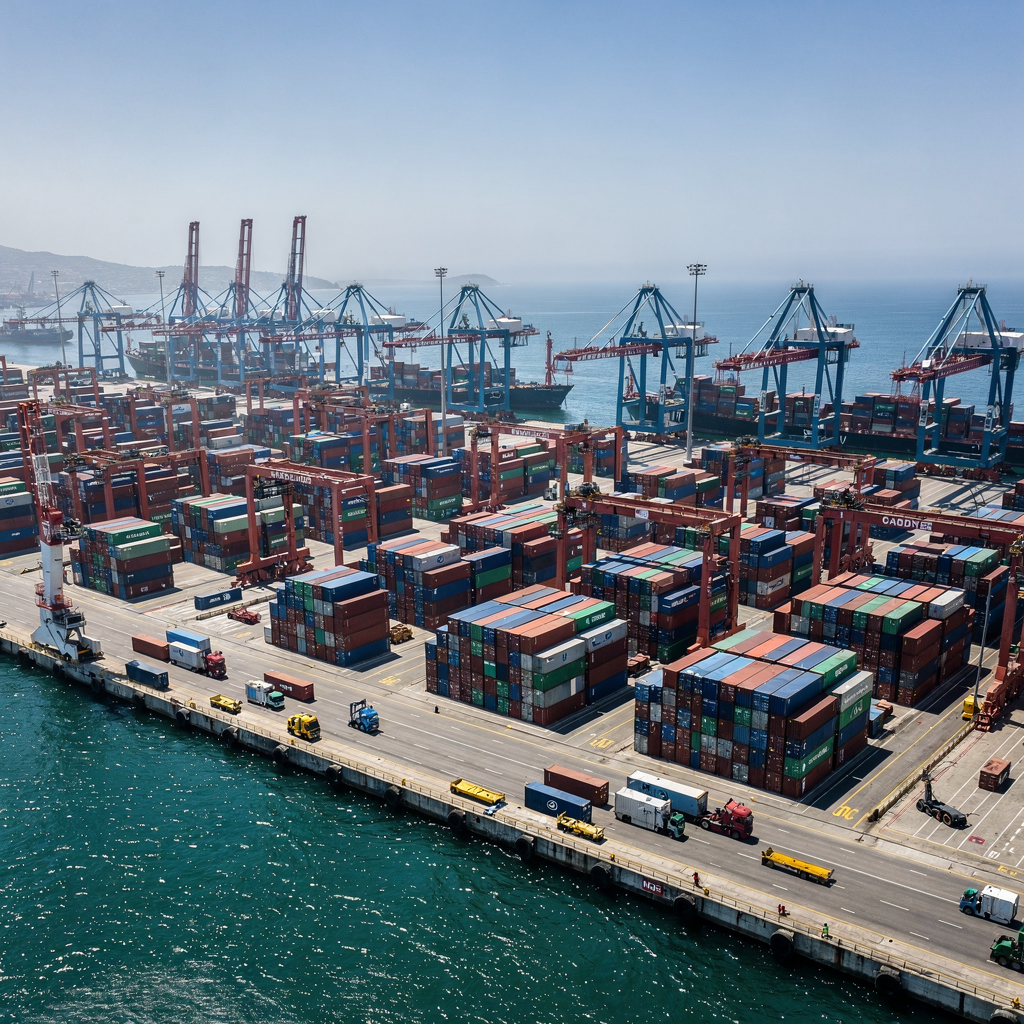
Deepsea container terminals act as major hubs in global maritime trade. They receive large container ship calls and move thousands of TEU every day. The role of a deepsea container terminal spans berthed operations, container storage, and hinterland handoffs. It also connects sea freight to rail and road. These hubs shape the flow of goods and the efficiency of the supply chain. Port congestion or a slow quay impacts exporters and importers downstream. For background on what this process entails, see this guide to container terminal simulation.
Traffic at large ports has climbed sharply. Global container port throughput grew by more than 50% in recent years, increasing pressure on quay space and yard capacity (UNCTAD). This rise forced terminals to adapt. New mega-ships changed berth layouts and equipment needs. Studies document that handling very large container ship calls requires rethinking crane deployment and berth configuration (ITF). Terminals must plan for longer calls and concentrated peak handling.
Supply chain interactions include vessel arrival patterns, gate and rail exchanges, and container storage dynamics. Arrival times can cluster and create peaks. These peaks influence quay crane allocation and yard throughput. Hinterland links determine how fast import containers clear and how quickly export containers arrive. If rail or truck links stall, the yard backs up and the quay slows. Therefore, terminals must coordinate with rail and road partners and the TOS to meet throughput targets.
Operational decisions range from berth allocation to stowage plans. They also cover quay crane shifts, yard allocation, and truck appointment windows. Terminals face trade-offs: maximize quay productivity or minimize yard congestion. Loadmaster.ai tackles those trade-offs with RL agents that train inside a digital twin. The system learns policies for stowage, stack balancing, and dispatch. This approach reduces firefighting and helps planners move from reactive fixes to stable, repeatable performance.
Container Terminal Model and Automated Container Handling
A robust container terminal model captures quays, yards, gates, cranes, and vehicles. The model must represent quay crane reach, yard block layout, and container stack heights. It must also include equipment types such as quay crane, yard cranes, and automated guided vehicles. In addition, the model accounts for service times, handling rules, and safety clearances. These elements shape the model’s ability to predict throughput and identify bottlenecks.
Automation alters handling rates and scheduling. Automated container cranes and automated guided vehicles reduce human variability. They can raise moves per hour and lower idle time. For instance, coordinated AGV and crane operation shortens transfer cycles and reduces crane idle time. Automated systems also change the shape of the container yard, so planners must rethink stack layouts and access lanes.
Model parameters must reflect real operations. Arrival rates, crane speeds, and spreader change times determine throughput outcomes. Service times vary with container type and stowage complexity. The model includes allocation rules for export containers and export lanes, and it models gate throughput and rail exchange. It also simulates rehandles and reshuffles that occur when a container is buried in a container stack.
Simulation helps compare automation scenarios. For example, a case can test a shift from straddle to automated yard cranes or from truck handling to AGV fleets. The analysis captures utilization of quay crane and yard cranes, travel time for AGVs, and the number of rehandles. A well-built model shows where automation yields gains versus where it increases driving distances or yard congestion.
Drowning in a full terminal with replans, exceptions and last-minute changes?
Discover what AI-driven planning can do for your terminal
Discrete Event Simulation Model for Terminal Simulation
Discrete event and agent-based approaches are common in container terminal analysis. Discrete-event focuses on events such as arrivals, crane starts, and truck gates. Agent-based models create autonomous actors like quay crane controllers and yard planners. Each approach has strengths. Discrete-event models excel at queuing and resource contention. Agent-based models capture adaptive behaviour and local decision rules.
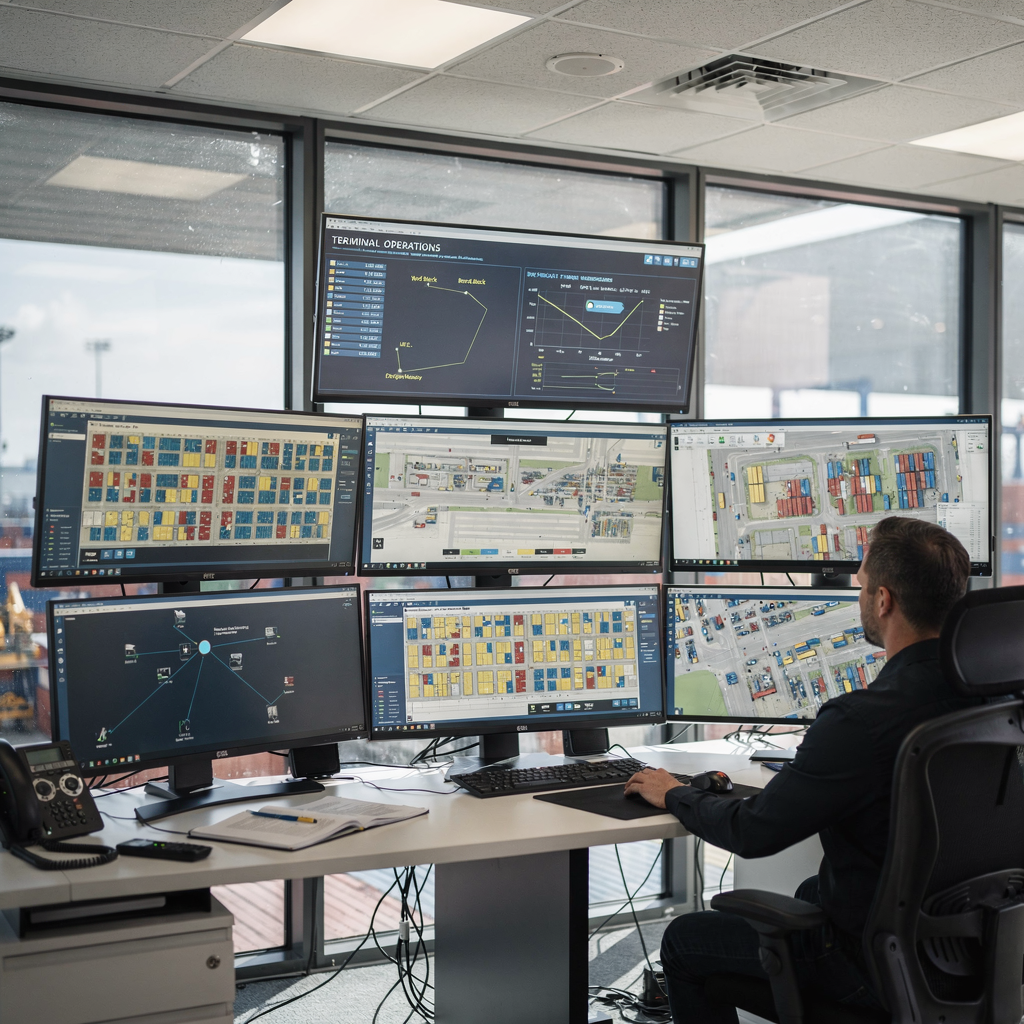
The structure of a simulation model includes entities, events, queues, and resources. Entities represent containers, vessels, trucks, and rail cars. Events change state, for example when a quay crane begins a lift. Queues hold waiting trucks or vessels, and resources include quay crane and yard cranes. The model records performance measures such as moves per hour, idle time, and berth occupation. A discrete-event simulation can run many scenarios and produce a dashboard for decision-makers.
For port applications, discrete event simulation is often paired with agent-based components. This hybrid approach models both system-level flows and planner behaviours. The discrete-event part handles queuing at the berth, and agent-based elements model dispatch decisions or truck routing. The result is a more realistic representation of terminal dynamics. A simulation model developed in this way can help test operational changes and quantify benefits.
Compared to system dynamics, discrete-event simulation provides higher-fidelity insights for scheduling in container environments. System dynamics gives strategic trends and feedback loops, but discrete-event reveals sequence-specific effects such as container rehandles and crane scheduling conflicts. Tools that support discrete-event and agent-based paradigms give planners a richer set of scenarios to test. That supports decision support for quay crane allocation and berth allocation, and it guides investments in equipment and yard layout.
Terminal Simulation Software and Port Simulation Software Selection
Choosing the right terminal simulation software matters. Evaluate scalability, customization, data integrations, and real-time links. Ports need a software tool that can handle large case sets, integrate AIS feeds, and connect to the TOS. Also consider 3D visualization, big data inputs, and a clear dashboard for KPIs. For discussion on replanning, read about real-time replanning capabilities.
AnyLogic is often highlighted for its digital twin capabilities and flexible modelling paradigms. anylogic’s support for agent-based and discrete-event constructs helps build realistic digital twins that link live telemetry and historical patterns. The platform can ingest AIS tracks and gate logs. It can also run what-if scenarios for quay crane deployments and yard reconfigurations.
Key selection criteria include the ability to run large experiments and to integrate ERP and TOS systems. Look for a tool that supports port and terminal data feeds and that can export performance measures to BI systems. Also check system requirements and integration APIs. A good port simulation software will let teams calibrate arrival times and service times, and then validate outputs against yard and berth records.
Vendor features to prioritise include interoperability with scheduling systems, support for automation, and the ability to model quay crane reach and ship loading and unloading processes. Also, confirm the software tool supports discrete-event simulation, 3D visualization, and big data analysis. For practical metrics, operators often compare results to industry benchmarks; see benchmarks for gross crane rate for guidance.
Drowning in a full terminal with replans, exceptions and last-minute changes?
Discover what AI-driven planning can do for your terminal
Container Terminal Simulation Model Design for Port Optimization
Designing a container terminal simulation model starts with clear objectives. Determine whether the goal is berth planning, crane scheduling, yard optimisation, or all of these. First, map the quay layout, yard blocks, gate, and intermodal links. Then capture equipment classes like quay crane, yard cranes, and automated guided vehicles. Define the KPIs the model will measure. For example, moves per hour, crane utilization, and average vessel turnaround.
Steps typically include data collection, model construction, calibration, validation, and scenario testing. Collect AIS vessel calls and gate timestamps. Use AIS feeds to validate arrival distributions and call windows. Then build the model to replicate ship loading and unloading, container storage, and truck flows. Calibrate the model for service times and crane scheduling logic against real records. This helps ensure outputs match observed throughput and idle time.
Calibrate berth planning and crane scheduling by adjusting service times and allocation rules until the model reproduces historical throughput. Use the model to test alternative quay crane rosters, berth planning strategies, and yard assignment rules. A simulation model allows comparison of scenarios: different quay crane counts, changes to yard cranes, or new AGV fleets. This supports investment decisions and port development plans.
AnyLogic and digital twin approaches enable closed-loop training for reinforcement learning agents, as practised by Loadmaster.ai. The company spins up a digital twin and trains StowAI, StackAI, and JobAI across millions of simulated decisions. The result is policies that reduce rehandles, balance workloads, and shorten driving distances. To validate the model, compare predicted throughput to terminal records and refine the model until output aligns with operational KPIs. A case study shows how simulation can inform berth planning and crane scheduling and support safer, more efficient operations (Efficiency study).
Benefits of Simulation and Terminal Simulation in Port Operations
Simulation delivers measurable benefits for port operators. Studies suggest simulation-based optimization can increase container handling productivity by up to 15-20%, reducing vessel turnaround and lowering operational costs (Efficiency and productivity). These gains come from better crane scheduling, reduced rehandles, and smarter yard placement. For terminals facing higher throughput, simulation helps anticipate pinch points and prioritize investments.
Risk management improves with scenario testing. Simulated outages, extreme weather events, and equipment failures reveal weak links. Planners can evaluate resilience and design robust contingency rules. This aids compliance and helps terminals meet sustainability targets by modelling emissions tied to equipment cycles and truck idling (Sustainability reference). In this way, simulation supports both operational efficiency and environmental goals.
However, challenges remain. Data quality and digital readiness affect model accuracy. A terminal with poor telemetry or incomplete records will need careful calibration and possibly additional sensors. Research shows terminals with higher digital maturity achieve more accurate predictions and faster operational responses (Digital readiness). Staff training and change management are also essential. Operators must align planners and dispatchers around new decision support outputs and dashboards.
Adoption of automation and AI requires clear constraints and governance. Loadmaster.ai emphasises safe-by-design deployment. Its closed-loop agents train in a risk-free digital twin and then deploy with operational guardrails. This reduces dependency on historical data and protects tribal knowledge. The benefits include higher utilization of quay crane assets, fewer reshuffles in the container yard, and steadier throughput across shifts. A final advantage is faster, data-driven decisions so terminals can move from reactive firefighting to proactive planning.
FAQ
What is a deepsea container terminal simulation?
A deepsea container terminal simulation is a digital recreation of quay, yard, gate, and intermodal operations. It models vessel calls, crane moves, truck flows, and yard storage to test operational strategies.
How does simulation improve berth planning?
Simulation shows how different berth allocation and quay crane assignments affect vessel turnaround. It helps planners test berth allocation schemes and select the best approach under peak loads.
Can simulation quantify efficiency gains?
Yes. Studies report productivity improvements of 15-20% when terminals apply simulation-based optimization to crane scheduling and yard moves. These figures come from controlled scenario comparisons and historical validation.
What role does a digital twin play?
A digital twin runs live models against real telemetry and historical patterns. It enables safe training of AI agents and supports real-time decision support by reflecting current terminal state.
Is AnyLogic suitable for terminal simulation?
AnyLogic supports discrete-event and agent-based modelling and often serves as the basis for digital twins. anylogic’s flexibility helps teams represent both system flows and local decision logic.
How do reinforcement learning agents integrate with a model?
Agents train in a digital twin to learn policies for stowage, stack placement, and dispatch. This reduces rehandles and balances workloads without requiring large historical datasets.
What data is needed to build an accurate model?
Key inputs include AIS arrival times, gate timestamps, and equipment service times. Calibration aligns the model’s output to measured throughput and idle time.
How does automation affect yard design?
Automation changes travel patterns and access needs for AGVs and yard cranes. Simulation helps test new layouts to avoid longer driving distances and excessive reshuffles.
Can simulation help with sustainability goals?
Yes. Simulation models equipment cycles and truck idling, which lets planners estimate emissions and test low-emission strategies. That supports greener terminal operations.
Where can I learn more about terminal congestion and solutions?
Explore resources on loadmaster.ai for practical guides and case studies on congestion, replanning, and crane benchmarks. These pages offer methods and tools for port managers seeking operational improvements.
our products
 stowAI
 stackAI
 jobAI
jobAI
Innovates vessel planning. Faster rotation time of ships, increased flexibility towards shipping lines and customers.
Build the stack in the most efficient way. Increase moves per hour by reducing shifters and increase crane efficiency.
Get the most out of your equipment. Increase moves per hour by minimising waste and delays.
stowAI
Innovates vessel planning. Faster rotation time of ships, increased flexibility towards shipping lines and customers.
stackAI
Build the stack in the most efficient way. Increase moves per hour by reducing shifters and increase crane efficiency.
jobAI
Get the most out of your equipment. Increase moves per hour by minimising waste and delays.