
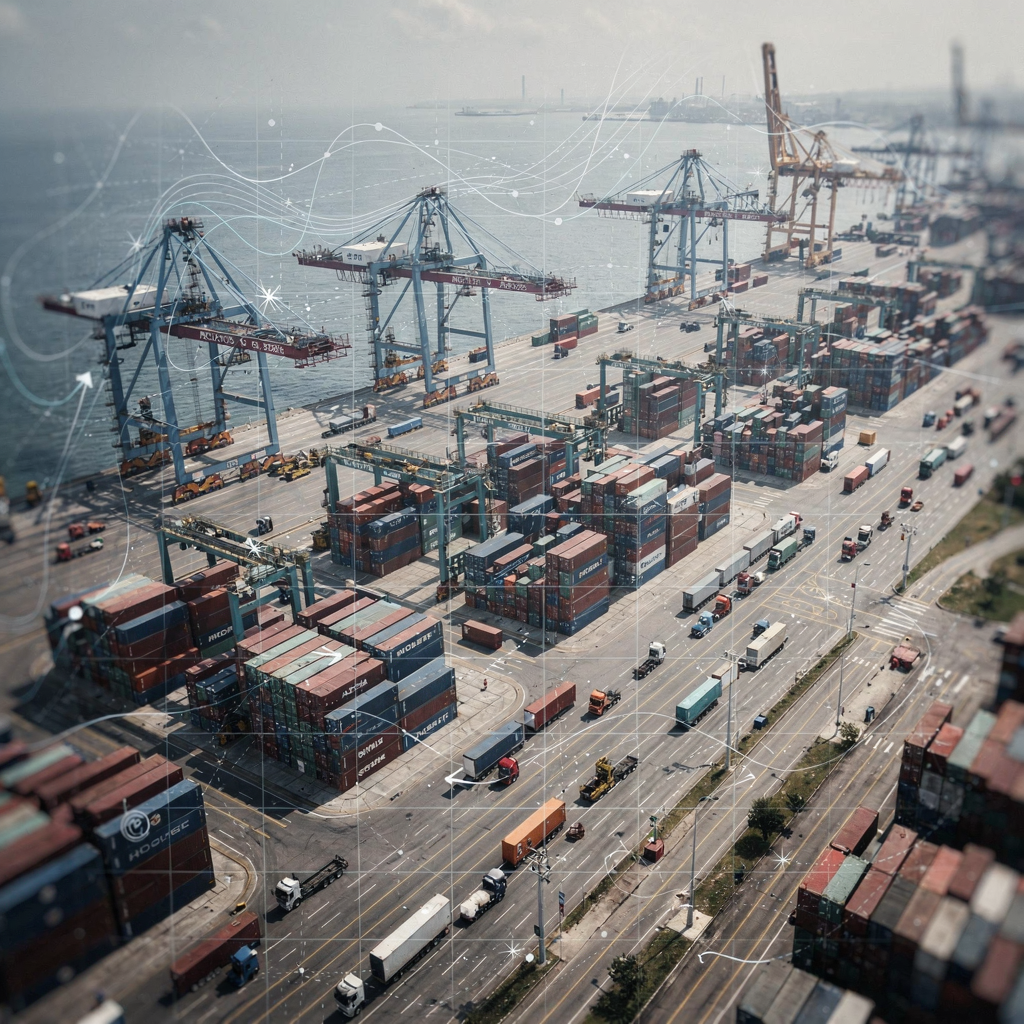
Introduction to terminal and digital twin for port operations
First, a terminal is where ships meet land and cargo moves between sea and hinterland. Next, modern ports depend on precise coordination of quay cranes, trucks, and storage blocks. A digital twin gives operators a live virtual representation of that physical space. It supports real-time monitoring and virtual strategy testing so teams can trial changes without halting operations. For example, research shows simulation results can cut unproductive container handling movements by up to 15–20% when strategies are validated in a controlled virtual environment (source). This statistic highlights why ports invest in a digital twin to increase efficiency and reduce cost.
Key components include sensor networks, telemetry, and data streams. Also, the model must mirror equipment operation and yard geometry. Therefore the role of the digital twin is to fuse sensor feeds, historical trends, and business rules into a trustworthy model that planners use daily. Real-time monitoring of crane cycles, truck arrivals, and stack occupancy enables faster reactions and clearer visualization of yard state. In practice, combining near real-time data with simulation allows teams to quantify the benefits of layout changes and resource reallocation before executing them (source).
Transitioning from manual planning to automated insight requires careful system requirements and verification. First, sensors and a terminal operating system must feed the model accurately. Next, engineers validate the model against yard telemetry and gate timestamps. Finally, stakeholders agree on KPIs and governance. Loadmaster.ai uses this approach when we spin up a digital twin, train agents, and test policies before deployment. This method reduces firefighting, helps planners, and keeps tribal knowledge within reproducible policies.
Building a simulation model for container terminal strategy testing
First, building a high-fidelity simulation model starts with mapping the terminal layout precisely. Then you add quay positions, berth constraints, roadways, yard blocks, and equipment zones. Next, collect granular data: crane cycle times, truck arrival distributions, dwell times, and container sizes. Also include rules for loading and unloading, safety buffers, and shift patterns. A robust simulation model uses both historical data and synthetic scenarios to represent variability. For a clear example, researchers proposed methods to create a virtual container yard that mirrors physical operations for strategy testing (source).
Data collection must cover telemetry, gate logs, and yard crane events. Also, you need container storage maps and dispatcher logs. Then feed that into a discrete event simulation engine. After that, tune parameters using calibration runs and compare simulated KPIs with real KPIs. Use verification cycles to increase confidence. For instance, simulation modeling helped terminals spot sources of rehandles and quantify gains from re-sequencing (source).
Validation must be rigorous. First, run the simulation model against a held-out day of operation. Then compare throughput, moves per hour, and average dwell. Next, adjust distributions until simulated metrics align within an acceptable error band. Finally, perform scenario stress tests for peak periods and equipment faults. Using this process makes the model reliable for planners and for training intelligent agents. Loadmaster.ai uses reinforcement learning agents inside the twin so agents learn by simulated millions of decisions. This solves cold-start problems and avoids teaching models to repeat past mistakes.
Drowning in a full terminal with replans, exceptions and last-minute changes?
Discover what AI-driven planning can do for your terminal
How to optimize allocation in terminal operations
First, allocation decisions shape yard congestion and drive distances. Therefore smart allocation reduces rehandles and boosts terminal throughput. To optimize allocation, begin with block assignment and slot rules. Next, implement dynamic rules that adapt to vessel mixes and gate peaks. For example, a yard strategy that groups containers by next-operation reduces unnecessary moves. In practice, optimization of slot assignment and allocation relies on algorithms that predict near-term demand and protect critical containers.
Heuristic and algorithmic approaches both have roles. A heuristic can quickly place inbound boxes near their next handling point. An algorithmic approach, including multi-objective solvers, can balance crane productivity and equipment utilization. Also, reinforcement learning agents can propose allocation policies that outperform historical rules because they explore policy space rather than imitate the past. For a focused study, Gao et al describe near real-time Digital Twin use to coordinate automated container storage yards and AGVs (source). That paper underlines how dynamic allocation improves coordination and reduces delays.
Resource allocation must consider equipment constraints and shift patterns. Also, allocation interfaces with dispatch and the terminal operating system. Good allocation lowers driving distances, balances workloads, and reduces shifters. A practical step is to add a slot-layer that tags slots with future priorities. Then dispatchers or an automated jobAI can respect those priorities during move sequencing. Finally, operators should measure utilization and rehandle rates to prove gains. To learn more about simulation models for automated terminals and how they tie into allocation logic, read our detailed guide on simulation models for automated terminal operations.
Resolving bottleneck and boosting throughput with automation and crane systems
First, identify common bottleneck scenarios: quay queueing, truck gate peaks, and stack congestion. Next, trace where delays form using time-stamped telemetry. Then apply targeted fixes such as adjusted crane sequencing and temporary block reservations. Real-time monitoring helps teams spot bottleneck formation early. Also, synchronised crane scheduling reduces idle time and switchovers. Case metrics show that synchronising cranes and harmonising yard moves can raise moves per hour considerably. For instance, studies report measurable gains when crane schedules are coordinated with yard flow and AGV timing (source).
Automation can smooth flows if implemented with a clear control system. Automated stacking cranes, automated guided vehicles, and intelligent dispatch reduce human variation. However, they need tight integration and robust scheduling. A terminal that adopts automation must test coordination in a sandbox twin before full rollout. Here, simulation exposes failure modes without endangering operations. Also, adding predictive feeds helps cranes prepare for the next container. For quay-to-yard handoffs, the optimal sequence minimises rehandles and reduces driving distances.
Finally, practical improvements often combine rule changes and technology. For example, synchronised schedules that protect quay productivity during peak arrivals increase terminal throughput while keeping yard congestion low. If you want a deeper technical look at crane scheduling trade-offs, see our analysis on congestion-aware multi-lane crane scheduling. Loadmaster.ai’s three-agent approach coordinates quay planning, yard strategy, and dispatching to reduce bottleneck emergence. That coordination boosts equipment utilization and stabilises throughput across shifts.
Drowning in a full terminal with replans, exceptions and last-minute changes?
Discover what AI-driven planning can do for your terminal
Decision support via simulation software and port simulator: case studies
First, simulation software and a port simulator let teams compare strategies in a virtual space before committing resources. A port simulator can run discrete event simulation at scale and track KPIs. In pilots, terminals used simulation to test new block layouts and crane assignments. One proof point shows simulation-based decision support led to fewer rehandles and shorter driving distances in a pilot block. For background, industry reviews discuss how digital twins are being used to test investment decisions and operational strategies (source).
Leading tools range from general-purpose engines to specialised port simulators. AnyLogic supports distributed simulation and custom agent models, while focused port simulators provide domain-specific primitives. When selecting simulation software, consider system requirements, data ingestion, and visualization needs. Also evaluate the ability to export scenarios for reinforcement learning. In pilot projects, teams often start with a testbed and then scale. A successful pilot documents KPIs, runs sensitivity analyses, and performs verification against actual operations. Afterward, teams roll the validated model into production phases.
Case studies matter. For example, a terminal built a digital twin to test berth allocation and yard re-stow rules. The test showed a 10–18% reduction in unnecessary moves and improved crane utilization. This saved energy and operator time. When you move from pilot to full deployment, governance and integration with the terminal operating system are critical. For further reading on how simulations integrate with yard strategy and stowage patterns, see our article on AI-driven yard strategy optimization. Also, find technical notes on terminal operations digitalization roadmap to guide pilots and scale-up.
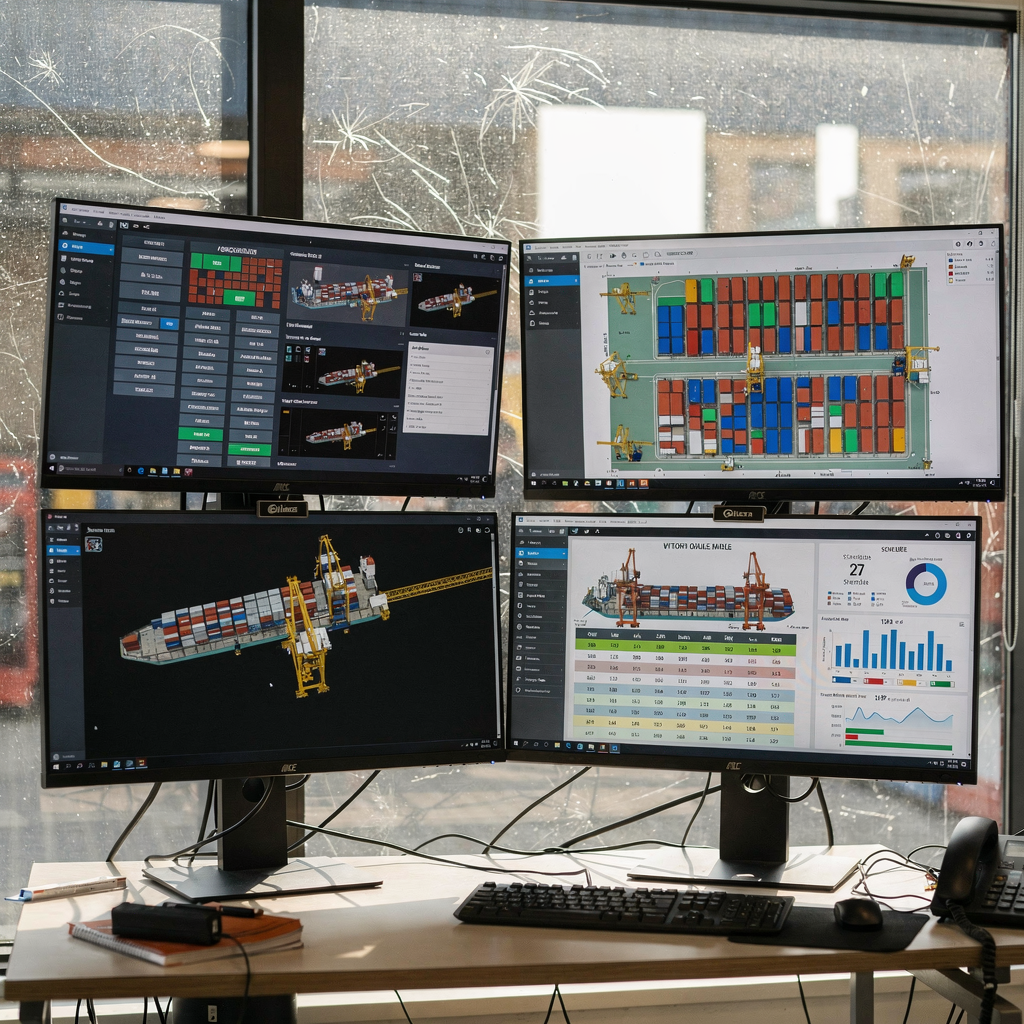
Smart ports using digital twin for production process and gantry integration
First, smart ports envision an end-to-end digital twin ecosystem that links berth planning, gantry scheduling, and hinterland flows. Next, integrate production process analytics with gantry and yard systems so decisions reflect current and predicted loads. The vision includes cloud computing and edge feeds, continuous data collection, and AI models that adapt to changing demand. In this architecture, a decision support system ingests telemetry and suggests policies in seconds.
Using digital twins, terminals can connect production process KPIs with equipment operation. This allows the system to protect quay during vessel peaks and shift focus to yard flow when gates flood. Also, reinforcement learning can train control policies that optimise multiple competing KPIs. Loadmaster.ai applies RL to create agents that coordinate stowage, stack placement, and execution to reduce rehandles and balance workloads. The approach produces consistent performance across shifts and gives terminals resilience to disruptions.
Future trends point to deeper AI-driven optimisation and proactive resilience. For example, combining predictive routing for trucks with gantry schedules reduces wait times. Also, integrating distributed simulation enables scenario ensembles that test shock events. For research directions, see work on digital twins for strategic planning and infrastructure investment that recommends what to quantify and how to include trade-offs in decisions (source). Finally, as industry 4.0 principles spread, terminals will rely more on simulation-based decision support and reinforcement learning to handle complex scheduling problems and shifting global trade patterns.
FAQ
What is a digital twin for a container terminal?
A digital twin is a live virtual mirror of a physical terminal that fuses sensor feeds, rules, and analytics. It enables planners to test operational changes safely and to monitor performance in near real-time.
How does a virtual container yard help reduce rehandles?
By simulating placement and retrieval strategies, a virtual container yard shows how moves cascade across the stack. Planners can trial slot assignment policies and measure rehandle rates before applying them in the real yard.
What data are required to build a reliable simulation model?
Essential inputs include crane cycle times, gate timestamps, truck arrivals, and container metadata. Historical data plus synthetic scenarios give a complete picture for calibration and verification.
Can automation fully remove bottlenecks?
No system removes all bottlenecks, but automation combined with coordinated scheduling reduces many common constraints. Also, simulation exposes weak points so teams can apply targeted fixes.
What role does reinforcement learning play in terminal optimization?
Reinforcement learning trains agents to develop policies that balance competing KPIs without needing large historical datasets. It can learn by simulating millions of scenarios inside a twin and then deploy with safety guardrails.
Which simulation software should terminals consider?
Terminals should evaluate tools that support discrete event simulation and domain-specific port primitives. Consider integration, scalability, and visualization; for more, see our page on simulation models for automated terminal operations.
How long does a pilot of a container terminal digital twin take?
Timelines vary, but pilots often run for several weeks to months to capture variability and to validate KPIs. Pilots focus on a testbed block and then expand once results meet governance criteria.
What KPIs should operators track in the twin?
Common KPIs include moves per hour, equipment utilization, drive distance, dwell time, and rehandle counts. Tracking these lets teams quantify gains and tune policies effectively.
How do terminals ensure simulation accuracy?
Accuracy comes from calibration, verification against real telemetry, and sensitivity testing. Regular updates to the model and continuous verification keep the twin aligned with reality.
How can I learn more about implementing a digital twin?
Start with a roadmap that maps technical, governance, and integration needs. Our terminal operations digitalization roadmap explains steps from pilot to scale and provides practical advice for deployment (resource).
our products
 stowAI
 stackAI
 jobAI
jobAI
Innovates vessel planning. Faster rotation time of ships, increased flexibility towards shipping lines and customers.
Build the stack in the most efficient way. Increase moves per hour by reducing shifters and increase crane efficiency.
Get the most out of your equipment. Increase moves per hour by minimising waste and delays.
stowAI
Innovates vessel planning. Faster rotation time of ships, increased flexibility towards shipping lines and customers.
stackAI
Build the stack in the most efficient way. Increase moves per hour by reducing shifters and increase crane efficiency.
jobAI
Get the most out of your equipment. Increase moves per hour by minimising waste and delays.