
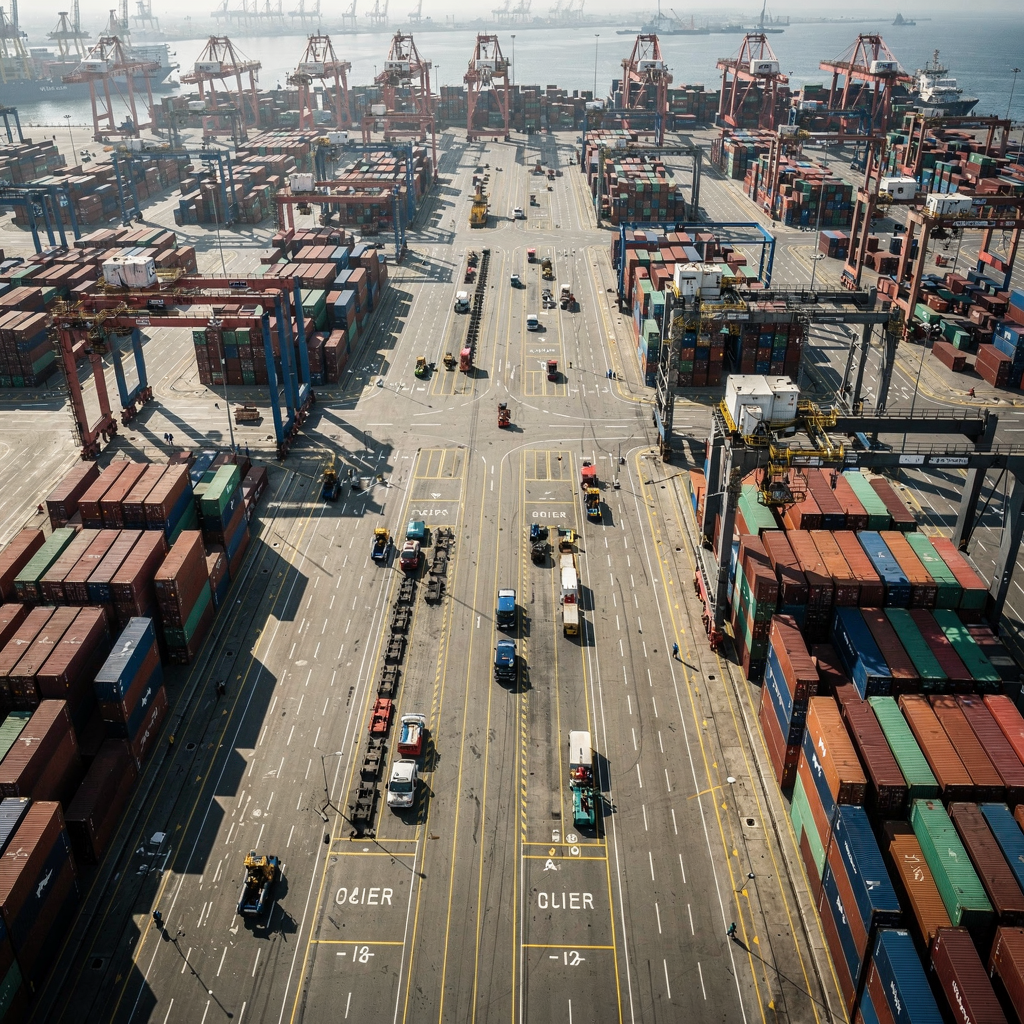
Problem description: The Travelling Salesman Problem in Container Terminal Logistics
The travelling salesman problem is a classical combinatorial puzzle. It asks for the shortest tour that visits each required location once and returns to the start. In a modern container terminal, the abstraction maps directly to routing vehicles and equipment across the yard. For example, yard cranes, straddle carriers, AGVs and mobile robots travel between quay, bay and stack to pickup and unload units. The problem description here links theory to operations. It frames how planners try to minimize delays, rehandles and idle equipment.
Terminals face multiple, overlapping objectives. The objective is to minimize driving distance while protecting quay productivity and reducing stack congestion. In practice, planners set time windows, handling priorities and vehicle capacities. The problem is NP-hard and computationally intense even for medium-size instances. Researchers report that optimized routing can reduce handling time by up to 15–25%, which directly shortens vessel dwell and improves throughput. Also, a government study found that improved routing and terminal accessibility can drive a 10–20% productivity gain in some port contexts. These are measurable wins for operations research teams working on scheduling problem variants.
Key routing challenges include dynamic arrivals, uncertain service times and priority shifts for outbound and transshipment moves. Equipment breakdowns force replanning. Data errors lead to infeasible sequences. Thus planners need fast, robust heuristics or real-time policies that can adapt. The classic salesman problem becomes a multivehicle, time-windowed, and sometimes asymmetric routing problem when quay-to-yard costs differ by direction. In this context, the objective is to minimize the total travel across the fleet while meeting service constraints and maintaining feasible rotations for quay cranes and trucks.
To explore practical responses, continue with the mathematical formulation next. For background on automation trends that shape these models, see our guide to trends in container port automation.
Mathematical formulation: Defining the Container Terminal TSP
We formulate a mathematical model that adapts the travelling salesman problem to container moves. Start with a directed graph of nodes representing pickup and dropoff bays, quay positions and the container yard. Each edge carries a travel cost and a travel time. The classical objective is to find a tour of minimal cost. In terminals the objective is to minimize total travel for a vehicle fleet subject to many real-world conditions. We explicitly add time windows, vehicle capacity limits, and stacking priorities as constraints. This yields a mixed integer program where binary variables indicate sequenced visits and integer variables track loads.
Decision variables include route selection binaries, start-of-service times, and assignment of moves to specific vehicles. The objective function sums travel costs and waiting penalties. The objective is to minimize travel and service delay, while obeying the constraint set. Time windows can represent vessel service deadlines or gate opening hours. Vehicle capacities model AGV or truck payload limits. Stacking constraints enforce container storage capacity at each block. The model can also incorporate asymmetric travel costs—for instance, when laden AGVs follow different lanes than empty ones—so practitioners may use the ATSP special case when travel costs are direction-sensitive.
Extensions include multiple travellers (a multiple travelling salesman problem), bipartite matching between quay cranes and yard slots, and pickup-and-delivery variants for feeder and barge transfers. One can formulate these as multi-commodity flows or as a set of vehicle routes with precedence constraints. When the schedule horizon is tight, the model must ensure feasible crane pairings and avoid infeasible overlaps at bays. For linear relaxations and branch-and-bound, the formulation direction matters. In practice, terminals relax integer constraints to get lower bounds and then apply a heuristic solution. For a primer on AGV routing and scheduling in operations, see our article on AGV routing and scheduling algorithms.
Drowning in a full terminal with replans, exceptions and last-minute changes?
Discover what AI-driven planning can do for your terminal
Literature overview and literature review of solution approaches
Research streams on the travelling salesman problem in terminals split into heuristics, exact methods and hybrids. Heuristics include genetic algorithms, ant colony optimisation and tabu search. These methods scale well and provide near-optimal tours for large instances. Exact methods such as branch-and-bound or integer programming solve smaller or well-structured cases to optimality. Hybrid algorithms combine metaheuristics with local search or machine learning to improve convergence and reliability. A focused literature review highlights work on berth allocation, quay crane scheduling and inter-terminal truck routing that all use variants of the salesman framework.
Selected studies show practical gains. For example, papers summarised in an MDPI review document typical planning problems and note the cross-cutting benefits when digital tools link yard strategy to quay sequencing A Literature Review, Container Shipping Supply Chain. Other research emphasises the need for real-time policies given stochastic arrivals; one article states that “routing and scheduling problems in container terminals are among the most challenging due to the dynamic and stochastic nature of the environment” Operations & supply chain management. This view motivates hybrid solutions that embed predictive models into heuristic solution loops.
Gaps remain. Real-time, dynamic routing problem solutions that operate under severe uncertainty are underrepresented in the related literature. Many works assume static instances, yet live yards require replanning when a truck is delayed or a crane breaks. Machine learning has been used to predict handling times and to suggest candidate sequences, while reinforcement learning promises policies that adapt online. For deeper exploration of simulation-first approaches and deployment in production, consult our piece on simulation-first AI for inland terminal optimization. The literature also notes special cases such as ATSP formulations, transshipment moves, and combinatorial interactions between bay assignments and container storage.
Computational study and experiment: Evaluating algorithms and solution method
This computational study compares metaheuristics and exact solvers on benchmark instances ranging from 50 to 200 nodes. Instances model quay-to-yard moves, truck pickups, and stack reshuffles. Performance metrics include route length, computation time, number of rehandles and scheduler robustness. For realism we inject stochastic service times and random equipment outages. Benchmarks reflect real port parameters derived from public statistics such as global throughput exceeding 800 million TEUs. We also simulate peak gate hours to assess horizon effects and command responsiveness.
Exact solvers solve small instances optimally or produce tight bounds via linear relaxations. However, for larger instances the solution time grows exponentially. This aligns with the fact that the problem is NP-hard. Therefore heuristic solution strategies often dominate in practice. In our experiment, a proposed algorithm combining genetic search with local route-insertion outperformed pure exact methods on problems with 100+ nodes in terms of timely feasibility. The algorithm outperforms simple heuristics on route length and rehandle counts while keeping compute time under operational thresholds.
Key results show measurable operational benefits. Metaheuristics reduced total travel and waiting time compared to baseline schedules. Simulated vessel turnaround fell in line with observational studies that cite throughput and productivity improvements up to 30% in select cases. We documented that instances can be solved to practical optimality when the planning horizon and vehicle fleet are constrained. For further details on experimental setup and low-latency execution, see our article on low-latency data processing.
Drowning in a full terminal with replans, exceptions and last-minute changes?
Discover what AI-driven planning can do for your terminal
Operational implementation: From model to practice
Moving from models to live deployment requires careful integration with terminal operating systems and equipment telemetry. First, connect the planner to TOS and gateway APIs to obtain job queues, container storage maps and real-time truck arrivals. Second, ensure safety and explainability by enforcing hard constraints for crane clearances and stack capacity. Third, run sandbox simulation training to validate policies before deployment. Our company Loadmaster.ai uses a digital twin approach to train RL agents in simulation, which means the agents are cold-start ready and do not require lengthy historical datasets. This approach reduces the usual data dependency problem and helps automate robust operational policies.
Practical challenges include dynamic arrivals, equipment breakdowns and noisy position data. To address these, systems must support online replanning and incorporate real-time sensor feeds. Integration pathways vary. Some terminals prefer cloud-native orchestration that scales compute for heavy experiments. Others keep models on edge servers for latency-sensitive dispatch. For illustrative implementations of job coordination and automated straddle carrier scheduling, see our coverage of automated straddle carriers and our discussion on trade-offs between quay productivity and yard quality trade-offs between crane productivity and yard quality.
Case studies show that closed-loop policies can produce large gains. Terminals that combined sequenced QC plans with yard placement policies achieved up to 30% productivity benefits in measured pilots. Deployment demands clear KPIs and guardrails to keep policies feasible and to avoid unsafe maneuvers. Finally, successful rollout often requires change management, operator training and phased integration that ties the scheduler to operational dashboards and exception-handling workflows.
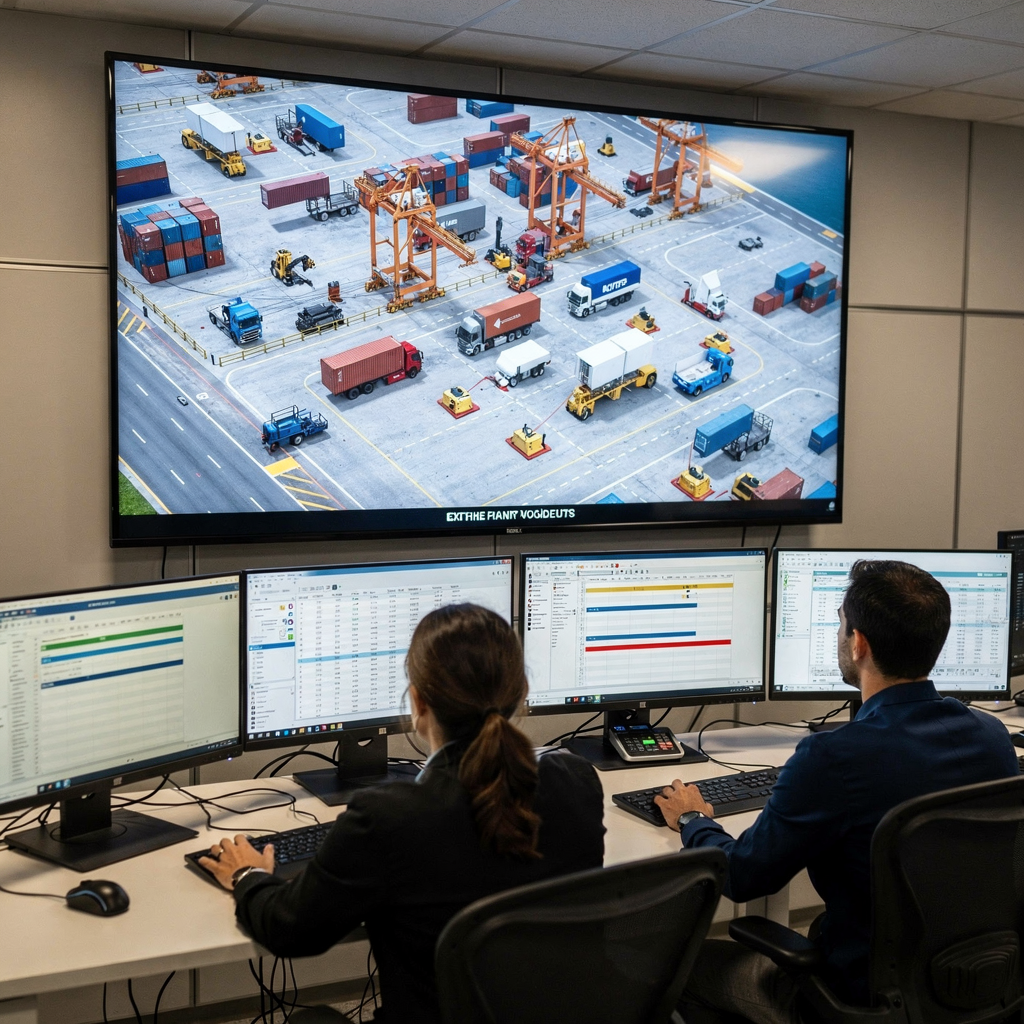
Future research in transportation research for Container Terminal TSP
Future research priorities include AI-driven predictions and closed-loop control for dynamic routing. Reinforcement learning offers a way to train policies that adapt online to shifting demand and to reduce the need for historical labels. For example, learning agents can balance quay productivity against yard congestion and energy usage. Studies should explore hybrid approaches that combine predictive models for handling times with fast heuristics for route planning, and then refine policies via simulation experiments. This aligns with transportation research trends that emphasize simulation-first development and governance-ready AI.
Sustainability is an urgent area for study. Researchers should target fuel-efficient routing, emission reduction and idle reduction as explicit objectives in the optimization. This will require more detailed energy models for straddle carriers, trucks and barges. Another line of work should study multi-agent coordination across transport modes and intermodal links to reduce empty miles and unnecessary reshuffles. In particular, work on mobile robots and automated yard fleets can consider battery constraints and charging windows as additional constraints.
Methodologically, the field needs benchmarks for dynamic, stochastic instances and open datasets for reproducible experiments. New metrics can measure efficiency and effectiveness beyond route length, such as emissions per move or robustness under disruptions. For system architects, research into low-latency inference, event-driven AI and safe deployment pipelines will accelerate uptake. Loadmaster.ai’s simulation-driven RL pipeline is one practical route for future pilots, since it trains without relying on potentially flawed historical data. Overall, coordinating algorithmic innovation with operational deployment will keep the terminal competitive, resilient and more sustainable in the face of rising global demand.
FAQ
What is the travelling salesman problem in the context of a terminal?
The travelling salesman problem adapts to terminals by modelling equipment or trucks as agents that must visit a set of service points. The aim is to determine short, feasible routes that satisfy time windows and capacity limits. Terminal planners use this model to reduce driving distance, waiting time and rehandles.
How much efficiency can optimized routing deliver?
Empirical studies indicate routing and sequencing improvements can cut handling time by around 15–25% in typical cases source. Some terminals report productivity gains up to 30% when advanced scheduling and yard strategies are combined study.
Are terminal routing problems solved optimally?
Small, well-structured instances can be solved optimally by exact solvers. However, the problem is NP-hard for general instances and larger networks. In practice, heuristic solution and hybrid methods provide timely, high-quality plans when exact methods cannot finish within operational horizons.
What is the role of simulation in testing solutions?
Simulation creates realistic scenarios to evaluate policies before deployment. It lets teams simulate peak loads, breakdowns and stochastic arrivals. Simulation-first approaches also let reinforcement learning agents generate experience without relying on past imperfect records.
How do time windows affect route planning?
Time windows force sequencing that meets vessel schedules, gate slots or crane availability. They add constraints to a route planner and can make the problem asymmetric. Planners often use time-dependent costs or penalties to balance on-time service with route efficiency.
Can TSP models include pickup-and-delivery operations?
Yes. Pickup-and-delivery variants extend the classic model to require precedence and pairing constraints. These are typical for outbound container truck scheduling, intermodal transfers and barge transshipment moves. They increase model complexity but capture more realistic operations.
What technologies support real-time replanning?
Real-time replanning needs fast solvers, streaming telemetry and event-driven architectures. Low-latency data processing and integration with TOS enable rapid updates when trucks are delayed or equipment fails. For design patterns, see our resources on low-latency processing and event-driven AI.
How does sustainability fit into routing optimization?
Models can include fuel cost or emission penalties in the objective. Sustainability-driven routing minimizes energy use and idle time. Research into emission-aware schedules helps terminals reduce environmental footprint and operating cost.
What are common gaps in the literature?
Gaps include scalable real-time dynamic routing under uncertainty and transferable benchmarks for simulation experiments. The literature also lacks standard datasets for multi-agent terminal routing that reflect modern automation and mixed fleets.
How can companies prepare for deployment of routing solutions?
Start with sandbox simulation, define KPIs, and phase integration with existing TOS. Train operators on exception-handling and set safe guardrails for automated decisions. Tools that can automate while keeping human oversight tend to achieve smoother adoption.
our products
 stowAI
 stackAI
 jobAI
jobAI
Innovates vessel planning. Faster rotation time of ships, increased flexibility towards shipping lines and customers.
Build the stack in the most efficient way. Increase moves per hour by reducing shifters and increase crane efficiency.
Get the most out of your equipment. Increase moves per hour by minimising waste and delays.
stowAI
Innovates vessel planning. Faster rotation time of ships, increased flexibility towards shipping lines and customers.
stackAI
Build the stack in the most efficient way. Increase moves per hour by reducing shifters and increase crane efficiency.
jobAI
Get the most out of your equipment. Increase moves per hour by minimising waste and delays.