
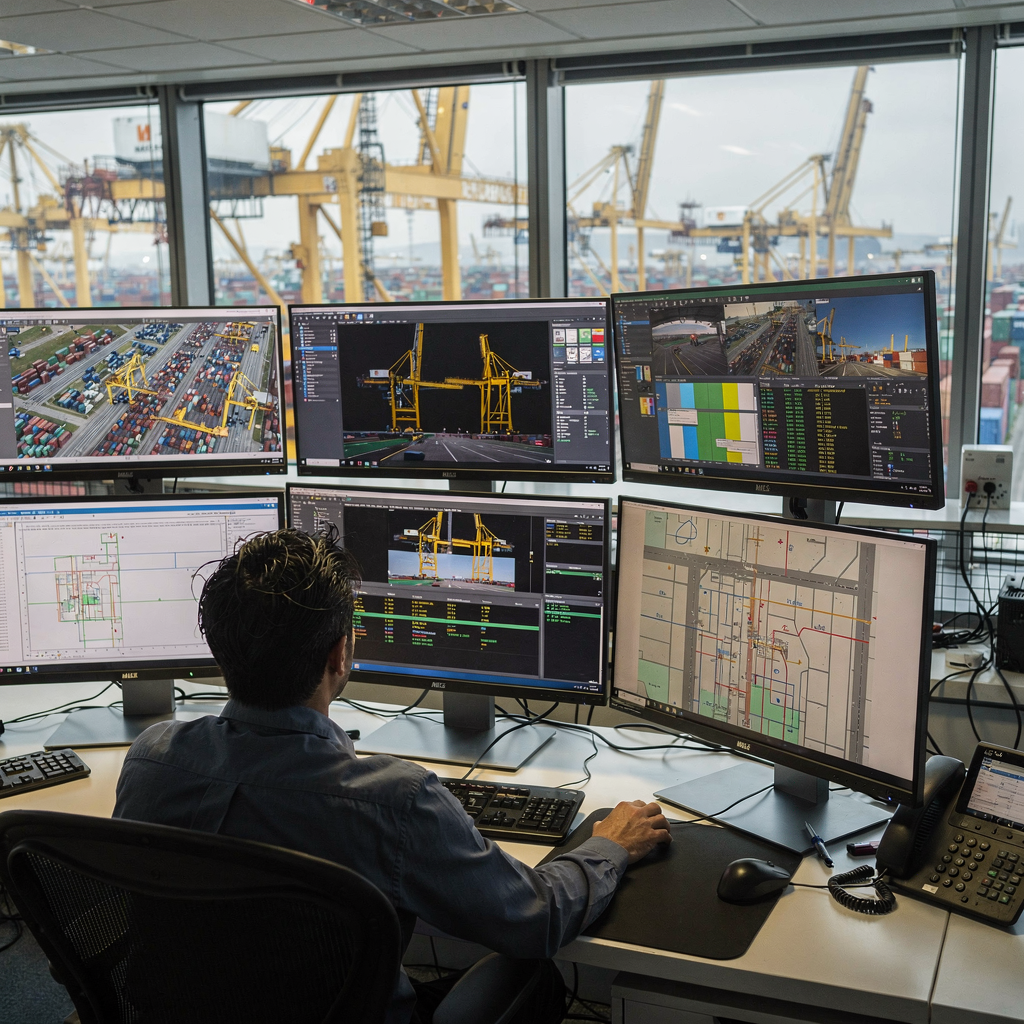
Port operations and port productivity Challenges
Deepsea container port operations are complex systems that link sea, quay, yard, gate, and hinterland. These systems handle massive container volume and tight schedules. KPIs such as quay crane moves per hour, berth productivity, yard throughput, and container dwell measure success. Port operators track berth planning and container turn times to meet service windows. However, congestion and unpredictability still slow many terminals. Equipment idle time, berth scheduling conflicts, and yard congestion form the most common productivity bottlenecks. Equipment idle time appears when quay cranes or yard cranes wait for moves. Berth scheduling misaligns vessel windows with crane availability. Yard congestion increases stacking and reshuffling. These issues raise costs and reduce operational efficiency.
PLCs are central to modern automation in these settings. Programmable Logic Controllers collect sensor readings, actuator statuses, and control signals across cranes, conveyor systems, and automated container handlers. PLCs feed event streams that describe start/stop cycles, motor currents, and door positions. By design, PLCs run control loops with millisecond timing, so they are a natural source of real-time signals for AI. In practice, these signals expose the immediate state of port equipment and reveal patterns before faults manifest. Historically, ports relied on historical data and rule-based systems that copy the past. That approach often fails when vessel mixes or yard states change. Loadmaster.ai uses simulation-first reinforcement learning to train AI agents without needing large amounts of historical data, which reduces dependence on old patterns and improves adaptability across the entire port.
Ports must balance throughput and resilience. A management system that only reacts will struggle during peak windows. Port authorities and port operators need tools that predict and act. This need is what drives the integration of PLC telemetry with event-driven AI architectures. For readers who want more on equipment-level AI tied to PLCs, see our guide about improving equipment responsiveness through PLC-integrated AI systems at Loadmaster.ai that explains how sensor events convert to execution signals improving equipment responsiveness through PLC-integrated AI systems. Overall, effective port management requires faster decisions, better synchronization, and clear KPIs that align quay, yard, and gate flows.
AI technologies and agentic ai for automation
Event-driven AI is a pattern where systems observe events and react immediately. For ports, this means using PLC event streams to trigger analysis and control. The concept of an event-driven architecture explains this shift well: “Event-driven architectures have proven to be a transformative foundation for modern AI and data processing systems” Event-Driven Architectures: A Technical Deep Dive. This model lets AI respond without waiting for batch jobs. As a result, ports gain faster feedback and reduced latency.
Agentic AI describes autonomous agents that take actions to achieve goals. In the port environment, agentic AI can sequence crane lifts, assign jobs to automated guided vehicles, or rebalance the yard. Typical AI models suitable for these tasks include reinforcement learning agents, anomaly detection models, and decision agents that encode operational constraints. Reinforcement learning excels where many trade-offs exist. For example, RL agents can balance quay productivity against yard congestion and driving distance. Loadmaster.ai builds three cooperative agents—StowAI, StackAI, and JobAI—to operate as a closed-loop team. These agents train in a digital twin, then deploy with operational guardrails so planners retain control.
AI systems process PLC event streams by converting raw tags into structured events. First, an event broker ingests telemetry. Next, a processing layer filters, validates, and enriches events with context. Then, models run inference or plan actions. For low-latency uses, edge compute near the PLC reduces round-trip time. For larger optimisations, cloud nodes aggregate data and retrain policies. To learn more about event-driven design in practice, see Hazelcast’s explanation of this pattern What Is Event-Driven Architecture?. In ports, agentic AI and event-driven design combine to automate repetitive decisions while enabling humans to approve exceptions.
Drowning in a full terminal with replans, exceptions and last-minute changes?
Discover what AI-driven planning can do for your terminal
Container terminal operations: application of ai in container handling
AI is already reshaping container terminal operations with targeted use cases. Examples include crane lift sequencing, AGV routing, and straddle carrier coordination. A single AI agent can optimise crane sequencing to reduce unnecessary lifts and rehandles. Another agent can route automated guided vehicles to minimise travel time and avoid congestion. The application of AI in container handling relies on fast sensor events from PLCs so the models can react to micro-changes on the quay and in the yard. In practice, these techniques reduce dwell time and improve safety.
Consider crane lift sequencing. An AI algorithm can predict the next best lift given vessel stow plans, current crane load, and yard acceptance windows. This reduces crane idle time and smooths berth productivity. Field trials show that digital optimisation can boost moves per hour while lowering yard reshuffles. For AGV routing, AI uses map overlays and event feeds to plan collision-free paths. This reduces driving distance and energy use. For straddle carriers, coordination agents minimise conflicts and balance work across shifts. The combined effect is lower container dwell and steadier throughput.
At a systems level, the container terminal operating system becomes the orchestration layer. Integration of AI helps the TOS make execution-level choices that historically depended on experienced planners. Because RL agents simulate millions of decisions in a digital twin, terminals avoid relying solely on historical data. This is important because historical data often embeds bad practices. Loadmaster.ai’s simulation-first approach enables terminals to automate complex trade-offs from day one without large training histories. For technical readers, our article on AGV routing and scheduling algorithms describes routing strategies for automated guided vehicles AGV routing and scheduling algorithms in terminal operations. Likewise, our review of low-latency processing shows how to deliver the PLC events that AI needs low-latency data processing for container terminal AI solutions.
Real-time ai integration with PLC Data
An event-driven architecture for ports typically includes PLCs, edge nodes, event brokers, and cloud services. The PLCs emit tag changes. Edge compute nodes validate and format messages. An event broker routes events to AI models and dashboards. This pattern ensures that decision agents receive timely, contextual inputs. For more on the software layers and cloud versus edge trade-offs, our guide about cloud versus edge AI for container ports explains deployment choices cloud versus edge AI for container ports.
Low-latency data ingestion from heterogeneous PLCs is challenging. Different vendors use different protocols, tag names, and sample rates. Techniques for rapid ingestion include protocol adapters, OPC-UA gateways, and parallel collectors that batch telemetry into event messages. For guaranteed delivery, you can use reliable message queues and persistent storage at the edge. Synchronisation across PLCs often depends on timestamp alignment and heartbeat messages. Data validation should run close to the source. It should drop malformed packets, flag missing tags, and enrich events with location and equipment IDs. Once validated, the event pipeline can feed both local AI agents and central analytics.
In ports that need sub-second responses, colocated edge inference reduces latency. For less time-sensitive analytics, a cloud training pipeline aggregates historical events and retrains policies. When designing for reliability, include retries, idempotent message handlers, and fallback operational modes that let human operators intervene. Standards and interoperability are essential. Use open formats and avoid vendor lock-in where possible. An architecture like this supports both automated container workflows and human-in-the-loop exception handling. For real-world workflow design and human oversight in vessel planning, see our work on exception handling with human-in-the-loop vessel planning exception handling workflows with human-in-the-loop vessel planning. Finally, event-driven pipelines let AI models update plans continuously and keep the entire port aligned.
Drowning in a full terminal with replans, exceptions and last-minute changes?
Discover what AI-driven planning can do for your terminal
Implementing ai for smart port terminal automation
Implementing AI across a port requires a phased roll-out. Start with pilot trials on a single berth or yard block. Then scale to multiple berths and connected gates. Finally, move to full operational deployment once KPIs show consistent improvement. A pilot should define success metrics, safety guardrails, and rollback plans. During pilots, use a digital twin to simulate edge cases. Loadmaster.ai trains agents in sandboxes so terminals can test policies without risking live operations.
Infrastructure requirements include resilient networks, edge compute nodes, middleware, and a modern management system. Network resilience often requires redundant links and industrial-grade switches. Compute nodes at the edge run inference close to PLCs. Middleware must support secure APIs and event brokers. Interoperability with the existing container terminal operating system is essential. You should also plan for integration with the port community system and TOS APIs. For implementation patterns that scale, see our terminal operations digitalization roadmap terminal operations digitalization roadmap.
Security frameworks matter. Protect real-time data and PLC channels with encryption, authentication, and role-based access. Staff training is equally important. Operators and planners must learn how to work with agentic AI and when to override decisions. Best practices include staged deployments, audit trails, and change control. Standardisation of messages and tags simplifies deployment across mixed fleets of port equipment. Ports should also adopt governance-ready AI processes to remain compliant with regulations and to provide transparency in decisions. These steps help ports smoothly automate more tasks and manage operations with predictable, measurable outcomes.
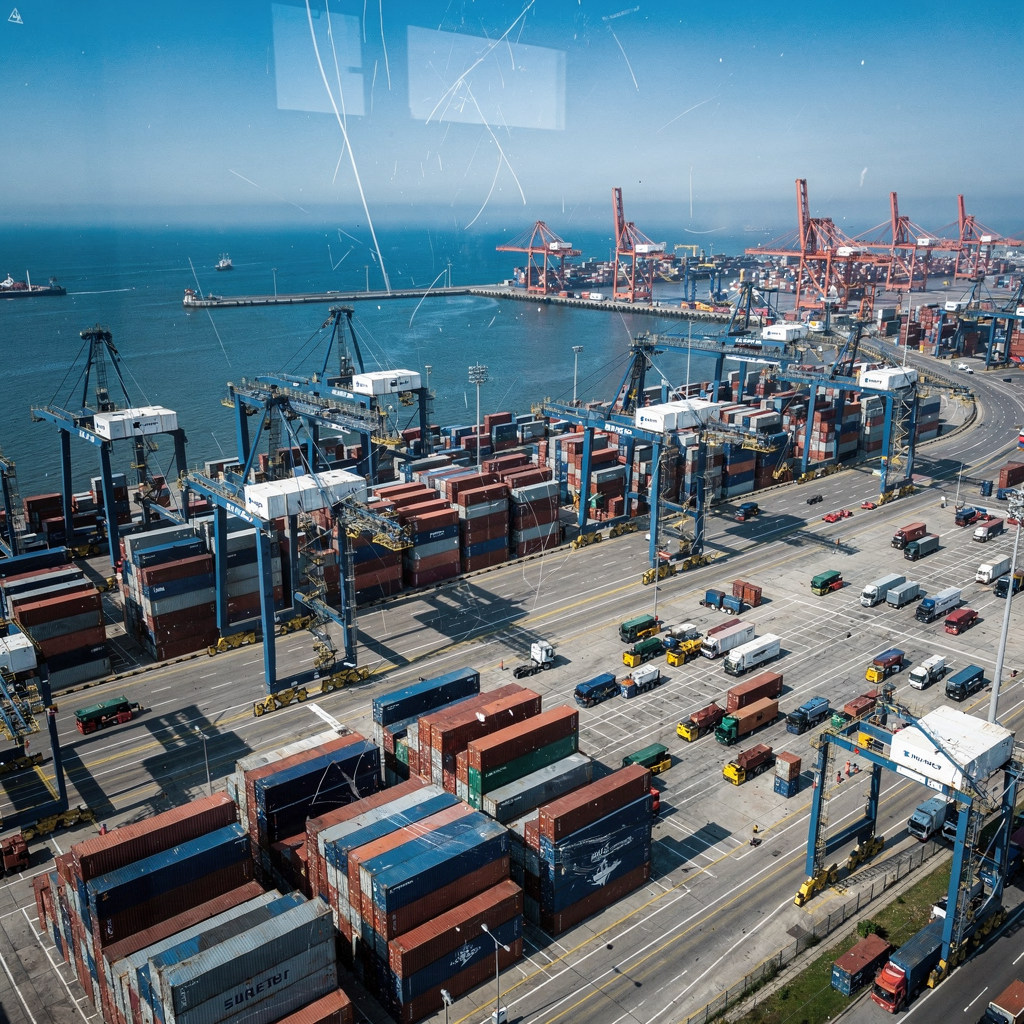
Benefits of ai and sustainability in port planning
The benefits of AI for ports extend beyond productivity. AI can reduce downtime, lower energy use, and improve labour allocation. Quantitatively, digital transformation initiatives can boost operational efficiency by up to 30% according to sector research Consultancy research into the UK maritime technology sector. Event-driven systems can also shorten software deployment cycles and improve integration testing, with reductions in deployment time reported around 40% in agile embedded software work Agile Continuous Integration Testing of Embedded Software. These improvements translate into fewer crane idle hours, lower fuel consumption for yard vehicles, and more predictable berth schedules.
Sustainability benefits include lower emissions through reduced driving distances and fewer idle engines. AI can optimise gate slots and reduce truck queuing. As a result, terminals cut carbon output and support city air quality goals. Ports worldwide face pressure to meet green port targets. Intelligent routing and scheduling contribute to a sustainable port future by reducing wasted moves and improving load factors on trucks and ships. For example, solutions that streamline operations at the quay and yard help reduce unnecessary rehandles and lower container dwell.
AI also supports strategic port planning. By analysing live events and historical trends, models can predict container volumes and simulate scenarios for expansion. This enables port planners to test investments in yard layout, crane fleets, and gate capacity before committing capital. In addition, data analytics applied to PLC events helps forecast maintenance, which reduces unexpected downtime and supports longer equipment lifecycles. As one study on socio-technical risks in autonomous maritime systems explains, addressing human and technical integration is central to safe adoption Socio-Technical Considerations for the Maritime Autonomous Systems.
Benefits of AI in ports are measurable. They include lower operating costs, energy savings, and better KPIs for berth and yard productivity. When ports adopt these models responsibly, they can become modern, efficient hubs that support global trade while meeting sustainability goals. To explore ROI and phased deployment approaches, see our resource on the ROI of port operations automation projects ROI of port operations automation projects. Overall, AI enables ports to plan and operate with higher confidence and fewer surprises.
FAQ
What is event-driven AI and why is it important for ports?
Event-driven AI reacts to events as they occur, rather than waiting for periodic batches. This approach fits well with PLC outputs, which produce continuous signals from cranes, conveyors, and gates. By responding in real-time, AI reduces latency between detection and action and enables more agile port operations.
How do PLCs feed AI models in a container terminal?
PLCs emit tags and status changes that are ingested by edge collectors or gateways. Those messages are validated, enriched, and forwarded to event brokers or local AI inference nodes. The AI uses that context to make decisions about crane sequencing, AGV routing, or maintenance alerts.
Can AI predict equipment failures from PLC signals?
Yes. Predictive maintenance models use patterns in PLC sensor data to flag rising risk of failure. When combined with scheduled checks and human inspection, this reduces unplanned downtime and extends equipment life.
What improvements can terminals expect when they automate with AI?
Terminals often see efficiency gains such as higher crane moves per hour, lower container dwell, and fewer rehandles. Research suggests that digital transformation can increase operational efficiency by up to 30% in some cases sector research. Results depend on the baseline and rollout quality.
How does agentic AI differ from traditional rule-based systems?
Agentic AI acts autonomously to optimize multi-objective goals and adapts to new conditions. Rule-based systems follow fixed procedures and often fail when the environment changes. Agentic approaches, such as reinforcement learning, can search for improved policies without needing large historical datasets.
Is it safe to let AI control crane and vehicle operations?
Safety requires layered controls: hard constraints, audit trails, and human-in-the-loop oversight. Pilots and simulated testing in a digital twin reduce operational risk before live deployment. Many providers implement guardrails so humans can accept or override suggested actions.
What infrastructure is needed to implement AI at a port?
Key components include resilient networks, edge compute for low-latency inference, event brokers, secure middleware, and integration with the terminal operating system. Training environments and digital twins are also important for verifying performance before rollout.
How do AI solutions help with sustainability goals?
AI reduces fuel use by shortening vehicle travel and avoiding idle time. It also optimises gate windows to reduce truck queuing and port emissions. These operational changes help ports meet emissions targets and lower their environmental footprint.
Can AI work without large historical datasets?
Yes. Reinforcement learning agents can train in simulated digital twins, producing policies that work from day one. This avoids the need for clean, extensive historical data and prevents learning from past inefficiencies. Loadmaster.ai uses this approach to deliver cold-start ready agents.
How should ports start implementing AI and automation?
Begin with focused pilots on a single berth or yard block and define clear KPIs. Use a digital twin for safe testing, then scale gradually while training staff. Adopt interoperability standards and robust security practices to ensure a smooth rollout and reliable management of port operations.
our products
 stowAI
 stackAI
 jobAI
jobAI
Innovates vessel planning. Faster rotation time of ships, increased flexibility towards shipping lines and customers.
Build the stack in the most efficient way. Increase moves per hour by reducing shifters and increase crane efficiency.
Get the most out of your equipment. Increase moves per hour by minimising waste and delays.
stowAI
Innovates vessel planning. Faster rotation time of ships, increased flexibility towards shipping lines and customers.
stackAI
Build the stack in the most efficient way. Increase moves per hour by reducing shifters and increase crane efficiency.
jobAI
Get the most out of your equipment. Increase moves per hour by minimising waste and delays.