
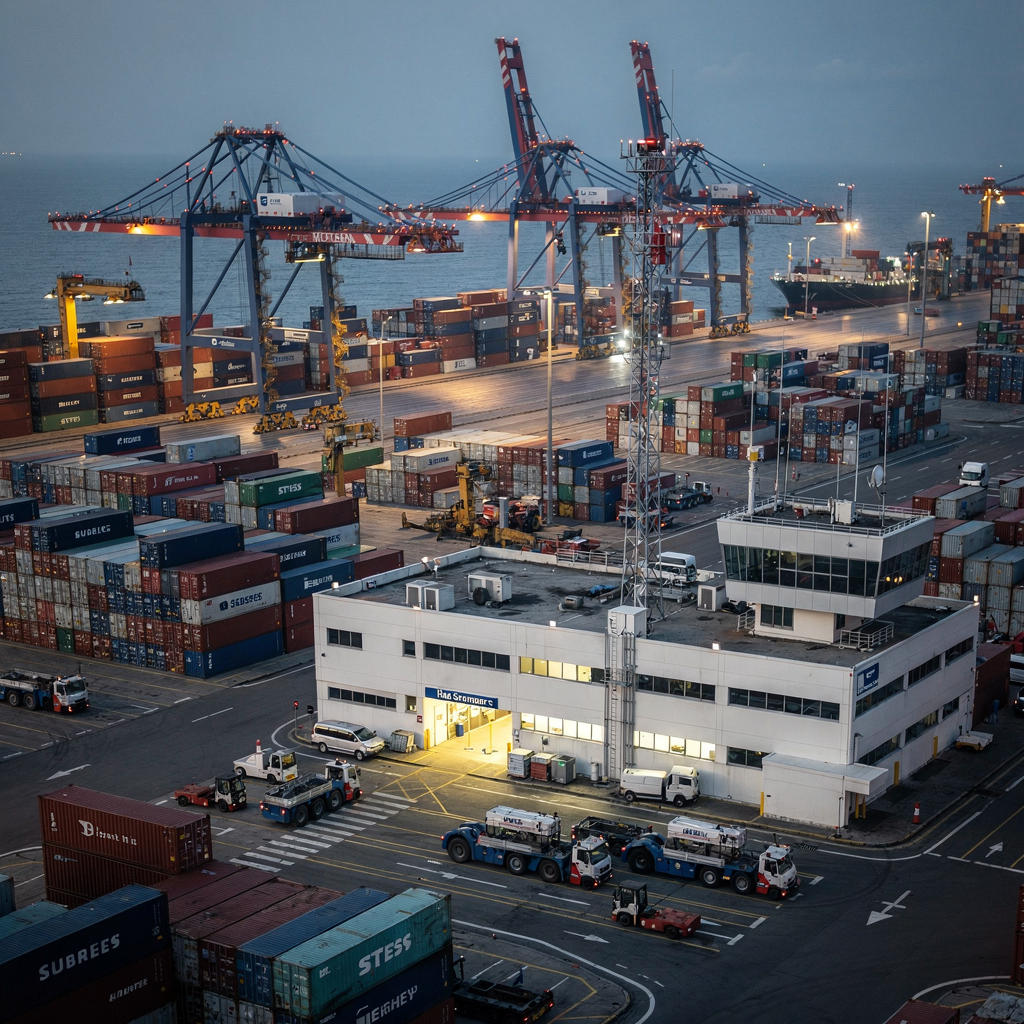
container terminal operating system: Key components and functions
A container terminal operating system defines control, coordination, and decision logic for container flow. It runs software agents that schedule moves, assign equipment, and monitor condition data across the yard. In practice, a CTOS for container merges real-time sensor feeds, operator inputs, and business rules. Importantly, it supports seamless data exchange with external systems; see detailed interfaces for data exchange with existing port operations TOS for integration guidance interfaces for data exchange.
The CTOS monitors cranes, gates, and automated guided vehicles. It also tracks yard management zones and container handling steps. Today, AI systems augment planners and dispatchers. For example, our Loadmaster.ai agents train in a digital twin and then run live policies that adapt to changing conditions. This use of AI shifts teams from firefighting to proactive planning.
Data management is core to effective control. The CTOS must preserve data integrity and provide operational data for analytics. Therefore, it keeps data streams short and local where possible to reduce data transmission delays. Low-latency is essential, so architectures push compute to the edge and keep critical loops inside the terminal. As a result, AI enables faster vessel turns and smarter yard choices. The CTOS also supports port and terminal communication standards to coordinate with carriers and customs. Throughout the terminal the system enforces rules and logs decisions so terminal operators can audit every move. Overall, a strong CTOS for container improves visibility, reduces rehandles, and helps optimize crane cycles and truck flow.
AI-driven ecosystem in modern container terminals
Modern container terminals deploy fleets of edge nodes and central services. Edge AI nodes run inference near sensors. Then cloud platforms provide model training and historical analysis. This cloud-edge hybrid architecture balances latency and compute. Edge computing handles real-time control while clouds handle simulation and heavy training. For more on AI-organized port flows see this simulation study Simulation-Based Evaluation of AI-Orchestrated Port–City Logistics.
Edge AI and data services collaborate with high-speed links. Terminals demand extreme bandwidth and microsecond-class latency. Networks in AI-centric terminals are designed for sub-microsecond switching and terabit backbones, which supports synchronized agents across cranes and automated guided vehicles ultra-low latency and terabit networking. Also, modern deployments must manage big data at scale and provide local data caching for resilience.
AI-driven orchestration synchronises autonomous vehicles, smart gates, and cranes. This ecosystem reduces idle time and cuts travel distance. Predictive maintenance reduces downtime by as much as 30% when paired with fast analytics predictive maintenance gains. The architecture must also support secure data transmission and edge model updates. For terminals transitioning from rule-based to policy-driven control, see our guide on from rule-based planning to AI optimization. In short, an AI-driven ecosystem enhances throughput, keeps machines healthy, and stabilizes performance across shifts.
Drowning in a full terminal with replans, exceptions and last-minute changes?
Discover what AI-driven planning can do for your terminal
Real-time logistics: Leverage AI for container terminal operations
Real-time analytics transforms scheduling and yard planning. AI models ingest data streams and then output near-instant decisions. These models use historical and real-time data to forecast demand and to prioritize moves. In practice, planners use predictive analytics to set priorities and to reduce rehandles. That said, model training often runs in the cloud while inference runs at the edge to meet strict microsecond targets.
Data in real time is essential for real time control of cranes and trucks. Streaming protocols and event buses deliver state updates across the yard. Low-latency data pipelines combine message brokers, RDMA networking, and optimized serialization to lower processing times and to preserve data integrity. Research shows networks must aim below one microsecond to support synchronized distributed training and control sub-microsecond targets. Also, terminals must protect operational data while keeping flows fast.
Machine learning and AI algorithms power demand forecasting, berth sequencing, and resource allocation. Predictive analytics models flag equipment wear and support predictive maintenance planning. Terminals that apply these models reduce idle time and shorten turnaround. One practical outcome is faster container retrieval and fewer truck queues. Additionally, simulation-first methods let agents learn policies without relying on historical data simulation-first AI. Together, these approaches improve processing times and traffic flow. They also enable balanced yard workloads and better crane utilization.
Application of AI in container: AI-powered gate operations
Automated gate systems speed entry and exit while reducing errors. Machine vision reads container IDs and chassis marks. Sensor fusion combines cameras, RFID, and weight sensors to confirm cargo and to verify seal status. This application of AI in container gates saves time at peak periods. For ports aiming to automate gate operations, AI-powered image recognition speeds chassis checks and reduces manual inspection time.
Security measures must protect data without adding latency. Edge inference keeps sensitive images local to the terminal. Encrypted tunnels carry only metadata to central systems. These choices maintain data protection and data integrity while keeping response times low. Also, access controls and audit logs guard against misuse.
Condition data from trucks and refrigerated container units feed quality checks. AI surveillance flags anomalies in motion or temperature. As a result, throughput gains and lower error rates follow from faster, automated ID capture and rule checks. For terminals that need to balance throughput with compliance, our modular agents can automate gate decision-making while leaving human supervisors in the loop exception handling workflows. Finally, these systems let terminals automate more tasks, free staff for exceptions, and improve security.
Drowning in a full terminal with replans, exceptions and last-minute changes?
Discover what AI-driven planning can do for your terminal
CTOS for container: Transform port operations with AI
The CTOS for container plays a strategic role in smart port transformation. It unifies planning, execution, and monitoring across the entire terminal. With AI orchestration, CTOS can recommend berth slots and adjust crane allocations in real time. CTOS for container also coordinates with port community systems to align vessel schedules and customs checks.
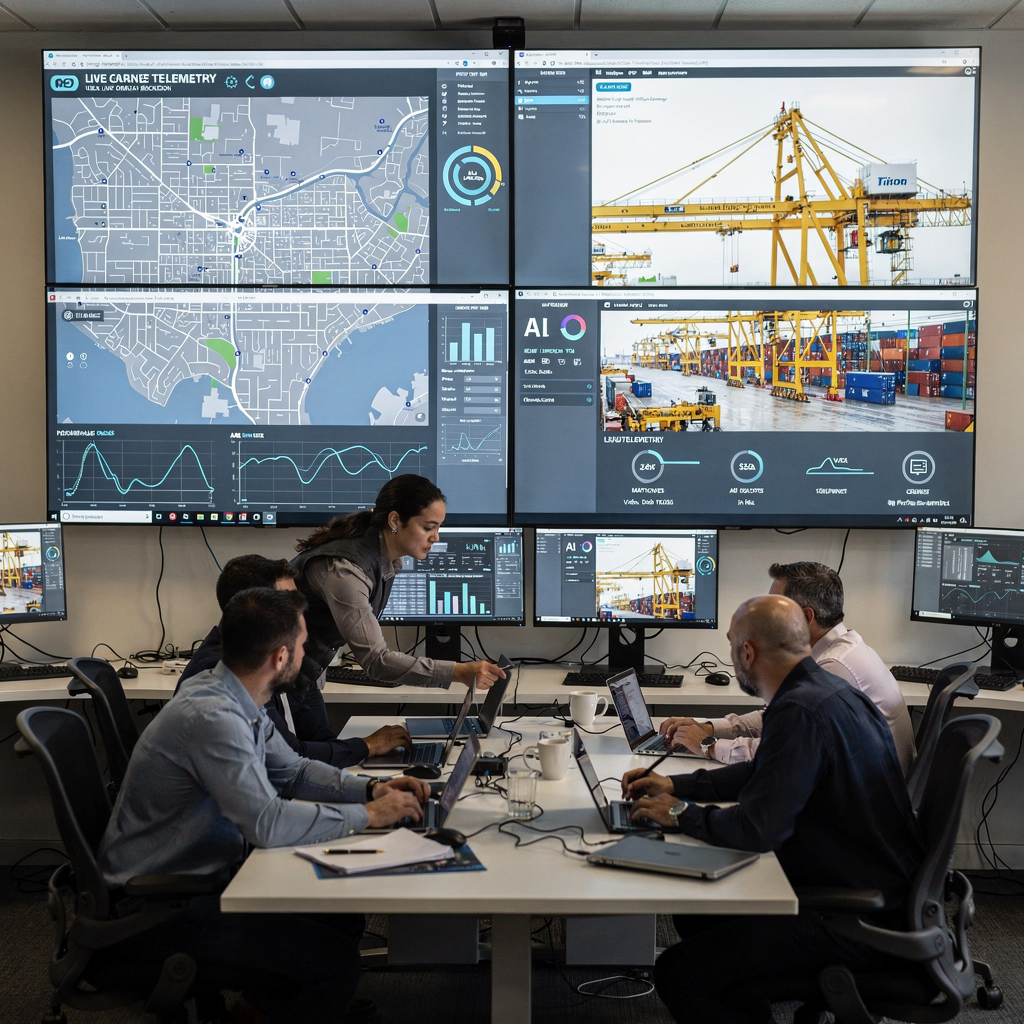
These systems are based on AI and they support multi-objective optimization. Loadmaster.ai demonstrates closed-loop optimization with reinforcement learning. Our StowAI, StackAI, and JobAI agents train in a digital twin and then deploy safely. This makes deployments cold-start ready and less dependent on historical data.
Nevertheless, challenges remain. Scalability requires robust network design and scalable compute. Data integration across vendors and legacy TOS can be complex. Privacy and data protection must be baked into edge deployments. The industry also needs standards that enable seamless data exchange across terminals and carriers. For terminals planning a rollout, consult our terminal operations digitalization roadmap digitalization roadmap. Overall terminal performance improves when AI reduces rehandles, when equipment responds faster, and when planners can trust consistent, explainable decisions.
Top 10 container terminal innovations to run AI in smart port logistics
1. Advanced networking that delivers sub-microsecond switching and terabit backbones. 2. Programmable network switches and RDMA fabrics for low-latency control. 3. 5G private networks for wireless connectivity to cranes and vehicles. 4. Edge AI and specialized inferencing accelerators to run models near sensors. 5. Breakthroughs in edge AI hardware and software platforms that simplify deployment. 6. Federated learning to share model updates without sharing raw data. 7. AI-driven robotics for automated stacking and precise moves. 8. Digital twin platforms to simulate millions of scenarios before live rollout. 9. Integrated predictive maintenance and condition monitoring. 10. Standardized APIs to link CTOS to terminal equipment and port community systems.
These innovations help run AI at scale across complex yards. They also support transforming operations and efficiency across the port. Edge AI can reduce reaction times, while federated learning protects privacy. In addition, digital twin technology lets teams envision enterprise solutions and to measure ROI before production. The combination of these trends reshapes maritime logistics and global trade. Terminals that adopt them can handle growing container volumes, reduce costs, and improve supply chain resilience. Finally, the top 10 container terminal list shows how to run AI safely and effectively in live operations measuring ROI. As the industry evolves, AI technologies will continue to mature and to enable smarter, greener, and more productive port operations.
FAQ
What is a container terminal operating system?
A container terminal operating system is software that schedules and coordinates moves across a terminal. It links equipment, sensors, and human workflows to manage container handling and to optimize operations.
How does low-latency networking affect AI in container terminals?
Low-latency networks let AI agents synchronize decisions for cranes and vehicles. When latency falls toward sub-microsecond levels, control loops run faster and decisions become more precise.
What are the benefits of edge AI for port operations?
Edge AI reduces round-trip times and keeps sensitive data local. It enables real-time control, and it supports fail-safe decisions when links to the cloud are slow or interrupted.
Can AI reduce equipment downtime?
Yes. Predictive maintenance powered by AI can lower downtime by as much as 30% in some studies predictive maintenance gains. Faster detection and scheduling of repairs keeps cranes and vehicles available.
How do AI models avoid relying on historical data?
Some platforms use simulation-first training and reinforcement learning. This approach generates experience in a digital twin so models learn effective policies before seeing historical data.
What security measures protect gate operations without hurting speed?
Terminals run inference locally and send only metadata outward. They also use encryption, access controls, and audit logs to maintain data protection while preserving throughput.
How do CTOS solutions integrate with existing TOS?
Modern CTOS platforms provide APIs and EDI adapters to exchange schedules, moves, and status. For practical implementation advice see our interfaces for data exchange guidance interfaces for data exchange.
What hardware upgrades support AI orchestration?
Upgrades include programmable switches, RDMA-capable NICs, and edge accelerators for inference. Private 5G and fiber backbones also improve connectivity and reliability.
How does a digital twin help deployment?
A digital twin simulates yard layouts, equipment, and workflows. It helps test policies, measure ROI, and train agents without disrupting live operations; see our simulation-first AI case studies simulation-first AI.
What is the first step for a terminal wanting to run AI?
Start with a clear set of KPIs and a sandbox digital twin. Then validate AI policies in simulation, integrate safely with the CTOS, and run staged deployments to measure gains and to ensure governance.
our products
 stowAI
 stackAI
 jobAI
jobAI
Innovates vessel planning. Faster rotation time of ships, increased flexibility towards shipping lines and customers.
Build the stack in the most efficient way. Increase moves per hour by reducing shifters and increase crane efficiency.
Get the most out of your equipment. Increase moves per hour by minimising waste and delays.
stowAI
Innovates vessel planning. Faster rotation time of ships, increased flexibility towards shipping lines and customers.
stackAI
Build the stack in the most efficient way. Increase moves per hour by reducing shifters and increase crane efficiency.
jobAI
Get the most out of your equipment. Increase moves per hour by minimising waste and delays.