
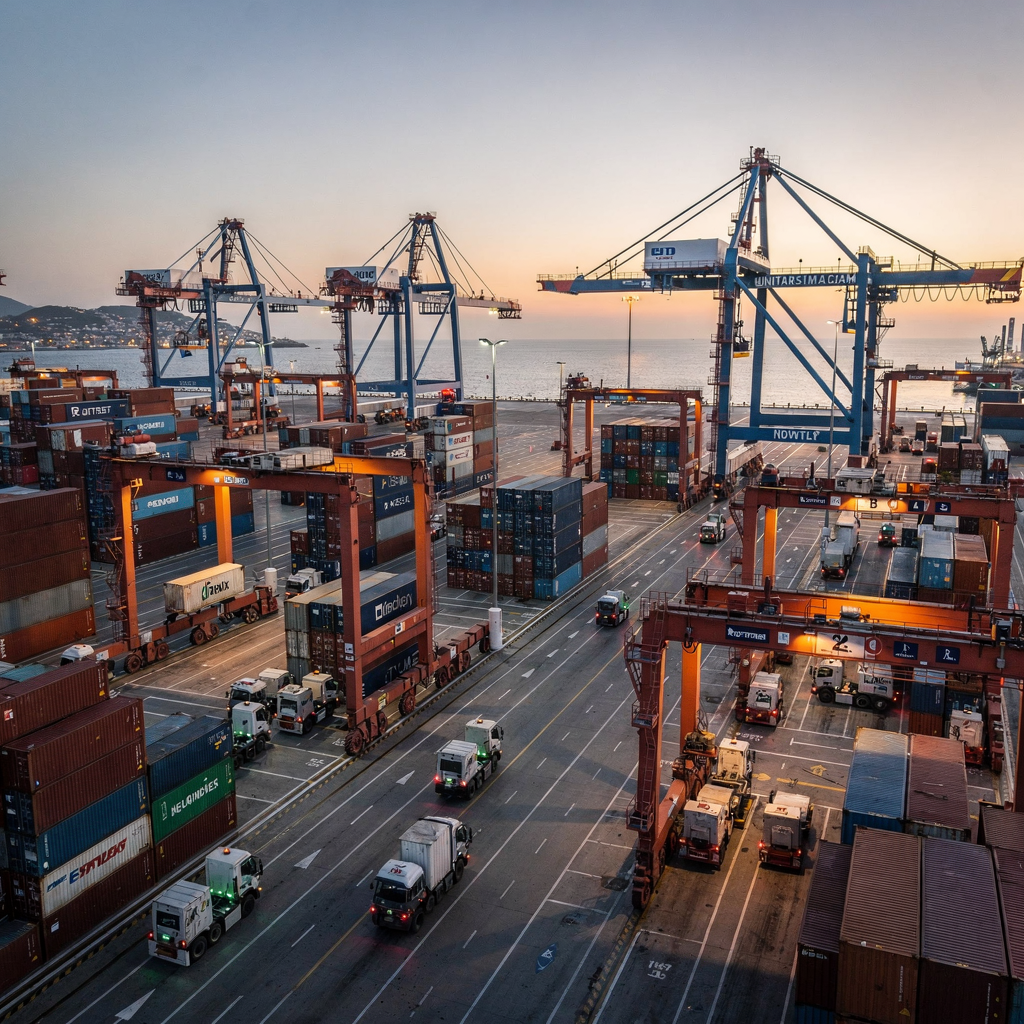
Embracing AI in Container Terminal Operations
Deepsea container terminals are rapidly adopting AI to manage complex flows of cargo. Today, modern container terminals combine sensors, software, and human expertise. AI helps planners, dispatchers, and equipment operators to make faster decisions. For example, AI can shift terminals from reactive firefighting to proactive control. As a result, terminals see steadier performance across shifts and clearer planning horizons. Loadmaster.ai uses reinforcement learning to train agents in a digital twin. This approach allows operator teams to test policies before live deployment and to optimize KPIs without relying on historical mistakes. Learn how our StowAI, StackAI, and JobAI work together to reduce rehandles and balance workloads.
Strategic benefits include improved safety, reduced costs, and greater agility. AI-driven scheduling and automation boost crane productivity and lower idle equipment. Studies show AI can improve operational efficiency by 15% to 30% in some settings. Meanwhile, predictive models and smart scheduling cut unplanned failures and downtime, which protects throughput and revenue. Ports that adopt AI also gain flexibility to handle varied vessel mixes and sudden disruptions in global trade.
Real-world case studies illustrate these gains. For instance, ports that deploy integrated AI and TOS workflows report measurable throughput improvements and fewer safety incidents. A leading industry report notes: “AI automation reduces manual tasks, enabling faster, more informed decisions that directly enhance terminal productivity and profitability.” This report highlights early adopters that combine automation, digital twins, and adaptive policies. Similarly, Dr. Helena Andersson observes that “the true value of AI in container terminals lies not just in immediate cost savings but in the strategic agility it provides.” That quote frames how port authorities and terminal operators evaluate the longer-term return.
Operational teams must plan an integration path that respects their terminal operating systems and human workflows. Effective integration involves staged pilots, clear metrics, and stakeholder buy-in. For readers who want to explore how KPIs map to AI projects, review our guide to key performance indicators for AI in port operations. That resource links KPI design to practical AI deployments and helps terminal operators set realistic goals.
Applications of AI Technologies: Predictive Maintenance and Smart Scheduling
Predictive maintenance is a high-value AI application. Machine learning models monitor sensor streams on quay cranes, stacking cranes, and trucks. These models predict wear and flag components before they fail. By preventing sudden outages, terminals decrease downtime and protect throughput. Research indicates predictive maintenance can reduce unplanned failures by up to 40% in related maritime equipment contexts. That saving converts directly to lower repair bills and steadier moves per hour.
Smart scheduling coordinates quay cranes, trucks, and yard resources in real-time. AI algorithms assign tasks to reduce travel distance, balance workloads, and minimize rehandles. When AI schedules are combined with digital twins, planners can test peak scenarios and refine policies in a safe sandbox. In practice, ML-driven berth scheduling improves berth allocation and predicts queueing around vessel calls, which smooths vessel arrival patterns. For more on berth modeling and forecasting, see our deep look at predictive berth availability modeling in deepsea container ports.
Automated container stacking and yard planning leverage AI to pack containers for future moves. Systems learn to place units so that subsequent vessel work and gate flows stay efficient. In many cases, automation and AI reduce unnecessary shifts and empty driving. This yields lower fuel use and fewer emissions. A review found energy optimizations through AI typically reduce consumption by about 12% to 18% in related maritime equipment applications (energy and environmental impact). Implementing such systems requires careful data collection, robust telemetry, and clear operational guardrails.
AI-driven predictive analytics also supports safety and risk mitigation. Real-time monitoring identifies anomalies in equipment behavior and yard patterns. Using AI, terminals can reduce safety incidents and lower liability costs. Some terminals report a 20% reduction in incidents after adding AI-based monitoring and anomaly detection (industry example). That result frees management to focus on strategy instead of constant firefighting.
Drowning in a full terminal with replans, exceptions and last-minute changes?
Discover what AI-driven planning can do for your terminal
KPIs for Measuring ROI in Deepsea Container Terminals
Measuring ROI requires clear KPIs and consistent measurement. Start with core metrics: throughput, container dwell time, and capacity utilisation. These metrics link directly to revenue and service quality. For example, container throughput and moves per hour show how changes to scheduling impact daily output. When AI improves throughput by 10% to 25%, terminals can handle more volume without expanding yard footprint (industry data). That gain demonstrates how AI contributes to return on investment across a 2–5-year horizon.
Equipment downtime, energy consumption, and safety-incident rates are also key. Track downtime reductions in hours per month. Measure fuel consumption and emission changes per move. These inputs feed the ROI formula: net benefits divided by total investment. Net benefits include increased revenues, reduced repair costs, and avoided penalties. Do not forget intangible benefits: improved customer satisfaction, consistent performance, and better compliance documentation. The international maritime organization also encourages reporting of environmental gains and incident reductions, which can affect port authority decisions and insurance premiums.
Translating efficiency gains into net ROI takes careful attribution. You must isolate AI impact from infrastructure upgrades or labor changes. Use A/B testing or phased rollouts to compare blocks of yard time with and without AI. For practical examples of yard-focused gains, see our analysis on container stacking optimization techniques. That piece shows how optimized stacking and fewer rehandles increase operational throughput and reduce labor-driven variability.
Finally, capture ongoing costs. Include initial AI implementation, training, integration expenses, and maintenance fees for the ai system. Factor in TOS integration work and any changes to the container terminal operating system. When you model payback, present conservative and optimistic scenarios. Conservative models assume gradual adoption and modest gains. Optimistic models assume quick learning curves and steady improvements. In both models, calculate the return on investment and report assumptions transparently.
AI Integration and Automation at Ports
Effective AI integration requires a plan that respects legacy systems. Most terminals run a TOS and a mix of vendor telemetry. Integration work focuses on APIs, EDI, and data mapping to ensure the ai system works with existing processes. Loadmaster.ai’s TOS-agnostic design makes it easier to integrate with common terminal operating systems and equipment telemetry. Our approach spins up a digital twin, trains agents, and then integrates policies with clear operational guardrails.
Best practices recommend phased automation. First automate monitoring, then local decision support, and finally full automation of repetitive tasks. For quay cranes, begin with advisory schedules. Next, extend to automated sequencing of lifts. Phased automation of quay cranes, trucks, and rail interfaces reduces risk and helps staff adapt. During each phase, collect metrics and refine models. Make sure to integrate human-in-the-loop controls so operators can override actions when necessary.
Change management, staff training, and stakeholder engagement are critical. Engage terminal operators from day one. Run workshops and simulations that let operators see ai-driven decisions and the logic behind them. Use transparent ai policies and explainable outputs to build trust. For example, provide clear explanations for why the AI prioritized a move or changed a stacking plan. This openness makes adoption smoother and reduces resistance from veteran planners.
Integration of ai must also align with regulatory and compliance needs. Document decision trails and safety checks. Ensure audit logs meet the expectations of port authorities and insurance partners. When the AI system documents its logic, it supports faster regulatory review. This is especially important for terminals that plan to scale automation across multiple berths and yards. Ultimately, a careful integration roadmap reduces disruption and accelerates measurable value from automation.
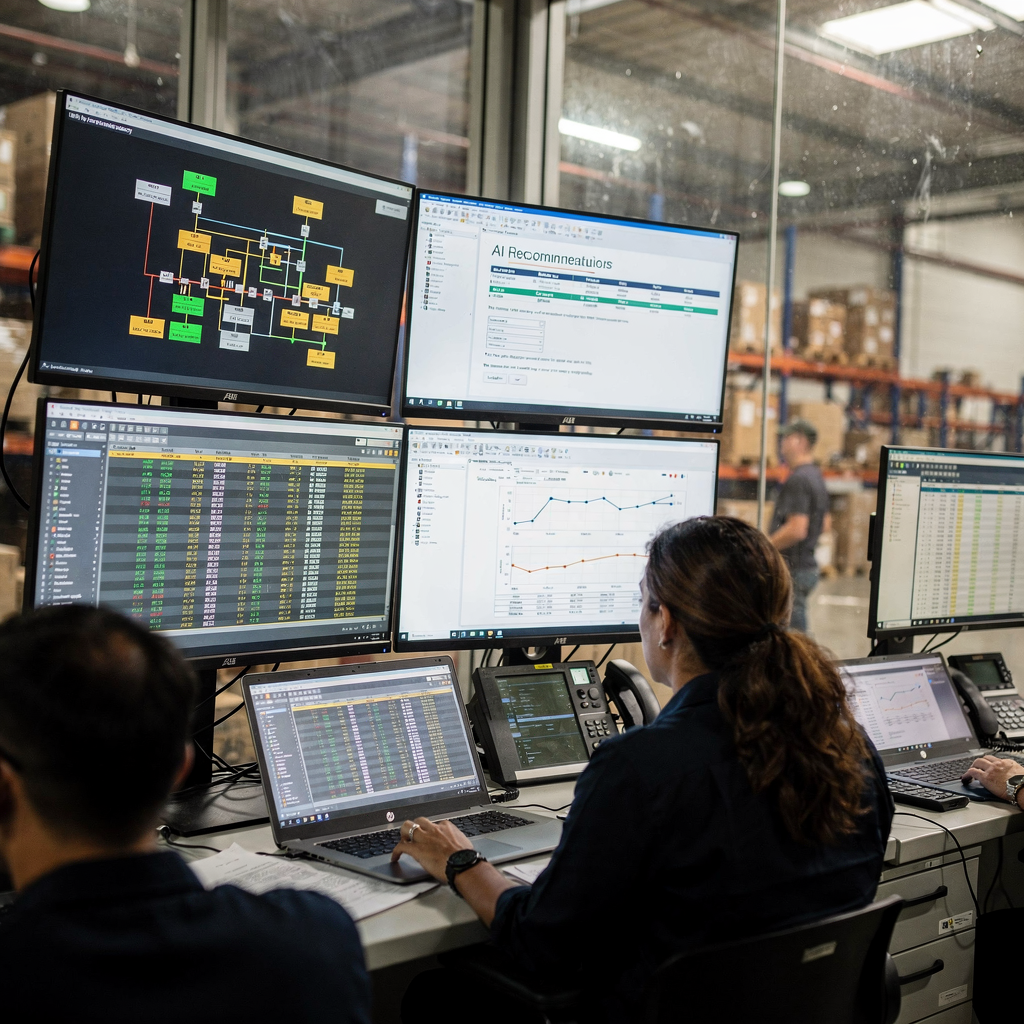
Drowning in a full terminal with replans, exceptions and last-minute changes?
Discover what AI-driven planning can do for your terminal
Machine Learning and Throughput Optimisation
Machine learning models are central to demand forecasting and resource allocation. By predicting peaks and troughs, ML helps terminals allocate cranes and trucks ahead of time. That reduces bottlenecks during vessel calls and peak gate periods. When ML forecasts vessel calls and container mixes, planners can minimize rehandles and reduce unnecessary moves. Use ML to forecast container flows and labor needs and to schedule shifts accordingly. This can increase container throughput while stabilizing service levels.
Impact on daily container moves shows quickly in metrics. During peak periods, better forecasts reduce queuing and keep quay cranes productive. Studies and pilots show AI-driven scheduling can raise moves per hour and improve gross crane rate. Moreover, ML enables adaptive resource allocation during disruptions. For example, when a vessel arrival is delayed, ML-driven re-plans can shift focus to yard flow or gate processing, thereby reducing idle crane time and wait times.
Ensuring data quality matters more than model type. Sensors, IoT feeds, and well-managed telemetry form the foundation for ML success. Implement data governance frameworks to maintain consistent tagging, timestamps, and health checks. When data streams are clean, ML models produce more reliable predictions. For terminals lacking rich historical data, reinforcement learning and simulation-based training provide a path forward. Loadmaster.ai trains agents in a simulated environment, so you do not need a full history to start optimizing. This cold-start ready approach reduces reliance on historical biases and helps the system learn novel strategies.
Finally, combine ML with operational rules in your TOS. Use ai algorithms to suggest schedules and let the TOS enforce constraints. That hybrid model preserves safety and compliance while unlocking optimization. For details on decoupling control logic from the TOS and improving move prioritization, see our article on decoupling fleet control logic from TOS.
Potential of AI and Best Practices for AI Implementation
Forecast ROI over a 2–5-year horizon and include both direct and indirect gains. Direct gains cover increased throughput, lower downtime, and lower operational costs. Indirect gains may include better customer retention and improved environmental compliance. When estimating, include the total cost of ownership: hardware, software, training, and ongoing model maintenance. A realistic ROI model shows payback points and sensitivity to different assumptions.
Overcoming challenges in data availability and attribution takes discipline. Start with pilots that measure clear before/after baselines. Use A/B testing blocks or rollouts by yard section. For problems where data are fragmented, consider digital twins to generate synthetic experience. Loadmaster.ai’s simulation-first approach is one way terminals can begin without extensive historical datasets. That approach helps operators assess the potential of AI and quantify expected gains before full-scale deployment.
Create a roadmap for scaling new technologies. Begin with advisory AI, then move toward partial automation, and finally toward full, supervised automation. Train staff continuously and create feedback loops so the system learns from live operations. Keep regulatory and ai policies visible to governance teams. Also evaluate energy and emission impacts and opportunities to reduce fuel consumption with smarter routing and scheduling. Over time, iterative improvement will reveal where to invest next. If you want deeper examples of predictive KPIs and their operational effects, explore our piece on predictive KPIs for shortsea container terminals.
To summarize the potential of AI: it can boost throughput, reduce downtime, and stabilize performance across shifts. With careful planning, terminals can increase container moves, lower fuel bills, and improve safety metrics. The implementation of AI should be phased, measurable, and governed. That approach delivers sustained value and helps terminals adapt to shifting cargo patterns in global trade.
FAQ
What metrics should I use to measure ROI for AI projects at my terminal?
Measure throughput, container dwell time, and capacity utilisation as primary metrics. Also track downtime, energy consumption, safety incident rates, and labor productivity to capture full-service impacts.
How long does it take to see measurable ROI from AI in a container terminal?
Most terminals see measurable gains within 6 to 24 months after deployment, depending on scope and integration. Conservative ROI models use a 2–5-year horizon to account for training, change management, and scale-up.
Can we adopt AI without historical data?
Yes. Simulation-based training and reinforcement learning let terminals start without large historical datasets. Loadmaster.ai uses digital twins to train agents and reduce dependency on past data.
What are common barriers to AI adoption in ports?
Barriers include fragmented data, legacy TOS integrations, and staff resistance to change. Effective rollout plans and transparent decision logs help overcome these challenges.
How does AI affect safety and compliance?
AI enhances safety by detecting anomalies and predicting equipment failures, which reduces incidents. Maintain audit trails and explainable policies to satisfy compliance and port authorities.
Do AI systems reduce energy usage in terminal operations?
Yes. AI can optimize routing and scheduling to cut unnecessary driving and idle time, which reduces fuel consumption and emissions. Reported energy savings in related applications range between 12% and 18%.
How do I integrate AI with my current TOS?
Use APIs and middleware to connect AI recommendations to your TOS, and run phased pilots to validate changes. Decoupling fleet control logic from the TOS can also simplify integration.
Which KPIs should I track during a pilot?
Track moves per hour, gross crane rate, rehandles, equipment utilization, and container dwell time during pilots. Include user acceptance metrics so operators can give feedback on usability.
Can AI handle sudden disruptions like delayed vessel calls?
Yes. AI-driven predictive scheduling and real-time re-planning help terminals adapt to delayed vessel arrival or gate surges. These capabilities reduce the need for manual firefighting and cut wait times.
What makes Loadmaster.ai different from other AI vendors?
Loadmaster.ai trains reinforcement learning agents in a digital twin, enabling cold-start deployments without historical bias. The platform focuses on multi-objective control, safe guardrails, and TOS-agnostic integration to deliver measurable gains in live operations.
our products
 stowAI
 stackAI
 jobAI
jobAI
Innovates vessel planning. Faster rotation time of ships, increased flexibility towards shipping lines and customers.
Build the stack in the most efficient way. Increase moves per hour by reducing shifters and increase crane efficiency.
Get the most out of your equipment. Increase moves per hour by minimising waste and delays.
stowAI
Innovates vessel planning. Faster rotation time of ships, increased flexibility towards shipping lines and customers.
stackAI
Build the stack in the most efficient way. Increase moves per hour by reducing shifters and increase crane efficiency.
jobAI
Get the most out of your equipment. Increase moves per hour by minimising waste and delays.